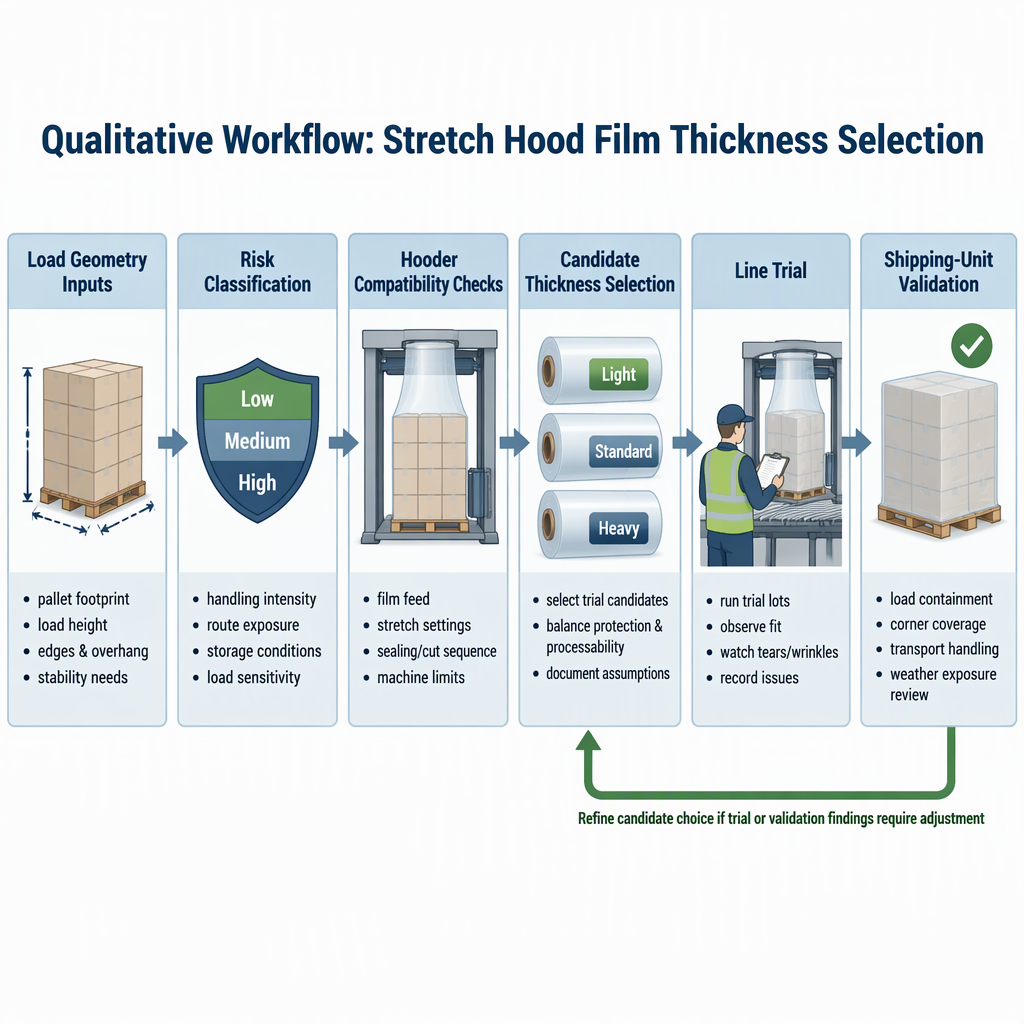
Specify stretch hood film thickness from the measured load, the stress points created by its geometry, the hooder’s operating limits, and a documented trial on the real line. A useful purchase specification is a tested working range for the load family, not a universal gauge copied from another pallet or bale application.
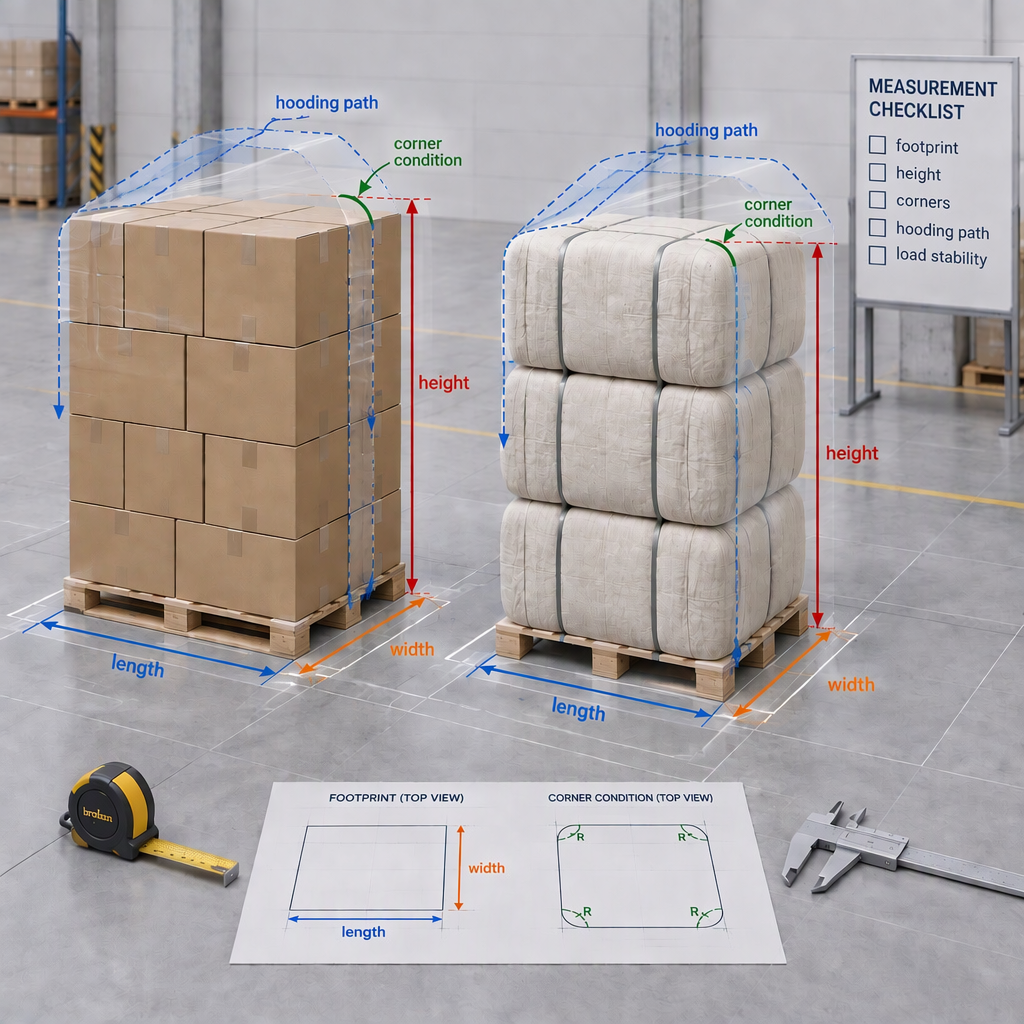
Before asking for stretch hood film thickness, collect the load footprint, height, weight, corner condition, stability, storage route, and hooder compatibility data that affect how the film stretches, seals, and protects the shipping unit.
For purchasing, treat film thickness as one part of a specification conversation between buyer and seller, not as a standalone number. ASTM D4649 is a guide for stretch film selection, specification, and use, and ASTM describes it as usable by buyer and seller when arriving at purchase specifications.
- Measure the load footprint, finished height, and the largest diagonal or protruding point that the hood must pass over.
- Record load weight and stability, because an unstable stack can stress the hood even when the film thickness looks adequate.
- Identify sharp corners, abrasive surfaces, strap edges, bale ties, or uneven layers that may create puncture or tear initiation points.
- Define whether the wrapped unit will remain in typical indoor logistics spaces such as warehouses, containers, truck trailers, rail boxcars, or transfer terminals; do not assume the same result for outdoor exposure or extreme temperatures.
- Note the required coverage area: top coverage, side coverage, skirt position, and whether contamination control is more important than simple containment.
Translate load geometry into film stress risks
Load geometry changes the thickness decision by changing stretch ratio, puncture risk, seal demand, and the amount of film needed to cover the hood path without breaks, jams, or poor coverage.
| Geometry condition | Likely specification concern | Buyer check before sampling |
| Square, stable pallet with smooth sides | The main issue is usually confirming coverage, machine fit, and stable containment rather than compensating for protrusions. | Ask for a trial specification that records thickness, layflat or hood size, and trial performance on the actual load. |
| Tall or narrow load | Higher height-to-footprint ratios can make load stability and hood tension more important during handling. | Check sway, tilt, and film movement after the hood is applied and after handling simulation. |
| Irregular or protruding profile | Protrusions can concentrate stress and make a simple thickness increase less effective than correcting the hood size or protecting the contact point. | Measure the largest protrusion and mark the first tear or whitening point during trials. |
| Sharp corners, bale ties, or abrasive surfaces | Edges can trigger puncture or tear, so the film grade, local protection, and trial method matter as much as nominal thickness. | Use edge protection or surface changes where needed, then compare film behavior under the same line settings. |
Do not turn this table into a fixed micron chart. Without measurements from the actual load and line, a thicker candidate can still fail if hood dimensions, stretching, sealing, or contact points are wrong.
Check the hooder before confirming the thickness
A candidate thickness is practical only if the hooder can open, stretch, cut, seal, and apply that film consistently on the intended load size.
Machine stretch hood selection should include material, thickness and strength, machine compatibility, load stability, and cost-efficiency. In practice, the same nominal thickness can behave differently if the roll, opening dimensions, stretch settings, seal conditions, or load presentation are not matched to the hooder.
- Confirm the film width, gusset or hood dimensions, roll size, and core requirements accepted by the machine.
- Check that the hooder can open the film cleanly over the largest measured load without scraping corners or protrusions.
- Review the machine’s permitted stretch range and sealing settings with the equipment manual or supplier before changing film construction or thickness.
- During trials, track film breaks, jams, incomplete opening, seal defects, and uncovered areas instead of judging only by appearance.
- If manual access is required to clear a film jam or inspect the hooding path, switch off and disconnect the applicable electrical, pneumatic, or battery power first, then follow only the access steps permitted in the machine manual.
Use standards as boundaries, not shortcuts
Use stretch film standards to frame the specification discussion, but do not treat them as a direct thickness calculator for a specific stretch hood load.
ASTM D4649-20(2025) is an active ASTM guide for the selection, specification, and use of stretch films and wrapping applications, including use between buyer and seller to arrive at purchase specifications.
Its stated scope is stretch films for unitizing, reinforcing, and palletizing in indoor logistics environments such as warehouses, closed containers, truck trailers, rail boxcars, and transfer terminals.
Keep the environmental boundary explicit in the specification. ASTM D4649 does not cover outdoor exposure, and ASTM notes that extreme temperatures may negatively affect stretch film performance. For outdoor staging, long exposure, or harsh climate routes, require a separate suitability discussion and trials under the expected conditions.
Validate candidate thickness with a line trial
Validate the candidate thickness by running the real load through the actual hooder, then evaluating the completed shipping unit against the handling and distribution hazards it is expected to face.
- Group loads into families by footprint, height, weight, stability, edge condition, and protection requirement.
- Select one or more candidate film specifications for each family, recording thickness together with hood size, material structure, roll format, and line settings.
- Run trial loads on the actual line and record film consumption, breaks, jams, seal quality, opening behavior, and coverage.
- Inspect the load after handling for corner damage, punctures, film lift, contamination entry points, and loss of containment.
- Where shipping performance is critical, validate the completed shipping unit rather than relying only on material gauge assumptions.
ASTM D4169-23e1 provides a uniform laboratory basis for evaluating shipping units against anticipated distribution hazards using a sequence of test elements.
ASTM also states that D4169 is not intended to replace material specifications or existing preshipment test procedures, so it should complement—not replace—the film specification and line trial.
Adapt the specification for cotton and industrial loads
Cotton bales and industrial loads need the same disciplined workflow, but the protection questions differ: contamination control, surface abrasion, corner stress, load stability, and storage environment should drive the trial plan.
Cotton bale protection
For cotton processors, specify the load dimensions, bale tie or edge condition, required coverage, and handling route before choosing candidate thickness. The trial should watch for punctures at contact points and openings that could allow dust or moisture exposure.
Industrial transport protection
For industrial packaging and logistics teams, focus on pallet stability, protrusions, abrasive surfaces, transfer points, and whether the film must prioritize containment, surface protection, or both.
If the load will be staged outdoors or exposed to extreme temperatures, do not rely on indoor stretch film assumptions. Define the exposure, ask the supplier how it will be addressed, and validate the finished load under conditions that match the route.
Turn the decision into an RFQ checklist
A good RFQ asks suppliers for a trial-ready film proposal tied to your load family, machine, handling route, and acceptance criteria.
Because ASTM D4649 frames stretch film selection and specification as a buyer-seller process, procurement should give suppliers enough detail to propose a candidate that can be tested rather than asking for thickness alone.
- Load family: footprint, height range, weight range, stability, surface type, and corner or protrusion risks.
- Protection requirement: containment, dust reduction, moisture concern, product cleanliness, top coverage, and skirt position.
- Machine information: hooder model or operating limits, accepted roll/core format, hood size range, and current line settings that may affect film behavior.
- Trial metrics: film breaks, jams, seal quality, coverage, load appearance after handling, and film consumption per load.
- Shipping-unit validation: the distribution hazards or preshipment test procedure the finished load must satisfy.
- Specification format: proposed thickness, material structure, hood dimensions, roll format, application settings, and acceptance criteria for repeat orders.
Conclusion: specify a tested range, not a universal number
The final stretch hood film thickness decision should be a documented, trial-proven specification for each load family, with limits for geometry, machine settings, route, and environment.
- Start with measured load geometry and handling risk before selecting candidate thickness.
- Confirm hooder compatibility before treating any gauge as purchase-ready.
- Use stretch film standards to structure the buyer-seller specification discussion.
- State indoor, outdoor, and temperature assumptions clearly because they affect suitability.
- Validate the completed shipping unit against the distribution hazards it must survive.
For cotton bales, mixed industrial pallets, and export logistics, the strongest specification is not the thickest film by default. It is the film that covers the measured load consistently, runs on the hooder without repeated faults, protects the required surfaces, and passes the agreed handling or shipping validation.
FAQs about stretch hood film thickness
These questions help buyers turn stretch hood film thickness from a guess into a measurable application specification.
Can one stretch hood film thickness fit every pallet or bale?
No. Different footprints, heights, surfaces, corner conditions, and handling routes create different stress patterns, so one thickness should not be assumed suitable for every load family.
Start with footprint, height, weight, diagonal or protruding points, surface roughness, corner shape, and stability. These details define the hood path and the likely stress points.
Does ASTM D4649 give a stretch hood thickness value?
ASTM D4649 supports stretch film selection and specification discussions, but it should not be used as a direct calculator for one stretch hood thickness on a specific load.
Can indoor trial results be applied to outdoor storage?
Not automatically. ASTM’s D4649 scope is tied to indoor logistics environments and does not cover outdoor exposure, so outdoor staging or harsh temperature conditions need separate evaluation.
What should be measured during a line trial?
Track film breaks, jams, opening behavior, seal quality, coverage, film use, load stability, and damage or contamination entry points after handling.
Why test the completed shipping unit?
Testing the finished shipping unit helps evaluate the combined load, package, and film system against anticipated distribution hazards instead of relying only on the nominal film gauge.
Is thicker film always safer?
Not necessarily. A thicker film can still fail if the hood size, machine settings, seal, or contact points are wrong; trials should compare performance, not thickness alone.