


For industrial shrink wrap selection, do not start with gauge alone. Define the load, handling, exposure, contamination risk and route first; then request film data that matches the risk, including controlled shrinkage information for film and sheeting, tensile-property data compared under controlled test factors, impact-resistance data with thickness limits understood, and shipment-system validation when the complete shipping unit faces distribution hazards.
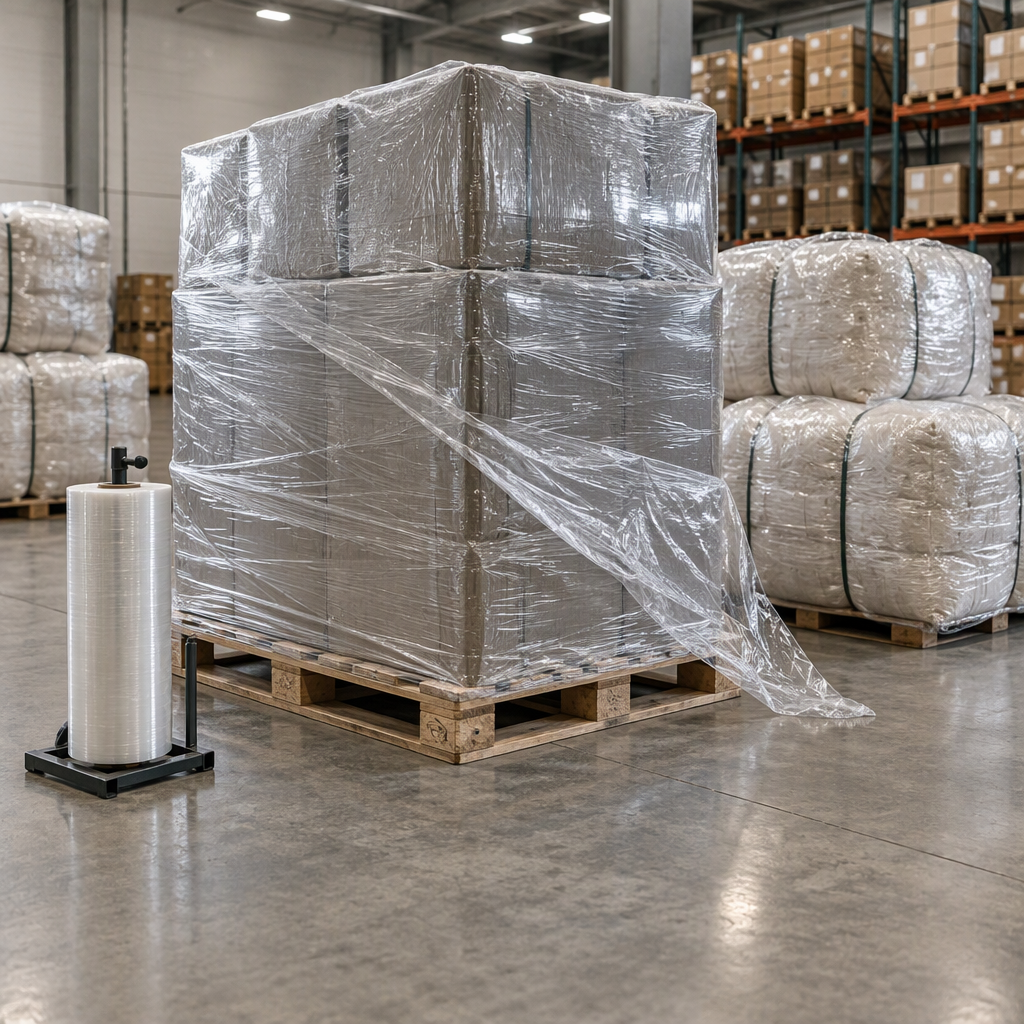
Start with the shipment protection job, not the film gauge
Choose industrial shrink wrap by describing what the package must protect against before comparing film numbers: contamination, abrasion, weather exposure, handling impacts, route hazards, and the shape of the load.
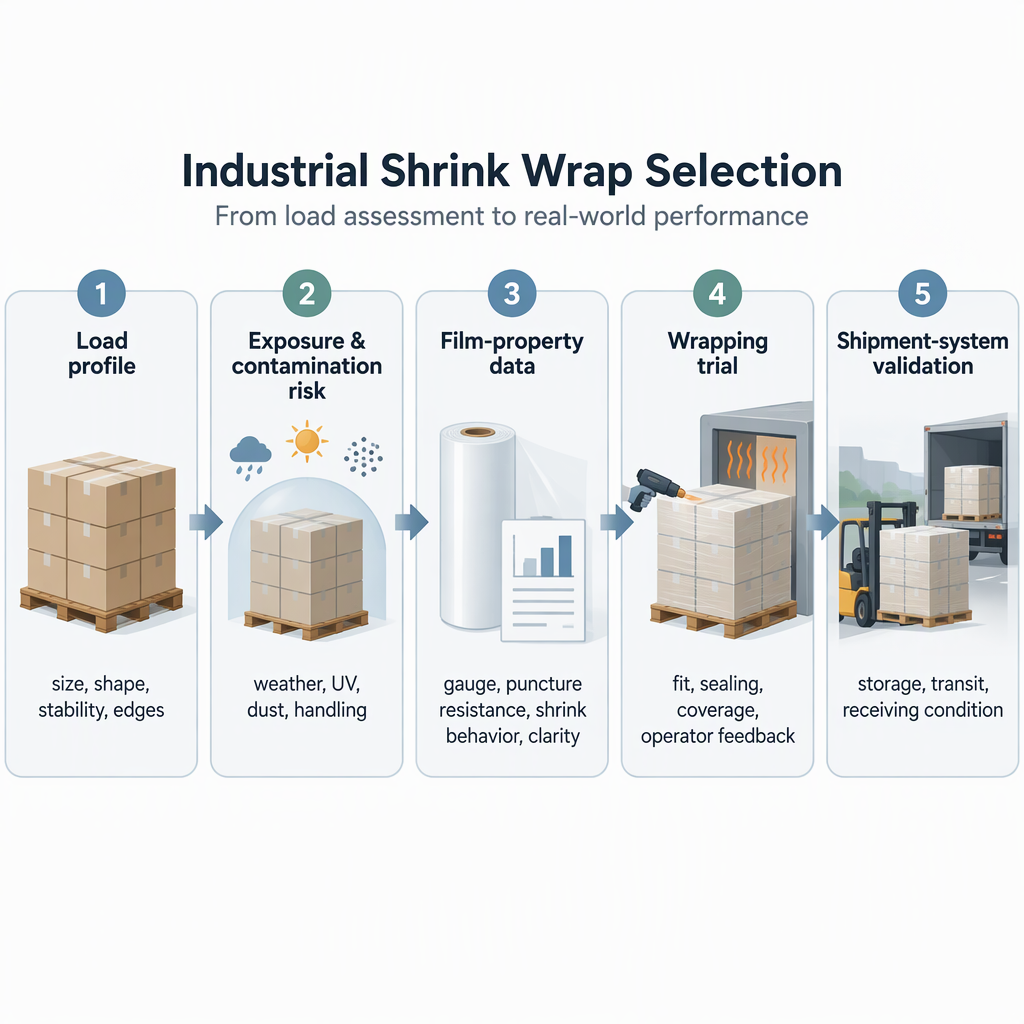
- Define the load: dimensions, sharp edges, protrusions, weight distribution, pallet or skid type, stacking limits, and whether the item is a cotton bale, a machine, or an oversized shipment.
- Define the exposure: indoor storage, outdoor staging, open-truck transport, sea freight, dust-prone areas, moisture risk, and expected handling points.
- Define the protection priority: cotton processors may emphasize contamination control and clean handling, while machinery shippers may emphasize abrasion, edge protection, and restraint of loose components.
- Request shrinkage data as a tested film behavior, not as a universal heat-gun or tunnel setting, because ASTM D2732 covers unrestrained linear thermal shrinkage at given specimen temperatures for plastic film and sheeting of 0.76 mm thickness or less.
- Decide whether the whole shipping unit needs route validation, because ASTM D4169 provides a laboratory basis for evaluating shipping units against anticipated distribution hazards.
The practical sequence is simple: specify the job, shortlist the film properties that matter, trial the wrapping method on the actual load shape, and then decide whether the complete package needs distribution testing before release.
Match film-property data to the actual risk
Ask for property data that corresponds to the failure mode you are trying to prevent: shrink fit, stretching or tearing under load, and puncture or impact during handling.
| Selection risk | Data to request | How to use it |
|---|---|---|
| Loose fit, wrinkles, or poor conformity around large shapes | Shrinkage data from a method such as ASTM D2732, which addresses unrestrained linear thermal shrinkage of plastic film and sheeting of 0.76 mm thickness or less at given specimen temperatures. | Compare films using the same test context. Do not convert a shrink percentage into a finished-package guarantee without a trial on the actual load. |
| Stretching, tearing, or load stress during wrapping and handling | Tensile-property data from a method such as ASTM D882, which covers thin plastic sheeting and films less than 1.0 mm thick and notes that results can vary with specimen thickness, preparation, speed, grips, and extension measurement. | Compare tensile values only when the comparison conditions are controlled, especially when suppliers quote different thicknesses or test speeds. |
| Puncture or sudden impact from corners, tools, forks, or rough handling | Impact-resistance data from a method such as ASTM D1709, which covers free-falling dart impact resistance and notes that impact values cannot be normalized across a thickness range without misleading data. | Use impact data to screen films, then add edge protection or cushioning when the load has sharp contact points. |
| Over-reliance on nominal gauge | Tensile comparisons can be affected by thickness and test setup. Impact comparisons should not be normalized across thickness ranges. | Treat thickness as one input, not the whole specification. Ask suppliers to state the test method and conditions behind the numbers. |
Film shrinkage, tensile behavior, and impact resistance are different properties. A useful RFQ separates them instead of asking for “heavy-duty shrink wrap” without defining the expected risk.
Adapt the selection to cotton bales, machinery, and oversized shipments
The right specification changes with the load: cotton-bale protection is often about cleanliness and surface protection, machinery protection is often about abrasion and protrusions, and oversized shipments add fit, handling, and route complexity.
Cotton bales and fiber-related loads
Prioritize clean handling, surface contamination control, and compatibility with bale dimensions and compression. Ask how the wrap will be applied without dragging film across dirty surfaces and how seams, edges, and openings will be controlled.
Industrial machinery and equipment
Map sharp corners, lifting points, painted surfaces, protruding controls, and skid or crate interfaces. Film alone may not protect a corner; the specification may need pads, edge guards, or a different outer protection layer.
Oversized or irregular shipments
Check whether the film can conform to the actual shape and whether installation creates safe access for operators. Large loads may require a trial wrap so the team can see seam placement, heat access, and handling clearances.
Do not use one generic “industrial” grade for every load. A cotton processor, an export crating team, and a logistics engineer may all need shrink wrap, but each should define the protection job, handling route, and acceptance criteria before buying.
Validate the packaging system for the shipment route
For high-value, long-route, export, or damage-sensitive shipments, validate the complete shipping unit rather than relying on film properties alone.
ASTM D4169 provides a uniform laboratory basis for evaluating shipping units against anticipated distribution hazard elements, but it is not intended to replace material specifications or existing preshipment procedures.
That boundary matters for procurement: distribution testing can help evaluate the package system, but it does not by itself define which shrink film, thickness, accessory, or wrapping process is suitable for every shipment.
For a route with warehouse handling, truck transfer, port staging, sea freight, and final delivery, the shrink wrap is only one part of the shipping unit. Pallets, skids, crates, strapping, corner protection, desiccants, labels, and handling instructions may affect the result. Ask the supplier and logistics team to agree on the test load, route assumptions, acceptance criteria, and who approves changes after a failed trial.
Build an RFQ checklist before asking for quotes
A good RFQ gives suppliers enough detail to recommend a film and trial plan without guessing the load, exposure, or acceptance standard.
- Load type: cotton bale, machinery, palletized industrial parts, irregular equipment, or mixed shipment.
- Dimensions and weight: include maximum length, width, height, weight, center-of-gravity concerns, and any protrusions.
- Surface and contamination risks: dust, fiber cleanliness, oil, paint, corrosion sensitivity, moisture, or outdoor storage.
- Shrinkage information: request the test method, specimen temperature conditions, and the shrinkage range used for comparison.
- Tensile information: request the test method and comparison controls, including thickness, specimen preparation, speed, grip setup, and extension measurement where relevant.
- Impact information: request the impact test method and avoid comparing impact values as if they scale cleanly across film thickness.
- Application method: handheld heat tools, shrink tunnel, temporary wrapping station, or outsourced packaging operation. If workers must manually access powered wrapping or heat equipment for cleaning, clearing film, or adjustment, switch off and disconnect the relevant power source before access and follow the equipment manual’s permitted access points only.
- Shipment validation: state whether the complete shipping unit needs laboratory distribution testing against route hazards.
- Commercial information: quote quantity, roll format, packaging, labeling, destination, required documents, inspection plan, and sample or trial requirements.
Know the limits before final approval
Approve industrial shrink wrap only after separating film test data, application trials, and shipment-system validation; each answers a different question.
Shrinkage tests characterize film behavior under stated temperature conditions. Tensile results depend on controlled comparison factors. Impact results have method and thickness limitations. Distribution testing evaluates the shipping unit but does not replace material specifications.
- Do not approve a film on gauge alone.
- Do not treat laboratory film data as a finished-package guarantee.
- Do not ignore load geometry; sharp edges and protrusions can defeat an otherwise suitable film.
- Do not let the RFQ omit route conditions, storage exposure, or handling points.
- Do not assume cotton-bale and machinery shipments need the same balance of cleanliness, abrasion resistance, and fit.
Final approval should be based on an agreed trial: the real load or a representative load, the intended wrapping method, documented film data, expected route, and acceptance criteria that purchasing, production, and logistics can all use.
Conclusion
The best next step is to turn the shipment into a specification: define the load, the route, the risks, the film data required, and the validation plan before requesting quotes.
Industrial shrink wrap selection is a risk-matching exercise. For large equipment and shipments, ask for shrinkage, tensile, and impact information where those properties matter, then decide whether the complete package needs route validation. A clear RFQ helps suppliers respond with relevant options and helps buyers avoid paying for the wrong protection. If you need product-specific pages before requesting a quote, check the supplier's official website and confirm the exact product, application, RFQ, or contact page before relying on it.
FAQs about industrial shrink wrap selection
Most buyer questions come down to the same issue: which data and trial conditions prove that a film is suitable for the actual load and route?
What is ASTM D2732 used for in shrink wrap selection?
ASTM D2732 is used to characterize unrestrained linear thermal shrinkage of plastic film and sheeting of 0.76 mm thickness or less at given specimen temperatures. For buyers, it helps frame shrinkage as tested film behavior rather than a universal machine setting.
Is thicker shrink film always more impact resistant?
No. ASTM D1709 notes that impact values cannot be normalized across a thickness range without misleading data, so buyers should not assume thickness alone proves impact performance.
Which film property should I ask for first?
The first property depends on the main risk. Ask for shrinkage data when fit and conformity are the concern, tensile data when stretching or tearing is the concern, and impact data when puncture or sudden contact is the concern.
Can lab film tests guarantee shipment performance?
Film shrinkage testing, tensile testing, and impact testing support comparison, but they do not replace a trial on the actual load or validation of the full shipping unit.
When should I consider distribution testing?
Consider distribution testing when the shipment is high value, damage-sensitive, long-route, export-oriented, or exposed to multiple handling hazards, because ASTM D4169 provides a laboratory basis for evaluating shipping units against anticipated distribution hazards.
How is cotton-bale shrink wrap selection different from machinery protection?
Cotton-bale selection should emphasize clean handling, contamination control, bale dimensions, and surface protection. Machinery selection often adds abrasion, protrusions, lifting points, painted surfaces, and edge protection.
What should I send a supplier before asking for a quote?
Send the load dimensions, weight, photos or drawings, surface sensitivity, route, storage exposure, handling method, required film data, trial expectations, and any complete-package validation requirement.
Should I choose industrial shrink wrap by price per roll?
No. Price per roll does not show whether the film fits the load, survives handling, protects against the actual route risks, or reduces rework. Compare price only after the specification and trial requirements are clear.


