


Condensation under shrink-wrapped equipment is a moisture-and-temperature problem before it is a film-selection problem: if humid air trapped inside the cover cools to its dew point, liquid water can form on colder surfaces. Choose ventilation, drying, spacing, vapor isolation, or a combined approach after you define the load, route, storage conditions, and handling risks.
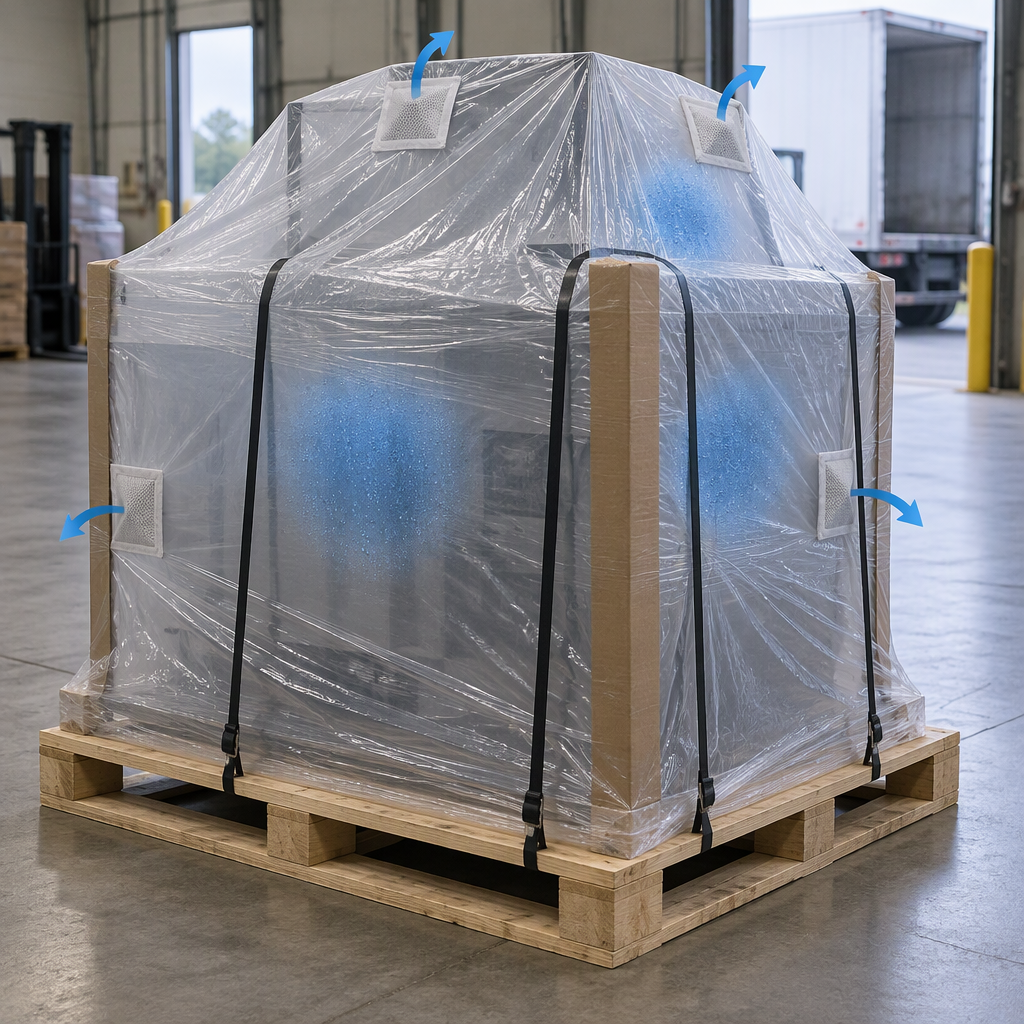
Why condensation forms under shrink-wrapped equipment
Water appears inside a shrink-wrapped cover when moisture is present and the air or covered surface cools enough for the air to reach saturation.
The National Weather Service explanation of dew point defines dew point as the temperature to which air must be cooled at constant pressure to reach 100% relative humidity; if cooling continues, water vapor leaves the air as liquid. A higher dew point means the air contains more moisture.
For shrink-wrapped equipment, that principle matters because the cover can trap moist air around metal, painted surfaces, controls, skids, padding, or packaging materials. When night temperatures, warehouse cooling, refrigerated transit, rain-cooled covers, or cold machinery surfaces reduce the air temperature near the load, the moisture can condense inside the enclosure.
Choose the moisture-control strategy before choosing the film
The right strategy depends on whether the package should let moist air escape, keep outside moisture out, reduce the moisture load before wrapping, or combine several controls.
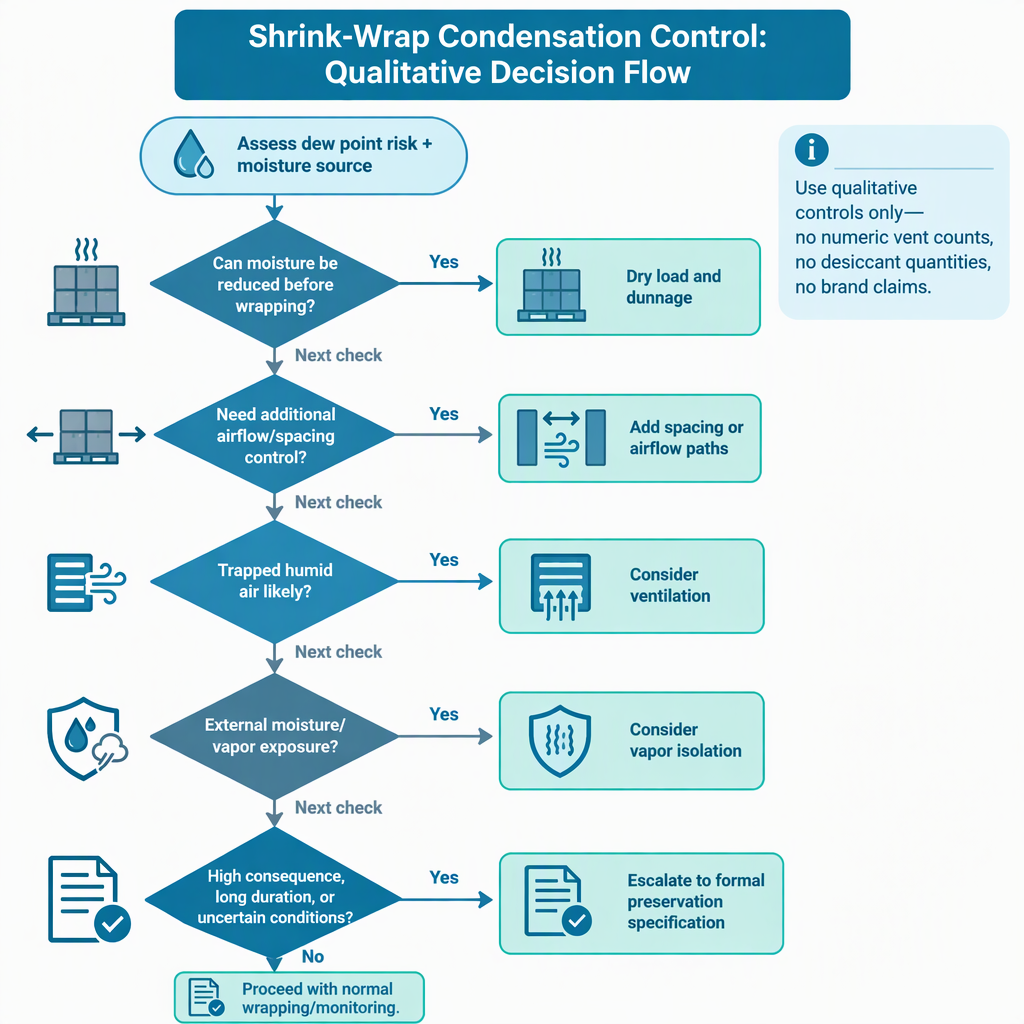
| Condition to evaluate | Likely direction | Buyer check before specifying |
|---|---|---|
| Humid air may be trapped and then cooled below dew point. | Use ventilation or airflow paths only if outside conditions will help moisture leave rather than enter. | Ask for the expected storage temperatures, day-night temperature swings, and humidity exposure along the route. |
| The load, pallet, blocking, or padding is already wet. | Dry the load and moisture-holding materials before wrapping; ventilation alone may not remove a large internal moisture source. | Confirm whether the load is dry to the buyer’s acceptance criteria before packaging begins. |
| The package will face rain, spray, outdoor storage, or container sweating. | Balance external water exclusion with a plan for internal vapor movement or moisture absorption. | Define whether the cover is mainly for dust, contamination, transport scuffing, weather exposure, or preservation. |
| The equipment is sensitive to corrosion, electronics damage, or surface staining. | Escalate from simple venting to a documented preservation method selected by the responsible engineer or supplier. | Request compatibility guidance for surfaces, coatings, electronics, dunnage, and any moisture-control accessories. |
Adapt the plan for cotton bales and cotton-processing equipment
Cotton-related packaging decisions must account for handling, storage, and transportation conditions, not only the wrap material.
| Application | What changes in the condensation discussion | What to confirm before procurement |
|---|---|---|
| Cotton bales and bale packaging | The National Cotton Council’s 2026 cotton bale packaging specifications describe JCIBPC specifications as manufacturing and use guidelines intended to improve bale quality, protection, appearance, and marketability. | Use the current cotton-bale packaging specification context for the crop year and confirm handling, storage, and transportation conditions with the buyer’s supply chain. |
| Cotton-processing or gin-related equipment | The same dew-point mechanism applies when humid air is enclosed around equipment and then cooled. | Define whether the equipment is clean and dry, whether cotton lint or dust control is required, and whether the cover must protect against contamination during transport. |
| Polyethylene cotton-bale wrap category | The supplier website includes a cotton-bale wrap film product category for transportation and storage. | Ask the supplier to provide approved product specifications, compatibility limits, and recommended use conditions before relying on any specific film for moisture-control design. |
Collect the field data that controls condensation risk
Before deciding how to ventilate shrink wrap, collect the conditions that influence dew point, moisture entry, and package damage during the actual route.
- Define the moisture source. Identify whether moisture is coming from humid air, wet surfaces, absorbent dunnage, rain exposure, ground storage, washdown, or the product itself.
- Map the temperature cycle. Record likely loading, warehouse, yard, container, port, truck, and destination conditions, especially expected cooling after warm humid air is sealed inside the cover.
- Check airflow assumptions. Decide whether vents can actually create useful air exchange or whether the load geometry, tight wrapping, container walls, or stacking pattern will block airflow.
- Include handling and storage damage modes. For cotton-related loads, consider packaging damage from handling, storage, and transportation, then choose protection details that tolerate those conditions.
- Set acceptance criteria. Define what the buyer considers acceptable: no free water, no staining, no corrosion, no contamination, intact cover, or another measurable receiving condition.
- Load description, dimensions, weight, sharp edges, lifting points, and support method.
- Cleanliness and dryness condition before wrapping.
- Expected route, storage duration, indoor or outdoor exposure, and container use.
- Expected temperature swings and humidity exposure that could bring trapped air to dew point.
- Inspection access needs, labeling, barcode visibility, and receiving checks.
Keep testing and standards claims inside their real scope
Use standards and test methods for the question they actually answer, and ask the supplier to connect those documents to the real packaging application.
For cotton-bale packaging, the 2026 Specifications for Cotton Bale Packaging Materials page describes JCIBPC specifications as manufacturing and use guidelines for cotton bale packaging materials. That kind of document is useful for packaging-material context in its own domain.
When a supplier cites a film test method, packaging guideline, or internal quality report, ask what the document proves: material behavior under a lab condition, manufacturing control, compatibility with a specific load, or field performance in a defined route. Do not turn a heat-shrink material test into a universal shrink temperature, line speed, vent count, or condensation-prevention guarantee unless the supplier provides current documents that make that connection.
RFQ checklist for shrink-wrap condensation control
A useful RFQ should describe the moisture risk, the route, the load sensitivity, and the required receiving condition instead of asking only for a film thickness or vented cover.
- Ambient conditions: expected humidity, temperature range, rapid cooling risk, and whether the load may be sealed while warm or damp.
- Load information: equipment type, sensitive surfaces, coatings, electronics, openings, sharp edges, and points that must remain accessible.
- Packaging construction: wrap coverage, seam method, overlap expectations, dunnage, edge protection, pallet or skid design, drainage path, and lifting method.
- Cotton-related logistics: handling, storage, and transportation conditions that may damage packaging materials or expose the load to contamination.
- Ventilation request: whether the buyer expects passive vents, airflow gaps, inspection openings, or a non-vented barrier approach.
- Verification request: supplier documents for material specifications, use limitations, compatible accessories, and field inspection criteria.
- Acceptance target: the receiving checks that matter most, such as intact cover, no visible free water, clean surfaces, readable labels, and no packaging damage.
Conclusion
Manage condensation by controlling moisture, temperature change, airflow, and handling conditions together; do not expect shrink wrap alone to solve every dew-point risk.
- Condensation starts when moist air cools to its dew point.
- Choose the control strategy before finalizing the film or accessory list.
- For cotton-related logistics, include handling, storage, and transportation conditions in the packaging discussion.
- Ask suppliers for current, application-specific documents before accepting numeric venting, shrinking, or preservation recommendations.
FAQs
Do vents stop condensation under shrink wrap?
Not by themselves. Vents can help air exchange only when the surrounding conditions and package layout support useful moisture movement; condensation can still form if humid air cools to its dew point.
Why is there water inside the cover after a cold night?
Warm humid air trapped during wrapping can cool overnight. When it reaches saturation, water vapor can leave the air as liquid on colder surfaces.
Should industrial equipment be vented or sealed?
Choose after comparing the moisture source and route exposure. Vented wrapping may help trapped humidity escape, while a tighter barrier may be preferred where outside rain, spray, dust, or humid air is the larger risk.
What matters for cotton bale or cotton-processing logistics?
Handling, storage, and transportation conditions matter because cotton-bale packaging specifications recognize that improper logistics conditions may damage packaging materials.
What shrink temperature prevents condensation?
No universal shrink temperature should be used as a condensation-control rule. Ask the film or equipment supplier for the current material data, equipment settings, and application limits for the specific load and wrapping process.
When should desiccant be considered?
Consider moisture absorption when the package must remain more closed and the main risk is moisture already inside the enclosure. The amount and placement should come from a documented preservation design, not a guess.
What should I send to a supplier before asking for a recommendation?
Send the load description, route, storage duration, expected temperature and humidity changes, exposure to rain or spray, cleanliness needs, handling method, and receiving acceptance criteria.


