


A pallet wrap or stretch hood never holds a load with one even force: the forces on a vertical edge change with position along that edge and with time. Pallet height, load shape and load weight also feed into how the film specification is matched to the load. Checking containment force therefore means reading several load-height bands on the same unit, recording how each band responds, and verifying the load unit as a whole.
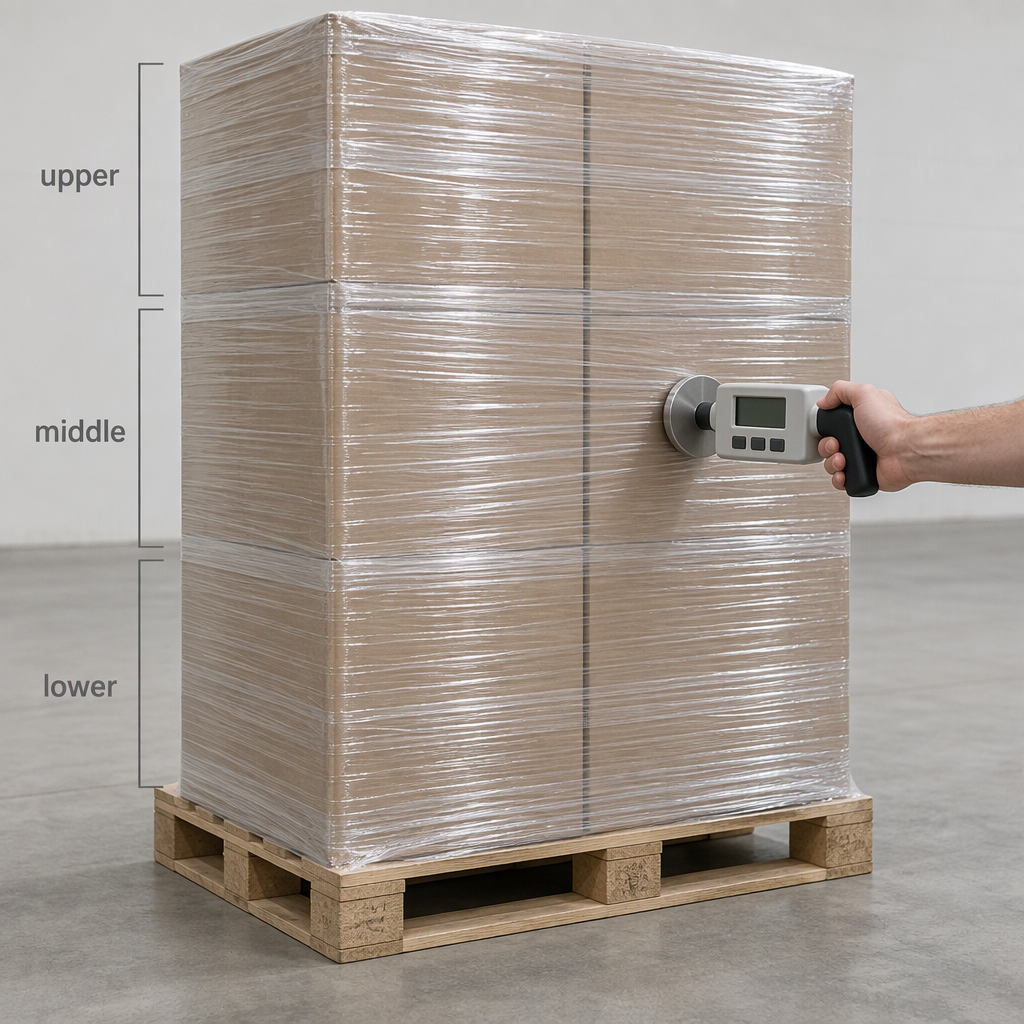
Why Pallet Wrap Containment Force Varies With Load Height
A single reading from one spot on the side of a pallet cannot represent the wrap on the whole unit. Forces that hold a load act on a vertical edge and are measured as a function of position along that edge and as a function of time, so a band near the top and a band near the base can behave differently on the same freshly wrapped pallet. Pallet height, load shape and load weight are themselves inputs to the film specification, which means the film is matched to the load profile rather than applied uniformly.
Agree acceptance values before measuring: published methods describe how force and deformation are measured and judged but give no figure for each load height, so keep thresholds in your own records and confirm them with a load-unit test. EUMOS has recorded that it discontinued its stretch wrapping film passport and stretch hood film passport work, after finding that on-pallet film performance depends on the type of contained load and on the wrapping pattern, so treat any generic promise of a force value per pallet height as unconfirmed for your own load.
Step 1: Define the Load-Height Bands You Will Check
Set band boundaries from the load's own geometry before you take any reading. Use the pallet deck, the lower third, the middle, the top edge, plus every transition — layer change, partial layer, overhang, hood gusset or seam. Because the force acts along the load edge, mark every boundary on the same face so readings stay comparable between shifts and film lots.
- Mark each band boundary on one fixed face and record its distance from the pallet deck.
- Keep the same number of bands on every pallet you compare, and record the total load height. Pallet height, load shape and load weight are the inputs a film specification is built on, so they belong in the same record.
- Add a band at every transition: a layer change, a partial layer, product overhang, or the point where a hood gusset sits.
- Describe the load profile — product type, unit weight, stacking stability, and indoor or outdoor storage.
- Reuse one sketch or record sheet so a second operator measures exactly the places you did.
Step 2: Measure Containment Force Band by Band
Take readings perpendicular to each face, band by band, using one instrument and one technique on every pallet. Work from the lowest band upward so the boundaries stay visible, press the gauge flat against the film, and record each value with its band, face and time. Edge force is also a function of time, so re-read at least one band after a fixed interval instead of trusting a single pass.
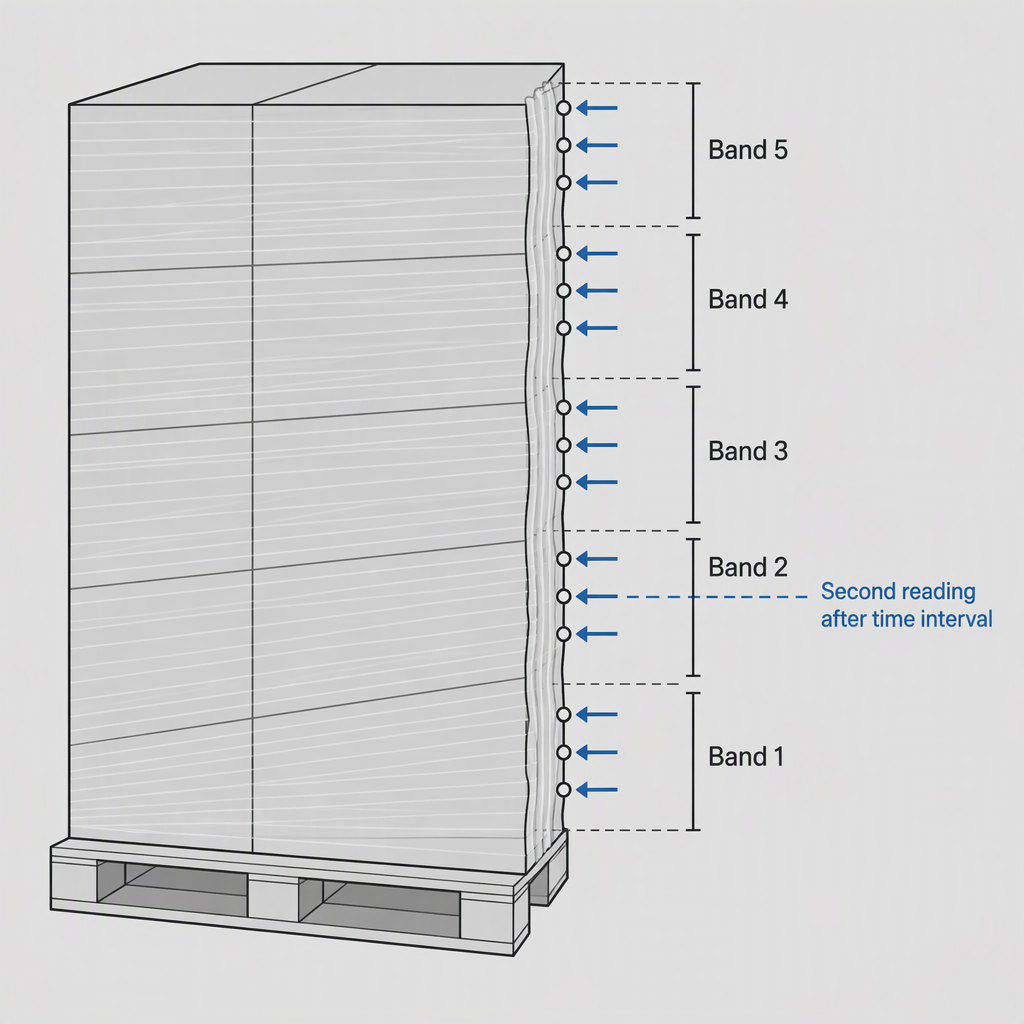
- Isolate the wrapping station before anyone reaches in: switch the wrapper off and disconnect it from its power supply, and use only the access the machine manual permits. Never put hands or a gauge into the film path of a powered machine.
- Confirm that the band markings and the load height match the record sheet, then note the ambient conditions and how long the pallet has been wrapped.
- Take the first reading in the lowest band, perpendicular to the face, with the gauge held flat against the film.
- Repeat the reading in each remaining band, then take a second reading in every band at a different point on the same face.
- Re-read one band after a fixed interval to see how the film relaxes.
- Record each value as you take it, with its band, face, instrument and time, rather than reconstructing the sheet afterwards.
A band reading is a snapshot of one load under one condition, not a transport guarantee. ASTM D5748 states that its laboratory puncture method cannot duplicate all field experience because the speed, weight and configuration of the forces that damage a load vary widely, and the same caution applies to any single force measurement taken on a pallet.
Step 3: Record Elastic Versus Plastic Response and Decide What to Change
Record the measured force together with the load's response after the force is applied, because that response decides what you change. A load-unit rigidity method such as EUMOS 40509:2020 sets out evaluation criteria for elastic and plastic pallet load deformation: a load that springs back when the film is released is behaving elastically, while a load that stays displaced, or whose layers have shifted, is showing plastic deformation at that band.
| Band reading and load response | What it indicates | Next action |
|---|---|---|
| Force holds steady and layers return to position when the film is released | Elastic response at that band | Keep the current film and pattern for this load profile, and re-check after any change of film lot, thickness or machine setting |
| Force falls on the later reading and the film is visibly slack | The band is losing holding force over time | Re-check standing time, temperature exposure and band definition before the pallet is accepted |
| Load stays deformed, corner units compress, layers slide under the wrap | Plastic deformation at that band | Treat that band as a containment failure and re-specify the film or the wrapping pattern for it |
| Low bands and high bands read differently on the same pallet | Force is position-dependent along the edge | Keep per-band acceptance values and do not average the bands into one figure |
| Readings differ between pallets of the same nominal product | Input or machine variation | Standardise the load-profile record and re-measure a sample under identical settings |
Step 4: Verify the Whole Load Unit, Not Just the Film
Band readings show that the wrap holds force where you measured; they do not show that the shipping unit survives distribution. Whole-unit verification uses a laboratory test plan built from a sequence of the hazard elements a distribution cycle is expected to contain — handling, stacking, vibration and impact — with test levels recommended from information about the actual shipping and handling environment.
What Film Test Data Does and Does Not Prove About Containment Force
Film data-sheet properties are measured on film, not on your pallet. Peel cling (ASTM D5458) measures cling between two layers of stretch wrap film, in both stretched and unstretched condition, and cling matters for keeping a wrap tight. Protrusion puncture (ASTM D5748) measures resistance to a probe pushed through the film at one standard low rate and a single test velocity under biaxial stress. Neither test is run on a wrapped load at several heights, so neither can stand in for a containment reading.
| Test or document | What it actually measures | What it cannot tell you |
|---|---|---|
| ASTM D5458 peel cling | Cling between two layers of stretch wrap film, stretched and unstretched | The holding force your particular load sees at a given height |
| ASTM D5748 protrusion puncture | Penetration resistance at a standard low rate and a single velocity under biaxial stress, reporting maximum force, force at break, penetration distance and energy to break | On-pallet containment; the method itself notes that field experience is not fully duplicated |
| ASTM D4649 stretch film guide | Selection, specification and use of stretch films for unitizing, reinforcing and palletizing, usable between buyer and seller to arrive at purchase specifications | A measured containment value for your load, and it does not cover performance issues associated with outdoor exposure |
| Stretch hood film product data | Film construction, dimension, thickness, elasticity, colour and additive options, plus the specification inputs the manufacturer evaluates with the customer | A promised holding force on your pallet; ask for measurements on your own load profile instead |
Cotton and Agricultural Loads: Keep Bale Specifications Separate
No. A containment-force check is about how a wrapped or hooded load holds together on a pallet; cotton bale packaging specifications are about the materials wrapped directly around the bale, bale identification and contamination control.
Keep the two document classes apart. The National Cotton Council, through its Joint Cotton Industry Bale Packaging Committee, publishes specifications for cotton bale packaging materials as guidelines for bale protection and marketability, with approved-manufacturer lists, bale identification tag specifications and contamination guidance. They cover neither pallet-wrap containment nor transport stability, so a unitised bale shipment needs both bale packaging meeting your buyer's or gin's specification and band readings for the pallet. Where loads are stored or moved outdoors, note that the selection guide behind this practice is scoped to indoor environments such as warehouses and closed containers including truck trailers and rail boxcars, warns that film performance may suffer at extreme temperatures, and excludes outdoor exposure.
What to Send a Wrap Supplier Before You Ask for a Quote
Send measurements, not adjectives. A supplier can match film to a load only when it knows load height, shape and weight, band readings and how they changed over time, the machine that applies the film, and the storage and travel environment. ECOPACK states that pallet height, load shape and load weight affect the stretch hood film specification, and that it evaluates hood dimensions, thickness and stretch characteristics against those inputs for different cargo profiles.
- Total load height, pallet footprint, load weight and the measured height of every band boundary.
- Band readings with the face, the gauge used, and the interval between the first reading and the later re-read.
- A description of the load profile: uniform or irregular, overhang, partial layers, corner units.
- The film or hood currently in use, including construction, thickness, dimension options and the machine settings applied.
- The travel and storage route: indoor warehouse, closed trailer or rail car, the temperature range the load will see, and any outdoor staging.
- Whether the unit will be performance tested as a whole, to which practice, and the test levels agreed with the customer or carrier.
- Send ASTM D4649 as the selection reference: it covers selecting, specifying and using stretch films for unitizing and palletizing in indoor environments including warehouses and closed containers, and can be used between buyer and seller to arrive at purchase specifications. State the edition you and the supplier agree to work to.
- Any customer, carrier or commodity packaging specification the load must also meet, including bale packaging requirements where relevant.
Conclusion
A defensible containment-force check has four parts: bands defined from the load's own geometry, a reading in every band with one repeat after a fixed interval, a record of elastic versus plastic response so each band produces a decision, and whole-unit verification through a distribution-hazard test. No single figure from a film data sheet replaces that sequence.
If you cannot check every profile, start where risk is highest: tallest loads, irregular layer patterns, long storage times and outdoor staging. Fix the band layout, re-read interval and acceptance values in your records, then send them to the film supplier with the load details above so the specification matches measured conditions.
Questions Buyers Ask About Containment Force Checks
The answers below cover readings per pallet, target values, published methods, temperature, sampling and hood versus film.
How many readings should one pallet get, and where should they be taken?
Plan one reading in every band and repeat each band on more than one face, because edge force is measured as a function of position along the edge. Then repeat one band after a fixed interval. Take the readings at different heights up the load rather than from one convenient spot near eye level, and record each one with its band, face and time so another shift can reproduce the layout exactly.
What containment-force value should I be aiming for?
Published methods tell you how to measure a force and how to judge a load's response, but they do not supply a pass figure to copy for each load height. Load-unit rigidity criteria separate elastic from plastic deformation, and that judgement is what your acceptance value has to encode. Set the value band by band with the customer, carrier or internal quality function that receives the load, and confirm it with a documented load-unit test on your own product.
Is there a published standard for containment force at defined height bands?
Two published methods are directly relevant. EUMOS 40513:2014 describes a test and measurement method for forces on a vertical edge of a load unit, covering forces applied by stretch hood film or by wrapped stretch film as a function of position along the edge and of time, and EUMOS 40509:2020 is a test method for load unit rigidity with evaluation criteria for elastic and plastic pallet load deformation and requirements for the test certificate. What does not exist is an agreed on-pallet stretch film performance standard: EUMOS records that it discontinued its stretch wrapping film passport and stretch hood film passport work because on-pallet performance depends on the contained load and the wrapping pattern. Work to the measurement method and set your own band values around it.
Does temperature or outdoor storage change what I measure?
Yes, and it belongs in the record. The stretch film selection guide is written for indoor environments such as warehouses and closed containers including truck trailers and rail boxcars, states that stretch film performance may be negatively affected by extreme temperatures, and does not cover performance issues associated with outdoor exposure. If pallets are staged outside or travel through very cold or hot lanes, measure under those conditions, note the temperature, and ask the supplier for a film construction suited to the exposure instead of assuming indoor readings carry over.
Should I check every pallet, or a sample?
Set your own rule in writing; the methods include no sampling table. A practical rule is every pallet for a new load profile, then a fixed sample per shift once the pattern is stable, plus a re-check whenever film lot, machine setting, product or load height changes.
Does the same check work for stretch hood film and stretch wrap?
Yes. The edge-force measurement method covers forces applied by stretch hood film or by wrapped stretch film, so one band layout and one record sheet serve both. The difference is where the holding force comes from: a stretch hood is a tubular, one-end-sealed multilayer polyethylene film whose elastic recovery generates holding force, and its dimensions, thickness and stretch characteristics are matched to the cargo profile. When the hood specification changes, re-measure the bands rather than assuming the earlier readings still apply.


