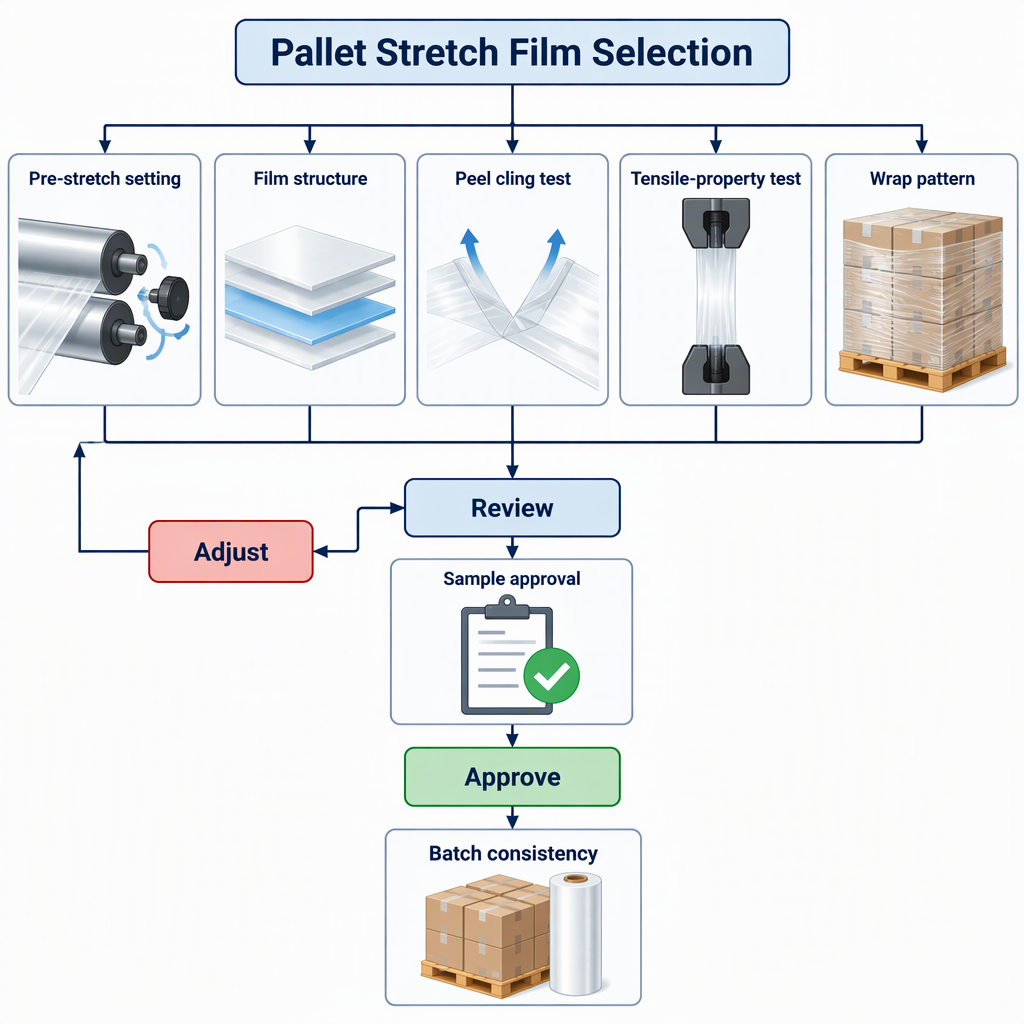
Pre-stretch changes pallet film selection because the film is elongated before it is applied to the load, so buyers should judge it by delivered containment, film behavior, wrapping setup, and application environment—not by film weight alone.
How Pre-Stretch Affects Load Containment
Pre-stretch can change film use, but load containment still depends on the film, the wrap pattern, the pallet profile, and the indoor transport or storage conditions in which stretch film is being used.
Start with the load profile. Map pallet height, edge sharpness, compression sensitivity, top stability, and whether the load will move through warehouses, closed containers, or transfer terminals.
Define the containment objective. Decide whether the priority is unitizing cartons, reinforcing irregular goods, protecting cotton bales from contact contamination, or stabilizing mixed industrial loads.
Check wrap tightness after application. Cling matters because it helps maintain a tight wrap after stretch wrapping; buyers should include cling behavior in sample checks.
Hold the wrapping setup constant. Compare candidate films under the same machine settings, wrap pattern, overlap, corner treatment, and handling route before approving a change.
Where Pre-Stretched Film Fits Cotton and Industrial Transport
For cotton processors and industrial logistics teams, pre-stretched pallet film is relevant when the packaging task involves pallet wraps, cotton bale wrap, pallet stretch hood, or transport protection categories rather than an unrelated packaging format.
Cotton bale contamination control
ECOPACK’s public industrial packaging site lists cotton bale wrap and pallet wrap categories, which makes cotton handling a relevant application area for buyer evaluation.
For a cotton environment, assess whether the selected stretch film and wrap pattern reduce contact exposure during indoor movement without trapping unacceptable handling problems at corners or bale edges.
Industrial pallet transport
The same first-party site lists pallet wraps, pallet stretch hood, reusable pallet wrap, pallet strap band, heat shrink wrap, and protective covers as industrial packaging categories.
For industrial loads, match the film to the unitizing and reinforcing task, then test the selected setup against the actual warehouse and closed-container handling path.
Selection Table: Material, Structure, and Wrapping Variables
A useful comparison separates material properties, film structure, cling, and wrapping setup so that buyers compare like with like instead of treating every pre-stretched film as interchangeable.
Selection variable
What to compare
Buyer decision
Tensile behavior
Use comparable tensile-property testing conditions for thin plastic films because test conditions affect comparability.
Do not approve a film based on a tensile value unless the test method and conditions are stated.
Cling
Request cling evaluation between film layers in stretched and unstretched condition where the application depends on wrap tightness.
Prioritize cling consistency when the load relies on film-to-film contact to stay tight after wrapping.
Application environment
Confirm whether the load is handled in indoor environments such as warehouses, closed containers, and transfer terminals.
Use separate evidence before approving outdoor exposure performance.
Wrap pattern
Compare the film under the same wrapping application, overlap, turns, and containment objective.
Approve the combination of film and wrapping setup, not the film roll in isolation.
Standards and Sample Tests to Request
Ask suppliers for a test plan that connects stretch-film selection, cling, tensile properties, and sample-batch comparability before changing pallet film.
ASTM D4649-20(2025) is listed as an active guide covering selection, specification, and use of stretch films for unitizing, reinforcing, and palletizing in indoor environments.
ASTM D5458-95(2025) is listed as an active test method for peel cling of stretch wrap film and states that cling is important in maintaining a tight wrap after a load is stretch wrapped.
ASTM D882-26a is listed as an active test method for tensile properties of thin plastic sheeting and notes that tensile properties are useful for material characterization, quality control, specification, and engineering design.
Request
Why it matters
How to use it
Stretch-film selection basis
It ties the film to unitizing, reinforcing, or palletizing use.
Compare the stated application with your load profile and handling route.
Peel-cling data
It helps evaluate film-to-film holding behavior after wrapping.
Use the same sample condition when comparing suppliers or batches.
Tensile-property data
It supports material identification, characterization, and quality-control comparisons.
Require the test conditions so values are not compared out of context.
RFQ and Batch-Consistency Checklist
A strong RFQ asks for comparable sample data, test conditions, and batch-consistency controls rather than only asking for roll price, gauge, or a claimed saving.
State the pallet type, load dimensions, handling route, and whether the film will be used in indoor storage, closed containers, or transfer terminals.
Describe the required packaging function: unitizing, reinforcing, dust reduction, moisture-resistance goal, or contamination-contact reduction.
Ask for peel-cling information when wrap tightness after application is important.
Ask for tensile-property data with the test method, specimen condition, and comparison conditions clearly stated.
Request sample rolls from the candidate specification and run them on the intended wrapping setup before approval.
Require batch identification and quality-control documentation so future deliveries can be compared with the approved sample basis.
Limits, Risks, and Claims to Avoid
Treat pre-stretch claims carefully when they move beyond the tested film, wrapping setup, and application environment.
Conclusion
The practical rule is to approve pre-stretched pallet film only when the film, test data, wrap pattern, and handling route work together for the load.
For loads that rely on tight wrap retention, include cling behavior in the sample review.
For material comparison, require tensile-property data with comparable test conditions.
For application approval, keep the environment boundary clear and validate the packaging setup before switching supply.
FAQs
These questions help buyers turn pre-stretch interest into a controlled selection, testing, and approval process.
Does pre-stretch always reduce pallet film use?
No. It may change how much film is applied, but the buyer should approve the delivered packaging result against the load, wrap pattern, and handling route rather than assume a universal reduction.
Is load containment the same as film strength?
No. Tensile properties help characterize thin plastic film, but containment also depends on wrapping application, load geometry, cling, and handling conditions.
What test is useful for cling?
ASTM D5458-95(2025) is a relevant peel-cling test method for stretch wrap film, and cling is important when a tight wrap must be maintained after wrapping.
What test is useful for tensile properties?
ASTM D882-26a is relevant for tensile properties of thin plastic sheeting and films less than 1.0 mm thick, with careful attention to test conditions.
Can a stretch-film selection guide prove outdoor performance?
No. ASTM’s public scope for D4649 is tied to stretch-film selection and use in indoor environments and excludes outdoor exposure performance issues.
What should cotton processors check before switching film?
Cotton processors should match the film to cotton bale wrapping or pallet protection needs, then test for contamination-contact reduction, wrap tightness, and handling performance in the intended route.
Should price or gauge decide the purchase?
No. Price and gauge are incomplete without comparable material data, test conditions, wrapping setup, and batch-control expectations.