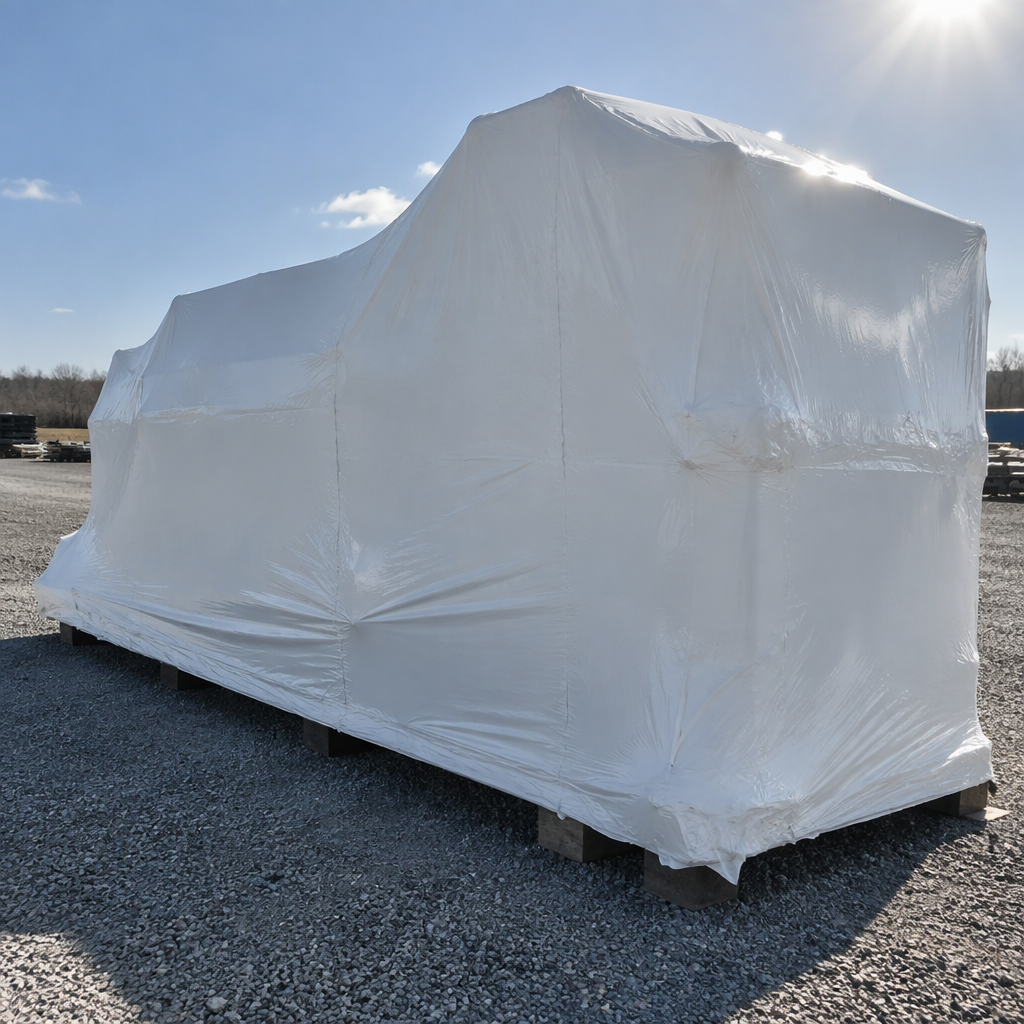
In a sunny yard the film changes as a material: a cover can look intact while its strength and flexibility have already fallen. Practices such as ASTM D4329 measure that change under controlled conditions, so film resistance can be measured rather than assumed.
A laboratory exposure is not a forecast. Fluorescent UV lamp and water apparatus practices are not intended to simulate localized pollution, biological attack or saltwater exposure, and running the apparatus correctly does not by itself produce a result: no result may be referenced unless reported together with the specific operating conditions that produced it.
Why Does the Same Film Last Longer at Some Storage Sites Than Others?
Relative durability can differ between locations because of differences in UV radiation, time of wetness, relative humidity, temperature and pollutants, and laboratory hours cannot be converted into months outdoors, because any acceleration factor depends on the material and its formulation.
Exposure factors to describe for your own storage site
Factor
Why it matters to the film
What to put in the enquiry
Storage season and sun angle
Sets when the strongest radiation reaches the covering
The months the equipment stands outdoors
Elevation
Ambient UV intensity rises with altitude, about 6% per kilometer above sea level
Site elevation and plateau location
Sky conditions
Clear skies transmit virtually all UV, while scattered, broken and overcast skies still transmit roughly 89%, 73% and 31%
Typical sky conditions during the storage season
Wet time and dew
Moisture acts together with radiation and heat
Rainfall pattern and where water collects on the cover
Local pollutants and dust
A factor that clean laboratory exposure is not intended to reproduce
Nearby industrial, agricultural or coastal influence
The public UV Index scale published by the US EPA gives buyers a shared way to describe how strong ambient ultraviolet is at a site: values of 1-2 are low, 3-7 moderate to high and 8 and above very high to extreme.
Which Film Construction Choices Affect a UV Specification?
Three decisions change what you can hold a supplier to: whether the film carries a declared UV stabilization package, whether it is a single-layer film or a reinforced laminate, and what the supplier will document for the exact construction and thickness you order.
No declared UV stabilization
Datasheet: no UV statement, or an indoor and short-term use limit
Request: written construction and the supplier's own outdoor-use limit
Effect on the specification: no outdoor period can be specified or checked
Sizes: supplier to confirm for your width and gauge
Declared UV stabilization
Datasheet: a named UV stabilizer or anti-aging package
Request: the exposure report, with the operating conditions behind any stated outdoor period
Effect on the specification: an outdoor period can be quoted and its evidence read
Sizes: supplier to confirm for your width and gauge
Reinforced laminate with declared UV stabilization
Datasheet: ECOPACK publishes its reinforced heat shrink wrap as polyethylene film laminated with a 100 gsm non-woven polyester layer, using UV stabilizers and anti-aging agents, with outdoor use stated at up to 18 months
Request: the exposure evidence behind that figure for the width and gauge you order
Effect on the specification: the reinforcement adds mechanical protection while the UV figure stays a supplier statement
Sizes: custom widths of 12-80 ft and thicknesses of 6-14 mil are published
What Should a UV-Protection Specification Actually State?
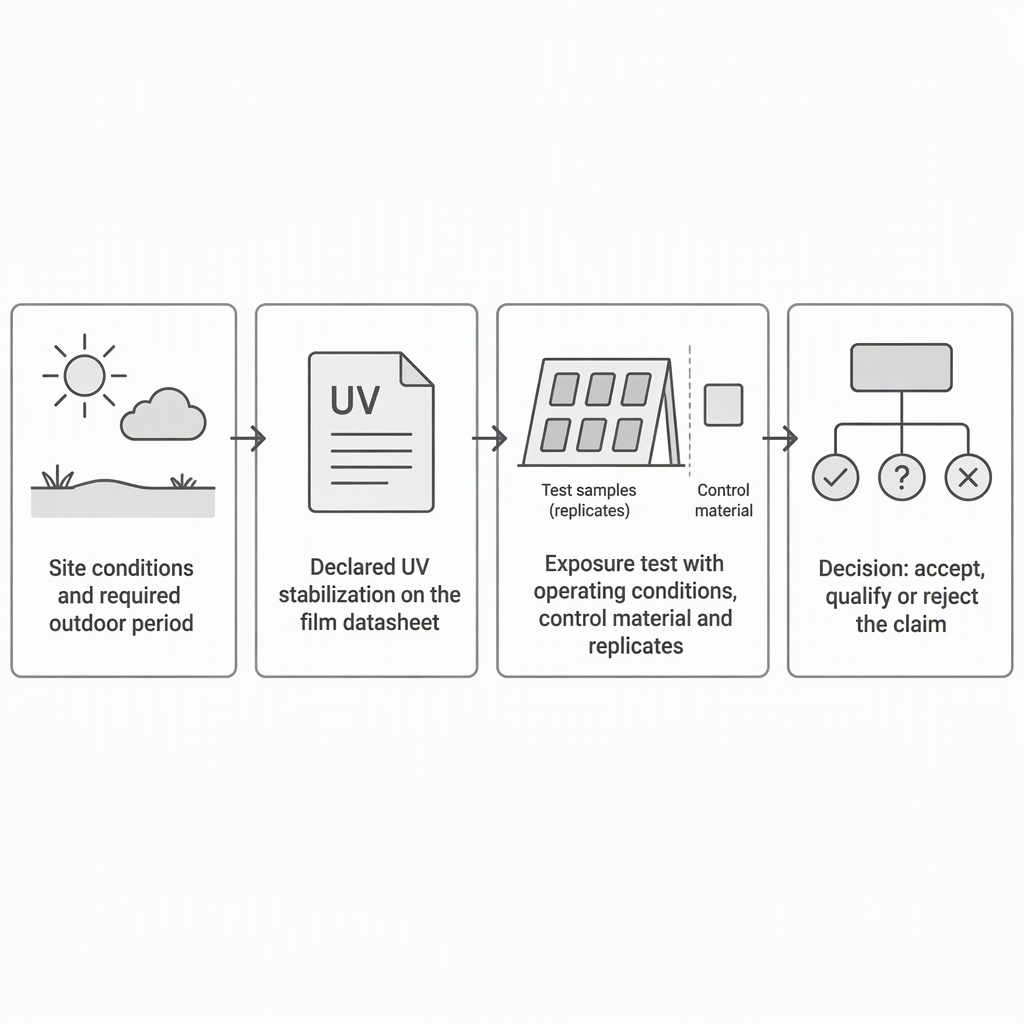
Write it in four parts the supplier can answer and you can check at delivery: the site and outdoor period; the construction, reinforcement and thickness; the declared UV stabilization and its exposure test; and the documents that must arrive with the order.
Turning site and service conditions into specification fields
Site and service period: storage months plus a short exposure description
Written confirmation that the quoted film is intended for that outdoor period
The build you intend to buy
Construction: layers, reinforcement type and weight, thickness in mil
A datasheet or written declaration for the exact construction and gauge ordered
The UV stabilization on offer
Declared stabilization: additive class, and loading where the supplier can state it
A written statement naming the stabilizer package used in the ordered film
The film's shrinkage behavior
Shrinkage characterized by unrestrained linear thermal shrinkage measurements at several temperatures across the film's range, using ASTM D2732
Shrinkage data with the test temperatures, plus the installation instructions
The exposure claim you will accept
Exposure testing: practice, apparatus, conditions, duration, mounting, control material and replicates
The complete exposure report, not a summary sentence on a datasheet
Delivery and traceability
Roll identification linking each delivered roll to the tested construction
Roll markings and a packing list that match the ordered specification
A shrink wrap outdoor UV protection specification is therefore short: the conditions, the film, the test and the paperwork. A field the supplier cannot answer belongs in the quotation, not after delivery.
Site location, elevation and how the equipment stands in the yard
The months the film stays outdoors, from loading to unloading
What the film must also keep out: dust, moisture or contamination
Equipment dimensions, sharp edges, and the points where straps and handling touch the film
Width and thickness needed, in the units the supplier quotes
The exposure method you require, with the operating conditions to be reported alongside it
Shrinkage data with test temperatures, and roll identification linking delivery to the tested construction
How Do You Read a Supplier's UV Test Evidence?
Treat a UV result as a package: the exposure practice, the operating conditions and the report. "UV tested" without the method, apparatus, cycle and duration cannot be compared between suppliers or connected to your site.
Can a supplier's "outdoors for N months" claim be derived from laboratory hours?
No, and the guidance behind the apparatus says so directly: calculating an acceleration factor between laboratory hours and months of exterior exposure is not recommended, because such factors depend on the material and its formulation. Ask what the stated period is based on. ASTM G151 frames exposure results for comparison between materials, not for conversion into months outdoors.
What must a UV exposure test report contain before you accept it?
The result and the conditions that produced it, reported together: no exposure result may be referenced unless it is accompanied by the specific operating conditions used. ASTM G154 sets out that reporting discipline, and it does not define a pass level or an outdoor service duration.
Identify the practice and edition the report follows, and check it is current.
Read the apparatus and cycle: lamp type, irradiance level, wet and dry periods, chamber temperature.
Check the discipline: specimen mounting and orientation, exposure duration, whether a control material was run, and how many replicates were tested.
Match the tested film to the order: layers, reinforcement type and weight, thickness and colour must describe the film you will receive.
Note what the report does not claim: no pass or fail threshold, and no conversion from exposure hours into months outdoors.
ASTM D4329 is the practice for fluorescent UV lamp apparatus exposure of plastics, and it treats a report of the specific operating conditions as part of the result. Ask for the report pages that record the conditions rather than a marketing extract.
What Installation Decisions Protect the Film's UV Life?
Four of them: correct shrinkage, a tight envelope, protection at contact points, and a record of what was installed. Shrinkage is characterized at several temperatures across the film's range, so the supplier's data and installation instructions govern the shrink step rather than a generic setting.
Before the crew starts, obtain the film's shrinkage data with its test temperatures and the supplier's written installation instructions.
Isolate the equipment first. Before anyone works on, over or inside a machine being wrapped, switch the equipment off and disconnect it from its power supply or battery, then secure it so it cannot be re-energized; use only the access the machine's own manual permits.
Lay out the film so the sun-facing surfaces and the top of the envelope carry continuous film, with seams positioned away from the most exposed faces.
Run the shrink step exactly as the supplier's instructions describe, including their fire precautions and your site's hot-work rules.
Protect the film where it meets sharp edges, corners, tie-downs and forklift contact points, and keep straps from cutting into the surface.
Record the roll identification, the installation date and the construction used, so the outdoor period can later be compared with the specified service period.
How Do You Inspect Wrapped Equipment and Decide Between Repair and Replacement?
Check the covering as a material: look for chalking, stiffness or cracking at folds, and whether the envelope still holds the equipment. Before anyone opens the film or reaches inside, switch the equipment off and disconnect it from its power supply or battery, then secure it so it cannot be re-energized.
When should an existing wrap be repaired instead of replaced?
Repair when the damage is local and the surrounding film is still tight and flexible. Replace when the same condition appears across several panels, or when the film has stiffened, cracked at folds or opened at seams. Re-wrap rather than patch where moisture, dust or contamination would reach the product.
Inspection findings and the action they support
Finding
What it suggests
Action
Local tear or puncture, surrounding film still tight and flexible
Localized damage rather than general film change
Repair the area and re-shrink it as the supplier's instructions describe
Tears at straps, edges or forklift contact points, film elsewhere unchanged
Handling and contact damage
Protect the contact points before repairing
Chalking, dulling, stiffness or cracking at folds on more than one panel
The covering has changed as a material
Re-wrap the affected unit or section
Open seams or film lifted from the upper surfaces after wind
The envelope no longer seals
Re-seal, and re-wrap the upper surfaces if it recurs
Any opening over a contamination-sensitive product
A path for moisture, dust or contamination
Re-wrap the affected section before the next rain
How Does This Apply to Cotton Bale Wrap Stored Outdoors?
Most of it carries over, with a sealing requirement added: cotton bales stored outdoors need the same declared construction, UV stabilization and exposure evidence. ECOPACK publishes its cotton bale wrap film as five-layer co-extruded with UV resistance for bales stored and transported outdoors.
For cotton processors and logistics teams the practical difference is what the covering protects: a film that survives the season but opens at a seam has failed if rain, dirt or contamination reaches the bale inside. Write the barrier requirement alongside the UV requirement.
UV exposure is not a contamination test. Fluorescent UV lamp practices are not intended to reproduce localized pollution, biological attack or saltwater exposure, so they cannot evidence a barrier claim.
Conclusion: Specify UV Protection as Tested Requirements, Not a Duration Slogan
The next request for quotation should carry the site, the service period, the film construction, the declared UV stabilization and the exposure evidence you will accept: a duration figure on its own cannot be checked.
That reframing is what makes a shrink wrap outdoor UV protection requirement workable for cotton processors, packaging buyers and logistics engineers alike: the specification names things a supplier can answer in writing and a receiver can verify against the delivered roll.
Keep the methods in the conversation rather than the adjectives. Naming the exposure practice, the operating conditions and the shrinkage test method makes quotations comparable and gives receiving inspection something concrete to check.
Frequently Asked Questions
Short answers to the questions buyers ask most often.
Does thicker or darker film automatically give better UV protection?
Not automatically. Relative durability depends on the material and its formulation, not on one visible property. Specify thickness and colour for mechanical reasons, and require a declared stabilizer package plus exposure evidence for the exact film you order.
What should a UV-related warranty or guarantee actually commit to?
It should name the conditions it covers: the construction and thickness, the installation method required, the exposure and inspection duties you keep, the period of cover and the remedy. Ask for those terms in writing with the order.
Do I need UV evidence if the film is only outdoors for one summer?
It depends on the site and the product. One season at a high-exposure location is not one season in a sheltered yard. Ask for the declared construction at minimum, and set the evidence requirement from the written exposure description.
How do I compare two suppliers whose films both claim UV stabilization?
Compare reports, not claims: the same exposure practice and conditions, the same construction and thickness, control material and replicates stated, and a duration that matches your storage season. A complete report against a one-line claim is itself the comparison.
What changes for a coastal yard or an overseas shipment?
Salt exposure sits outside the scope of the standard UV practices, which are not intended to simulate saltwater exposure. State the coastal or marine conditions in the enquiry, ask what the supplier can document for them, and keep salt protection as a separate requirement.
How often should wrapped equipment be inspected?
Set the interval from the supplier's written guidance and from the exposure at your site, and add a check after significant wind or storm events. Record the date, the finding and the site conditions each time.
Is "UV resistant" enough to write into a specification?
It is a starting point, not a field. ECOPACK's reinforced wrap is published with UV stabilizers, anti-aging agents and a stated outdoor use of up to 18 months; that statement becomes usable in a specification together with the construction, the ordered thickness and the exposure evidence behind it.