


When corrosion appears under a protective cover, treat the cover as one part of a packaging system: inspect the symptom, moisture conditions, seal condition, handling exposure, and the chosen corrosion-control method before changing materials.
Check the symptom before blaming the cover
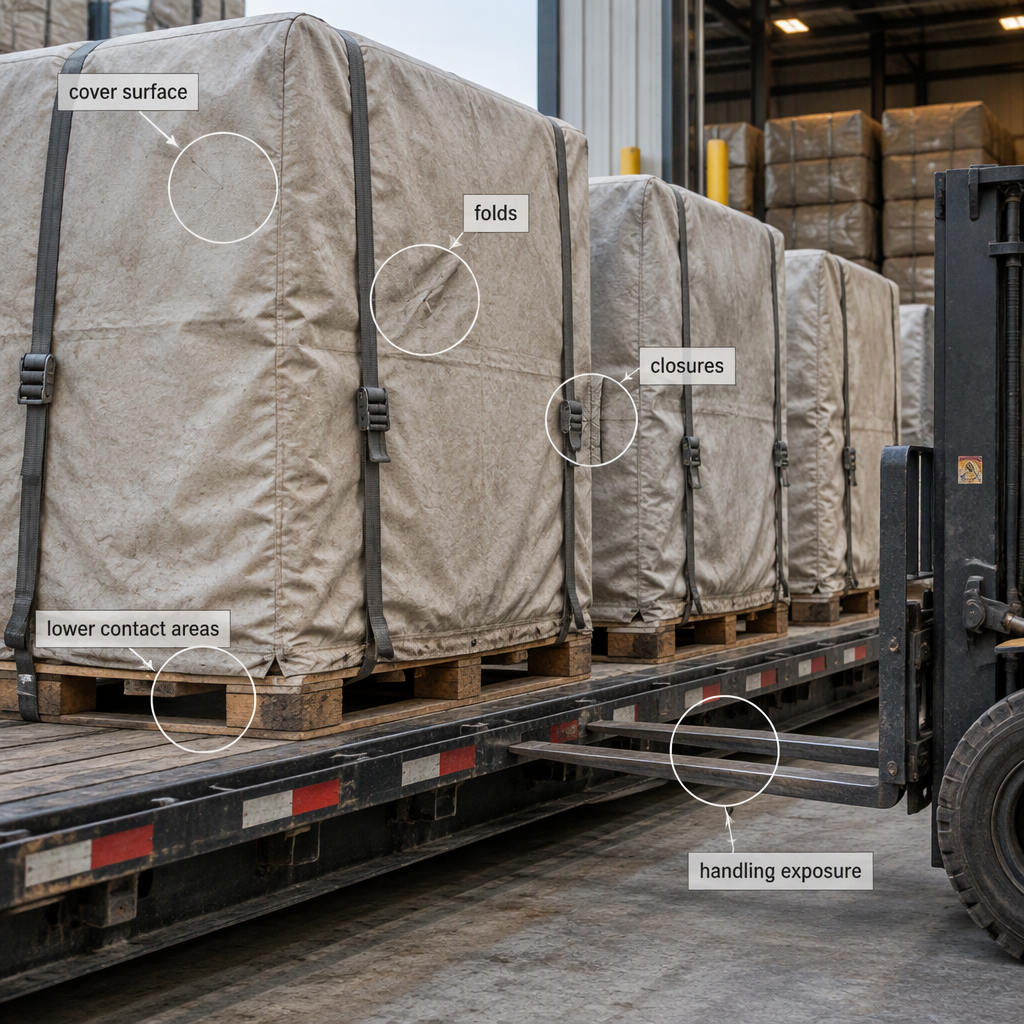
Start with visible evidence: where the corrosion appears, whether moisture is present, whether the cover is damaged, and whether the packaged item already had a compatible corrosion-control method.
- Record whether corrosion is concentrated at folds, contact points, lower surfaces, openings, or areas where the cover was rubbed or punctured.
- Look for liquid water, condensation marks, wet dunnage, saturated desiccant, damaged seals, or gaps that could let humid air move into the package.
- Check whether the item depended on a separate method such as VCI, desiccant drying, a protective coating, or a vapor-tight barrier, because these methods have different operating conditions.
- Separate cosmetic staining, contamination, and true rust or corrosion so the corrective action matches the actual symptom.
Do not treat the cover as the whole corrosion-control system
A cover can help shield goods from handling and exposure, but corrosion prevention also depends on the protected item, the existing protection, the atmosphere inside the package, and the method selected for corrosion control.
The Transport Informations Service packaging guidance describes multiple corrosion-protection approaches, including VCI, desiccants, protective coatings, and inert gas, and emphasizes matching the method to the packaged item and manufacturer specifications.
| Question | What it tells you | Buyer action |
|---|---|---|
| Is the item bare metal, coated metal, electronics, machinery, or non-metal cargo? | Different items may require different corrosion-control methods and compatibility checks. | Ask the product owner or supplier which protective method is allowed. |
| Is the inner package intended to stay sealed? | Desiccant-based methods depend on a water-vapor-tight barrier and proper resealing. | Inspect seals, repairs, and closure practices before approving a material change. |
| Was a protective agent already applied? | Existing coatings or corrosion inhibitors must be considered when selecting additional protection. | Confirm compatibility instead of layering methods by assumption. |
Separate condensation, trapped moisture, and barrier failure
If corrosion is found after covered storage or transport, check whether moisture entered from outside, was sealed inside, or formed by temperature-driven condensation.
| Symptom | Likely check | Corrective direction |
|---|---|---|
| Rust appears near openings or damaged edges | Cover tears, loose closures, abrasion, or repeated handling | Improve handling protection and closure control before changing the whole cover. |
| Moisture appears inside a sealed package | Wet cargo, wet pallets, damp dunnage, or sealing before the load stabilized | Dry or condition the load and packaging components before sealing. |
| Desiccant is present but corrosion continues | Whether the barrier is water-vapor-tight and whether the package was resealed correctly after opening | Review barrier integrity and resealing practice, not only desiccant quantity. |
| Corrosion appears after hot-cold transport cycles | Condensation at cold surfaces, metal contact points, or low-airflow zones | Review temperature transitions, spacing, and moisture-control method. |
Match the cover with the corrosion-control method
Choose the corrosion-control method first, then check whether the protective cover supports that method instead of interfering with it.
| Method | Useful check | Limit to confirm |
|---|---|---|
| VCI | Confirm the packaged item and existing protection are compatible with the inhibitor system. | Do not assume VCI is suitable for every material or mixed load. |
| Desiccants | Confirm the package has a water-vapor-tight barrier and that openings are resealed. | Desiccants cannot compensate for a leaking barrier or repeated unsealed access. |
| Protective coatings | Confirm coating suitability for the metal surface and later cleaning or use requirements. | Coatings may affect handling, cleanliness, or downstream processing. |
| Inert gas or controlled atmosphere | Confirm the package can maintain the intended atmosphere. | Loss of enclosure integrity can defeat the method. |
Because industrial packaging guidance treats VCI, desiccants, coatings, and inert gas as distinct methods, the purchasing specification should name the intended corrosion-control approach and its required enclosure conditions.
Adapt the checks for cotton bales and industrial transport loads
For cotton bales and industrial transport loads, broaden the inspection from metal corrosion alone to packaging damage, contamination risk, handling exposure, storage conditions, and transport abuse.
- For cotton bale applications, align the cover review with packaging goals such as bale quality, protection, appearance, and marketability described by the JCIBPC cotton bale packaging specifications.
- Inspect whether handling, storage, or transportation damaged the packaging materials before concluding that the cover material itself is unsuitable.
- For industrial loads, compare cover contact points against sharp edges, strapping, fork handling areas, and areas where water could collect.
- Where cotton and metal components share a logistics environment, separate contamination prevention requirements from metal corrosion-control requirements.
Follow a troubleshooting sequence before replacing the cover
Use a fixed sequence: identify the symptom, check moisture, inspect cover and seals, review the corrosion-control method, review handling and storage, then retest the corrective action.
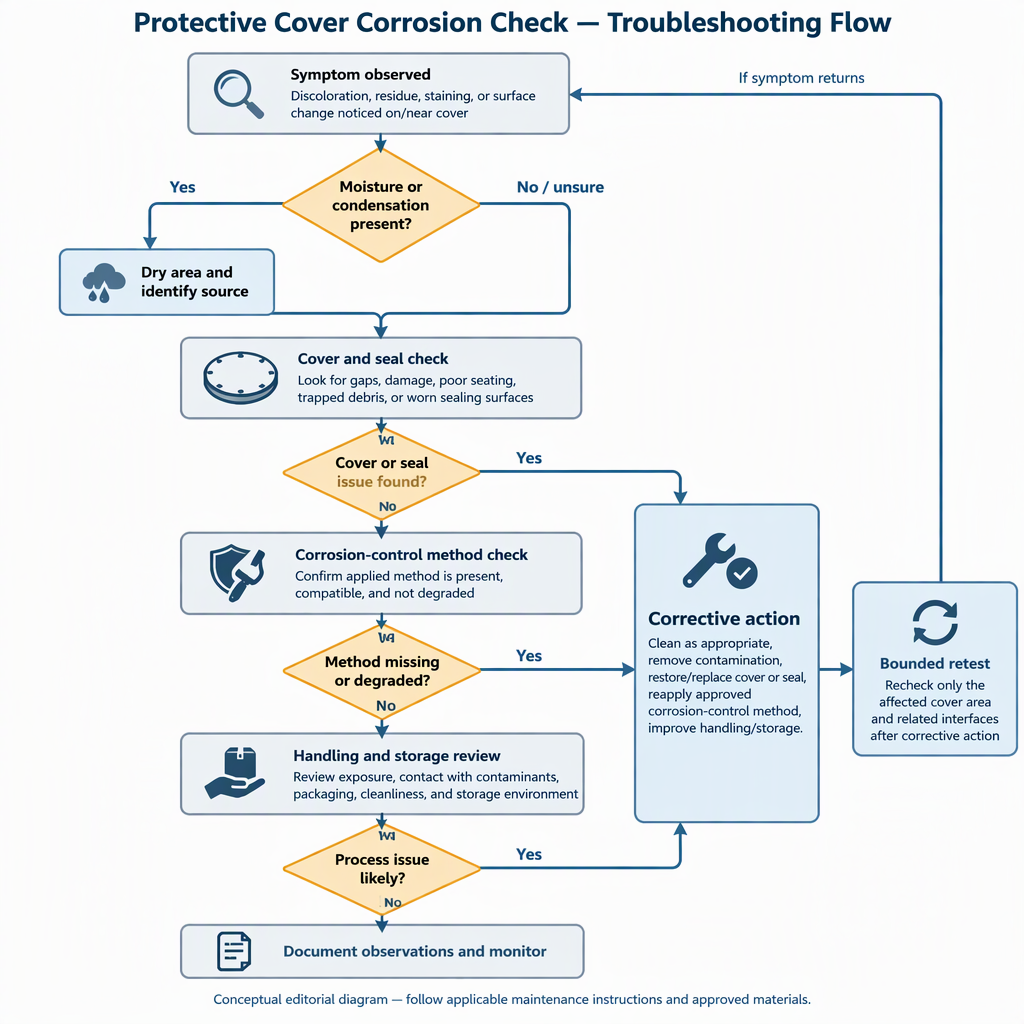
- Photograph and map the corrosion pattern before moving the load, so later teams can compare the same locations.
- Check moisture indicators first: condensation, wet pallets, damp dunnage, saturated desiccant, or open resealed areas.
- Inspect barrier and closure integrity when the method relies on a water-vapor-tight enclosure.
- Confirm the chosen method matches the packaged item, existing protection, and manufacturer specifications.
- Review handling, storage, and transport events that may have damaged packaging materials.
- Change one variable at a time where practical, so the retest can show which correction mattered.
| If the main finding is... | Change first | Do not jump straight to... |
|---|---|---|
| Wet cargo or dunnage | Drying and pre-seal controls | A different outer cover only |
| Openings or poor resealing | Closure method and access procedure | More desiccant without barrier repair |
| Abrasion or punctures | Edge protection, handling method, and cover fit | A corrosion inhibitor change alone |
| Method mismatch | VCI, desiccant, coating, or barrier specification | A universal corrosion-prevention claim |
Use humidity tests as bounded evidence, not a service-life promise
Humidity-cabinet rust testing can support controlled comparison of metal preservatives, but it should not be treated as a direct guarantee of how long a protective cover will prevent corrosion in transport.
ASTM D1748-24 is an active standard test method for evaluating rust-preventive properties of metal preservatives in a humidity cabinet, and ASTM notes that the method should not be relied on when high humidity is not the principal rusting factor.
Retest and document the corrective action
After changing a cover, seal, drying step, desiccant plan, VCI approach, coating, or handling method, retest against the original symptom rather than relying on a general assurance.
- Define the original failure pattern: location, time in storage or transit, weather exposure, and package condition.
- Apply one corrective action, such as improving dryness before sealing, repairing closures, adding edge protection, or changing the corrosion-control method.
- If desiccants are used, confirm barrier integrity and resealing before judging the result.
- If a laboratory humidity test is used, keep its conclusion within the test scope and do not convert it into a field-life guarantee.
- Compare the same inspection points after the retest and record whether corrosion, moisture, and packaging damage decreased.
- Document cover condition before and after handling.
- Record storage and transport exposure that could affect moisture.
- Keep supplier instructions for the chosen corrosion-control method with the shipment file.
- Require the next quotation to state the intended protection method, not only the cover material name.
Conclusion
The best purchasing decision is to specify the complete protection system and inspection method, then change the cover only when the troubleshooting record shows the cover is the limiting factor.
For protective cover corrosion prevention, buyers should connect the cover specification to the protected item, the moisture-control method, the corrosion-control approach, and the package closure conditions.
For cotton bales and industrial transport loads, add handling, storage, transportation, and contamination checks before treating corrosion prevention as a cover-only issue.
- Inspect the symptom pattern before naming the cause.
- Keep moisture, sealing, handling, and corrosion-control method checks separate.
- Use laboratory humidity-test references only within their stated scope.
- Ask suppliers to document compatibility and enclosure requirements for the chosen method.
FAQs
These questions help buyers approve a practical corrosion-control review without turning one cover material into a universal answer.
What should I check first when corrosion appears under a protective cover?
Check the corrosion pattern, moisture signs, cover damage, closure condition, and the corrosion-control method used with the package.
Can a protective cover alone prevent corrosion?
Not reliably in every case. Corrosion control depends on the protected item, atmosphere inside the package, enclosure integrity, and any VCI, desiccant, coating, or barrier method.
How do I know whether condensation is involved?
Look for water marks, wet dunnage, saturated desiccant, corrosion on cold contact areas, or rust concentrated near low-airflow points and lower surfaces.
When should desiccants be reviewed?
Review desiccants when the package is intended to be dry inside, but also confirm the barrier is water-vapor-tight and resealed correctly.
What changes for cotton bale protection?
Cotton-bale checks should include packaging quality, protection, appearance, marketability, and damage from handling, storage, or transportation.
Does passing a humidity cabinet test guarantee field performance for a cover?
No. ASTM D1748-24 is for rust protection by metal preservatives in a humidity cabinet and should not be treated as a field service-life guarantee for a protective cover.
What should be documented before changing cover materials?
Document the original corrosion pattern, moisture condition, package damage, storage and transport exposure, closure method, and the corrosion-control method already in use.


