+86-189-1313-5729      gf@szecopack.com
You are here: Home » News » Stretch Hood vs. Shrink Hood: Which Fits Your Pallet Load and Line?

Stretch Hood vs. Shrink Hood: Which Fits Your Pallet Load and Line?

Views: 0     Author: Site Editor     Publish Time: 2026-12-03      Origin: Site

Inquire

facebook sharing button
twitter sharing button
line sharing button
wechat sharing button
linkedin sharing button
pinterest sharing button
whatsapp sharing button
sharethis sharing button
Stretch Hood vs. Shrink Hood: Which Fits Your Pallet Load and Line?

Two palletized industrial loads in a warehouse being evaluated for stretch hood and shrink hood packaging methods

Stretch hood vs. shrink hood: the like-for-like comparison

Compare the two methods under the same pallet pattern, handling route, storage exposure, and acceptance test; otherwise the result is a packaging preference, not a valid selection.

Start with stretch hood when the trial is mainly about elastic containment

EUMOS describes a film edge-force method for forces on a vertical edge of a load unit, including forces applied by stretch hood film over position and time.

That makes stretch hood a useful candidate when your approval question is whether the hood can maintain containment on the load shape you actually ship.

Start with shrink hood when the line can justify a heat-shrink step

Use shrink hood as a candidate only where the packaging line, product tolerance, fire-risk review, and operating space can support a heat process without compromising the load or the site’s safety controls.

Decision field Stretch hood evaluation Shrink hood evaluation
Primary approval question Can the hood deliver the required edge-force behavior over the relevant positions and holding time? Can the hooding material and heat process protect the load without damaging product, labels, packaging, or palletized geometry?
Load-stability proof Use load-unit rigidity and deformation checks as part of the approval discussion. Use the same load-unit stability acceptance logic so the method comparison is fair.
Environment question A standards listing for ASTM D4649-20R25 describes stretch-film use for unitizing, reinforcing, and palletizing in indoor environments and states that outdoor-exposure performance issues are outside that guide’s scope. Ask separately how outdoor exposure, condensation, contamination, and heat-process limits will be handled for your load.
Procurement risk Do not approve from film name alone; require trial data for the load, line speed target, pallet pattern, and handling route. Do not approve from shrink appearance alone; require the same load, line, and safety review before switching.

Start with the pallet load, not the film name

The right method is the one that keeps your specific load stable and protected after palletizing, handling, storage, and transport simulations—not the one that looks best on a brochure.

Load condition Why it matters Buyer action
Irregular or compressible load faces Edge-force behavior matters when containment forces act on vertical load edges over time. Map the most vulnerable corners, bulges, and gaps before specifying trial samples.
High consequence of pallet deformation EUMOS describes load-unit rigidity testing with evaluation of elastic and plastic pallet-load deformation. Define acceptable elastic recovery and unacceptable permanent deformation before the trial.
Indoor-only storage assumption The ASTM D4649-20R25 listing describes an indoor-environment scope for stretch films and excludes outdoor-exposure performance issues. If pallets wait outdoors, move weathering, moisture, UV exposure, and contamination into the supplier questionnaire.
Mixed pallet formats One film setting or heat setting may not suit every pallet height, top profile, or load density. Group loads into families and test the worst practical examples from each family.

Check the line: heat, automation, space, and safety constraints

A hooding method that fits the load can still fail the project if the packaging line cannot safely support its space, heat, automation, maintenance, and operator-access requirements.

  • Confirm the available footprint for film storage, hood application, pallet movement, guarding, and rejected-load handling.
  • For any manual access to hooding equipment, conveyors, heat areas, or jammed packaging, switch off and disconnect the relevant power source before reaching into the equipment, then follow the model manual’s permitted access procedure.
  • Check whether your load or existing packaging can tolerate the proposed process conditions without product damage, condensation problems, label distortion, or contamination risk.
  • Review whether the line can handle the required pallet height range, pallet quality variation, and top-load profile without repeated stops.
  • HSE guidance for cellular plastics states that many cellular plastics are fire hazards and that controlling ignition sources and hot work is part of reducing fire risk.
  • For a shrink process, use that ignition-source principle as a prompt for a site-specific fire, ventilation, heat-source, and emergency-response review.

Validation tests and standards to discuss before approval

Before approving stretch hood or shrink hood, ask for a validation plan that connects load stability, edge containment, environmental assumptions, and acceptance criteria to your real shipment route.

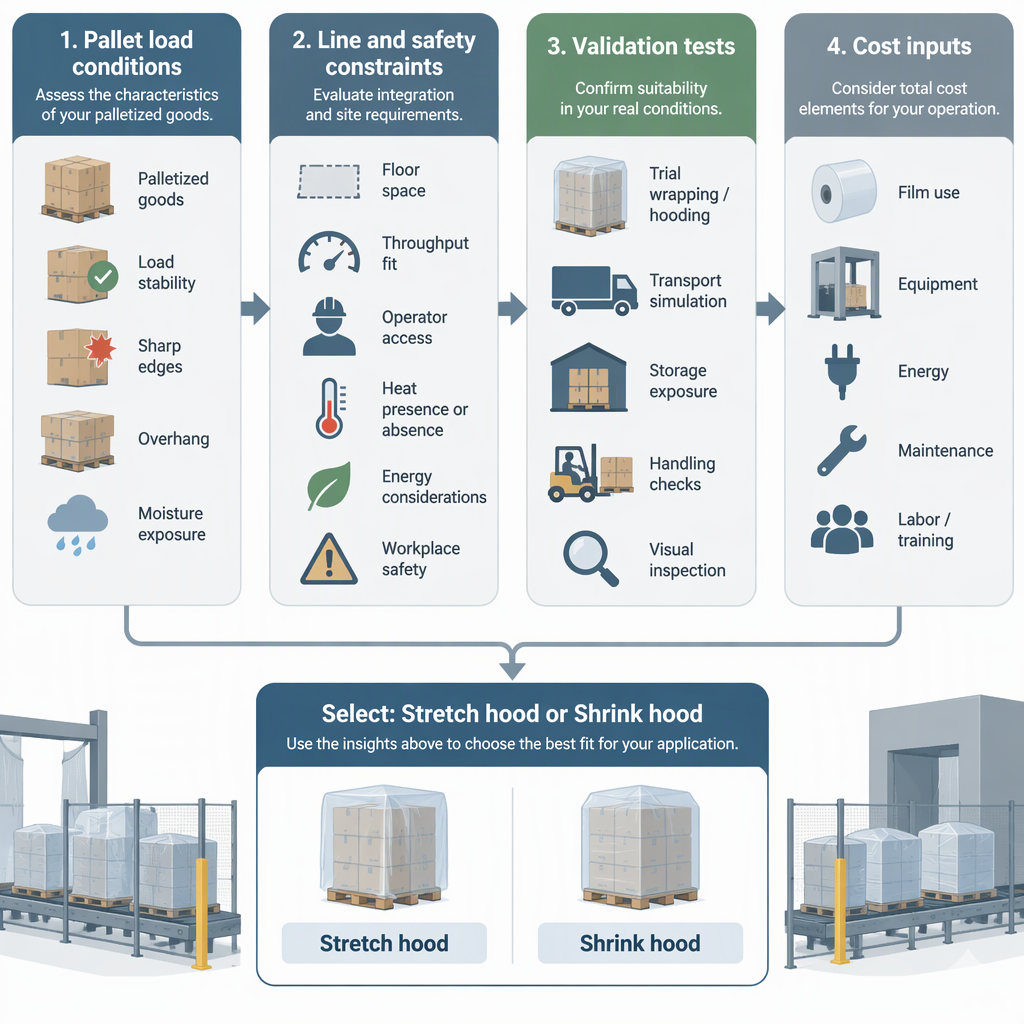
Decision flow from pallet load conditions through line constraints, validation tests, cost inputs, and final hooding method selection
  1. Define the load family. Record pallet size, height range, top profile, load weight range, bale or carton compression behavior, and contamination-sensitive surfaces.
  2. Set measurable stability criteria. EUMOS describes EUMOS 40509:2020 as a test method for load-unit rigidity with test conditions and evaluation criteria for elastic and plastic deformation.
  3. Define containment-force questions. EUMOS describes EUMOS 40513:2014 as a film edge-force test and measurement method for forces on a vertical edge of a load unit, including stretch hood film or wrapped stretch film forces over position and time.
  4. Separate indoor and outdoor assumptions. The ASTM D4649-20R25 listing describes stretch-film guidance for indoor unitizing, reinforcing, and palletizing and states that outdoor-exposure performance issues are not covered by that guide.
  5. Run a controlled production trial. Compare load appearance, containment, rejected pallets, operator interventions, film handling, and post-transport condition for the same load family.

For load-stability terminology and test-plan discussion, review the official EUMOS standards page, which describes cargo-securing and transport-packaging standards including load-unit rigidity evaluation.

The same EUMOS page also describes the edge-force method, which is especially relevant when a stretch hood candidate must maintain containment force around vertical load edges.

Cost components to compare in supplier quotes

Compare total applied cost, not a claimed film saving: the useful quote is the one that separates material, energy, labor, rejects, maintenance, space, and validation work for the same load family.

Cost component What to request Why it changes the decision
Packaging material Film type, roll dimensions, hood size range, consumption per approved pallet format, scrap basis, and minimum order quantity. A lower unit film price can lose value if the trial needs more material, more rejects, or more pallet-specific variants.
Equipment and utilities Machine configuration, installation scope, compressed air or electrical needs, heat-related utility assumptions, and guarding requirements. The line decision may be driven by available infrastructure rather than material price alone.
Labor and uptime Operator touch points, roll-change method, rejected-load handling, cleaning access, and planned maintenance tasks. Small process differences can affect staffing, stoppages, and safety controls.
Validation and quality Trial quantity, test method, acceptance criteria, documentation, and responsibility for retesting after load changes. Unbudgeted validation can delay approval even when the material looks acceptable.
Transport loss exposure Inspection plan for contamination, shifting, puncture, deformation, and arrival condition on the route you actually use. The cheapest applied wrap is not economical if it increases rejected or reworked loads.

Cotton bale and industrial transport fit

For cotton processors and industrial logistics teams, the selection boundary is contamination control plus transport stability: the hooding method must protect the load face you ship, not just cover a laboratory pallet.

  • For cotton bales, identify the surfaces most exposed to dust, moisture, handling abrasion, strap contact, fork contact, and warehouse floor contamination.
  • For industrial goods, identify sharp edges, load voids, unstable top layers, product temperature sensitivity, and any packaging that could deform under containment force.
  • ECOPACK lists relevant industrial packaging categories including Heat Shrink Wrap, Cotton Bale Wrap, Pallet Wraps, Pallet Stretch Hood, Reusable Pallet Wrap, Pallet Strap Band, and Protective Covers.
  • Use those categories as a starting vocabulary for supplier discussions, then request project-specific material data, test samples, and line-fit confirmation before approval.
  • Do not treat a cotton bale trial as proof for industrial components, or an industrial component trial as proof for cotton contamination prevention.
  • Define the inspection point: immediately after wrapping, after warehouse storage, after truck or container movement, and at receiving.

RFQ and trial checklist for stretch hood or shrink hood

A strong RFQ asks suppliers to prove fit against your load, line, and route; it does not ask them to recommend a film name in isolation.

  • Provide pallet dimensions, load height range, top profile, unit weight range, stack pattern, and photos or drawings of representative load families.
  • Ask how the supplier will document load-unit rigidity, elastic deformation, and plastic deformation acceptance criteria.
  • Ask how edge-force behavior will be measured or otherwise controlled when stretch hood containment is part of the proposed solution.
  • Ask whether the proposed stretch-film guidance assumes indoor use and what separate evidence is needed for outdoor exposure.
  • Ask for trial rolls or trial hoods, machine setting ranges, operating limits, waste-handling assumptions, and rejected-load criteria.
  • Ask who owns retesting when pallet height, bale density, route, climate, or handling method changes.
  1. Shortlist candidate methods using load geometry, line constraints, and contamination risk.
  2. Run the same load family through each candidate under controlled production conditions.
  3. Inspect load stability, hood integrity, contamination protection, operator interventions, and rejected pallets.
  4. Compare total applied cost only after the trial assumptions are the same.
  5. Approve the method only for the load families and operating conditions actually tested.

Conclusion

Choose stretch hood or shrink hood by proving performance on your pallet load and line, then lock the approval to the tested load family, route, and acceptance criteria.

Use load-unit rigidity and deformation criteria to keep the comparison objective.

Use edge-force questions when stretch hood containment is central to the decision.

Separate indoor stretch-film assumptions from outdoor exposure questions.

For ECOPACK category discussions, start with the relevant packaging families and request project-specific trial data before specification.

FAQs

These questions help buyers turn the comparison into a practical RFQ and trial plan.

Does one method always use less material, lower cost, or run faster?

No. Treat any universal claim as incomplete until the supplier states the load family, line conditions, film assumptions, utility assumptions, rejection basis, and acceptance test.

Which method is best for cotton bales?

The better method is the one that protects the actual bale surface from contamination and handling damage while passing your stability checks. Test representative bale density, dimensions, strapping, and storage conditions before approval.

Which standards or test topics should procurement request?

Ask about load-unit rigidity and deformation evaluation, and use EUMOS terminology as a useful discussion point for transport-packaging validation.

Why does edge force matter for stretch hood?

EUMOS describes edge-force measurement for forces applied by stretch hood film or wrapped stretch film on a vertical load edge over position and time, so it is directly relevant when containment around the pallet edge drives the decision.

Can indoor stretch-film guidance decide outdoor storage performance?

No. The ASTM D4649-20R25 listing describes indoor stretch-film use and says outdoor-exposure performance issues are outside that guide’s scope, so buyers should request separate outdoor-exposure evidence.

What should be checked before using a heat-based shrink process?

Review ignition-source control, hot-work control, ventilation, emergency procedures, material compatibility, and local safety requirements; HSE plastics guidance treats ignition-source control as an important fire-risk reduction measure.

What should a supplier provide before approval?

Ask for material data, machine setting guidance, trial samples, load-stability acceptance criteria, rejected-load rules, safety information, and responsibility for retesting when the load or route changes.

ECOPACK, established in 2000, is a leading manufacturer of industrial packaging materials in China.
  +86 18913135729
 +86-18913135729
 Building 1,Wanhui Plaza ,Suzhou City, China 215131

Quick Links

Product Category

Contact Us
 Copyright © 2023 Suzhou Ecopack Co.,Ltd. All Rights Reserved. Sitemap | Supported by leadong.com | Privacy Policy