Physical segregation
Certified material is kept separate from non-certified material, so the certified share is physically in the film delivered. Confirm that segregation is maintained down to the plant that made your hood.

Views: 0 Author: Site Editor Publish Time: 2026-12-14 Origin: Site


A recycled-content percentage is a claim to verify, not a specification to approve. Before you accept a stretch hood offer, establish what the percentage counts and on which basis it is stated, which chain-of-custody model carries it, and what the film must do on your load — then require the same evidence with every batch.

A recycled-content claim is only as strong as the definition behind it: US guidance states that such claims should be made only for material recovered or diverted from the waste stream during manufacturing or after consumer use, and that a partly recycled product should be qualified with the percentage.
The exposure does not stop with the film maker: UK Competition and Markets Authority guidance notes that responsibility for green claims runs through the supply chain, so ask for the approved wording and the records behind it.
Pin down two things before you compare quotations: which material is counted, and whether the figure is stated as post-consumer content, as total recovered material, or as a combined number. The EPA Comprehensive Procurement Guideline program publishes recommended recovered-material content levels for designated products on exactly those two separate bases — post-consumer material content and/or total recovered material content — which is why an unqualified percentage cannot be compared between suppliers or repeated in your own documents.
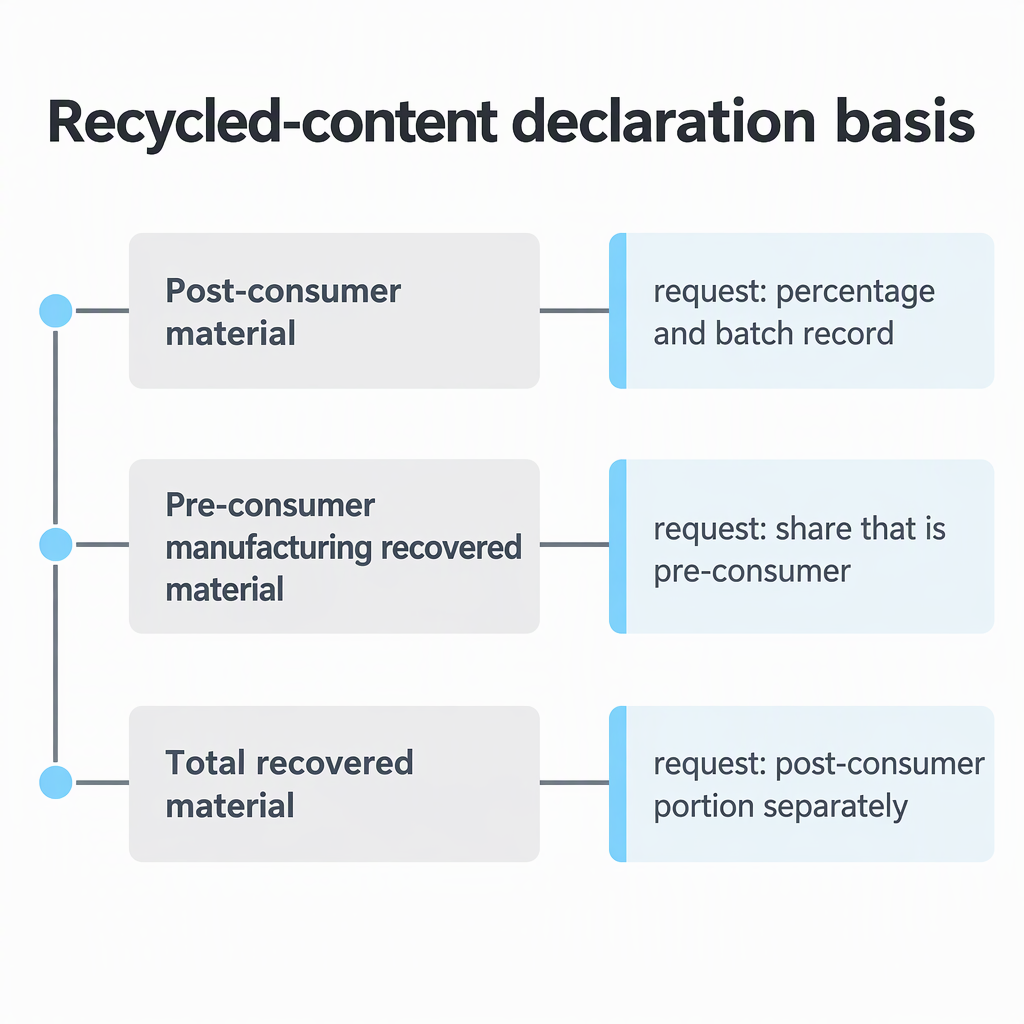
| Declaration basis | What it counts | Wording you may see | What to request |
|---|---|---|---|
| Post-consumer material | Material recovered after consumer use and diverted from the waste stream. | Made from 30% post-consumer recycled material. | A written statement of the percentage and the basis, with the batch record behind it. |
| Pre-consumer, manufacturing recovered material | Material recovered or diverted from the waste stream during the manufacturing process. | Made from 30% recycled material, with no further qualification. | The share of the figure that is pre-consumer rather than post-consumer. |
| Total recovered material | Recovered content from both routes reported as a single combined figure. | 30% total recovered material. | The post-consumer portion on its own, so the offer can be compared with others. |
If the supplier cannot name the basis, keep the figure out of your approved specification.
Ask which chain-of-custody model the certificate uses, because the three recognised options do not make the same promise about what is physically in your film. ISCC PLUS is a voluntary third-party certification scheme for recycled and bio-based feedstocks, covering plastics and packaging, that tracks alternative materials through physical segregation, controlled blending and mass balance.
Certified material is kept separate from non-certified material, so the certified share is physically in the film delivered. Confirm that segregation is maintained down to the plant that made your hood.
Certified and non-certified material are mixed under documented rules rather than held apart. Ask what those rules are, how the mix is recorded, and how the certified share is attributed to your order.
Certified input is tracked through the site’s records rather than kept separate, so the certified volume may be booked against production instead of your individual hood. Ask how certified input is reconciled with certified output, and whether your batch is matched to certified material or to a production period.
Whichever model applies, the paperwork has to be site-specific: certificates under this scheme are issued per site and are valid for 12 months, so ask for the certificate covering the plant that handled the certified material rather than a group-level document.
Compare the wording on the datasheet against the FTC Green Guides tests, then decide whether to accept it, qualify it or push back. The summary states that partial recycled content should be qualified with the percentage, that unqualified general environmental benefit claims such as “green” or “eco-friendly” should not be made, that a marketer holding a third-party certification must still substantiate all express and implied claims, and that unqualified degradable claims are unsuitable for items destined for landfill, incineration or recycling.
| Wording offered | Buyer action | Why |
|---|---|---|
| Made from 30% post-consumer recycled material | Accept, once the basis and the batch record are supplied | The percentage and the declaration basis are both stated. |
| Made with recycled material, with no figure | Qualify: ask for the percentage and the basis | A product made partly from recycled material should be qualified with the percentage. |
| Eco-friendly film, green pallet packaging | Push back | Unqualified general environmental benefit claims should not be made. |
| Recycled and independently certified | Qualify: ask what the certificate covers and who substantiates the claim | Holding a third-party certification does not remove the duty to substantiate express and implied claims. |
| Biodegradable, on film used for loads that end up in landfill, incineration or recycling | Push back | Unqualified degradable claims require proof of complete breakdown within about one year and are unsuitable for those disposal routes. |
These tests reflect US claim guidance; outside the US, check the national requirements that apply to your market.
Treat the recycled-content figure and the film performance as two separate agreements with the same supplier. Do not assume that recycled content weakens the film, and do not assume it changes nothing: agree the parameters your load depends on, then ask for the data against that specification for the material actually supplied.
A recycled-content percentage does not change the scope limits of the film. The standard guide for stretch film selection and use is written for indoor environments such as warehouses, closed containers, truck trailers, rail boxcars and transfer terminals, and it excludes performance issues associated with outdoor exposure. If pallets sit outside or stage on an open dock, ask what the film itself is specified for, separately from the recycling claim.
The most common mismatch is an outdoor assumption. ECO PACK states that UV-stabilized stretch hood formulations are available for applications involving outdoor pallet storage, so the option exists in the product line — but it has to be specified for your order and confirmed in writing, and it should never be inferred from a general product description.
Ask for the claim and the records in the same request rather than in sequence. The statement, the certificate and the batch link together are what make a recycled-content figure usable in your own paperwork; if any one of the three is missing, treat the figure as unconfirmed.
You can check the last point at the source: the UK Green Claims Code sets out what businesses are expected to do when they make environmental claims, and states that responsibility for those claims matters throughout the supply chain.
Approve a recycled-content stretch hood when the percentage is defined on a stated basis, the chain-of-custody model is named and certified per site, the claim wording survives the tests above, and the film performance is agreed between buyer and seller as its own specification rather than carried by the environmental claim.
These are the questions that come up most often when a stretch hood quotation arrives with a recycled-content figure attached.
It counts material recovered or diverted from the waste stream, during manufacturing or after consumer use, so pre-consumer and post-consumer material can sit behind one figure.
Ask which basis was used: recovered content is conventionally reported as post-consumer material content and/or total recovered material content, and a total-recovered figure can include production material recovered before the film reached a user.
Physical segregation keeps certified material separate, controlled blending mixes certified and non-certified material under documented rules, and mass balance tracks the certified volume in the site’s records.
No. General environmental benefit wording of that kind cannot be substantiated for the whole product; ask for the percentage, the basis and the records behind it.
No. Recycled content describes where the material came from, not whether the film breaks down; unqualified degradable claims require proof of complete breakdown within about one year.
A certificate is a starting point, not a substitute for checking: the plant behind your order needs its own certificate, valid for 12 months. A marketer holding a third-party certification must still substantiate all express and implied claims it makes.
Do not assume it changes the film in either direction. Agree thickness, layer structure, elasticity and load stability as a separate buyer-and-seller specification.
Outdoor exposure is a separate question from recycled content. The standard guide for stretch films is written for indoor environments and excludes performance issues associated with outdoor exposure, so an indoor specification does not cover pallets that sit outside. ECOPACK states that UV-stabilized stretch hood formulations are available for outdoor pallet storage, so specify that option explicitly if your loads are staged or stored outside.
Cotton bales need a wrap that accounts for moisture, dust and handling. ECO PACK describes its cotton bale wrap film as protecting cotton from dust, moisture, pests and handling damage, a different product from pallet stretch hood film, so confirm which film is quoted for your bales.


