


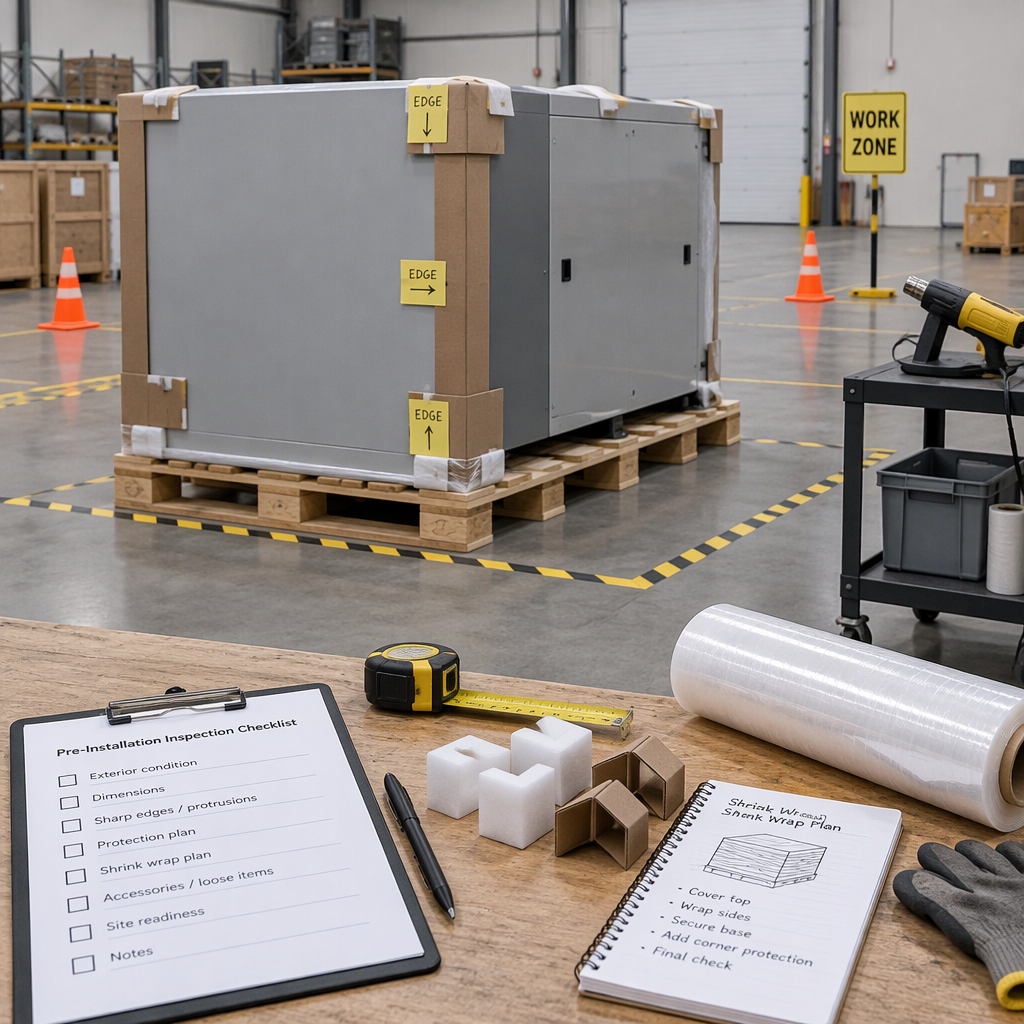
Start with a pre-installation go/no-go check
Approve installation only when the load is suitable for the selected wrap, the work area is safe for heating, the film documents match the job, and destination rules have been checked separately from product claims.
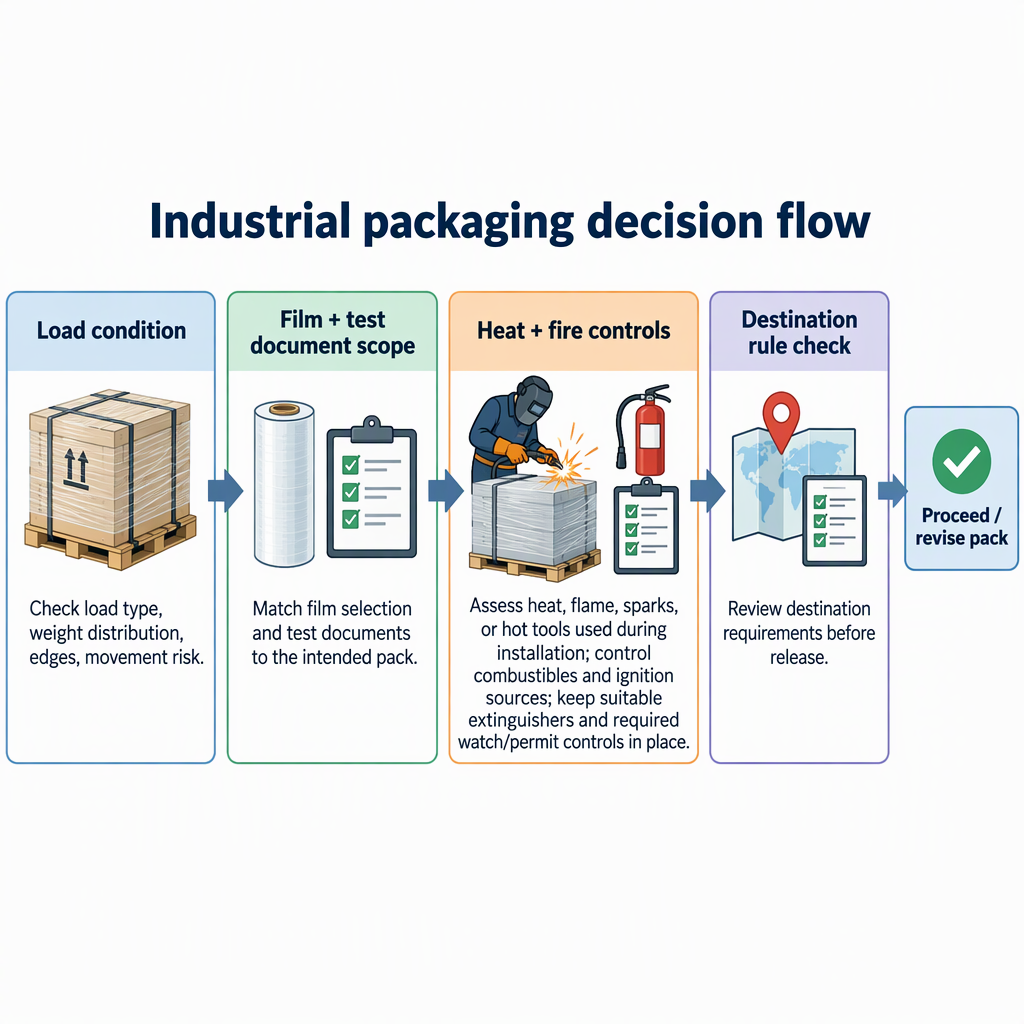
- Confirm cargo size, weight, shape, exposed edges, sensitive surfaces, likely transport handling, storage environment, and the intended packing process before selecting reinforced shrink wrap.
- Clear or protect combustible materials before heating and identify ignition sources that could affect the work zone.
- Keep suitable fire extinguishing equipment available and assign a fire watch when the scale, setting, or site procedure requires it.
- Check whether any film-shrinkage data refers only to a test method for plastic film and sheeting, rather than to installed package performance.
- If inspection requires touching, moving, clearing, or reaching into powered equipment, switch it off and disconnect the applicable electrical, battery, pneumatic, hydraulic, or other stored-energy source before manual access; use only access permitted by the official equipment manual.
| Gate | Proceed when | Pause when |
|---|---|---|
| Load condition | Dimensions, weight, irregular shapes, sharp edges, and sensitive surfaces have been reviewed for packaging fit. | The load has unprotected edges, unknown movement risk, or surfaces that may be damaged by contact or heat. |
| Heat safety | Combustibles, ignition sources, extinguishers, and watch arrangements are controlled for the hot-work setting. | The work area contains uncontrolled combustibles or no suitable fire-response arrangement. |
| Film documents | Test-method references are read within their stated film-testing scope. | A test method is being treated as proof of completed load protection. |
| Destination rules | Carrier, customer, port, warehouse, and local requirements have been checked for the shipment. | A product description is being used as a substitute for destination acceptance rules. |
Check the equipment, load geometry, and contact surfaces
The shape and condition of the load should drive the packaging decision because reinforced shrink wrap is positioned for heavy, sharp-edged, irregular, high-value, machinery, equipment, and transport loads.
- Measure the length, width, height, and practical wrap path around the equipment or transport unit.
- Identify sharp edges, protrusions, tie-down points, lifting pockets, and irregular shapes that may concentrate stress.
- Flag sensitive surfaces such as painted panels, polished parts, sensors, labels, vents, or customer-facing finishes.
- Review transport risk and storage environment before approving the wrap type and installation method.
- Where cargo can shift, abrade, or trap moisture, add buyer-side protection requirements to the packing instruction before wrapping begins.
Control heat, ignition sources, and combustible materials
Shrink wrap installation safety depends on controlling fire risk whenever heat, flame, sparks, or hot tools are used near combustible materials.
- Assess the fire risk in the work area before heating starts, including nearby stored materials and likely ignition sources.
- Move combustible materials away from the heating zone where practicable, or protect them through the site’s approved method.
- Place suitable extinguishers where installers can reach them quickly.
- Maintain a fire watch after hot work when the site procedure, project scale, or risk assessment calls for it.
- Use a permit-to-work system on larger projects where the work needs formal control.
Set installer controls before applying heat
The installation team should control the work area, the heat source, nearby materials, and emergency response before heat is applied.
- Assign responsibility for approving the work zone, operating heating tools, monitoring the load, and stopping the job if conditions change.
- Keep combustible materials and ignition sources under control throughout the heating operation, not only at setup.
- Follow the heat-tool and film supplier instructions for permitted use; do not guess temperatures, dwell times, or heating speed.
- Keep extinguishers available and maintain the required watch during and after heating where the job conditions call for it.
- Stop if the film, cargo, pallet, dunnage, labels, or surrounding materials show unexpected heat effect.
- Stop if airflow, weather, confined space, or poor visibility prevents controlled heating.
- Stop if personnel enter the work zone without the required protection or communication.
Match film specifications and test documents to the job
Use product information to screen application fit, and use test documents only for the property and test scope they actually describe.
| Document or claim | Useful buyer question | Boundary |
|---|---|---|
| Application description for reinforced shrink wrap | Does the supplier position the material for machinery, equipment, heavy loads, irregular shapes, or transport protection? | That description does not by itself prove a certification, destination approval, or guaranteed outcome. |
| Selection inputs | Have dimensions, weight, sharp edges, sensitive surfaces, transport risk, storage environment, and packing process been reviewed? | Selection inputs still need job-specific approval by the buyer and installer. |
| Film shrinkage test method | Does the report identify the test method, sample condition, and film property being measured? | A film-shrinkage method does not state heat-gun settings or completed-package protection. |
ASTM D2732-14(2025) is listed by ASTM as an active standard for determining unrestrained linear thermal shrinkage of plastic film and sheeting of 0.76 mm or less; its scope does not turn a film test into an installation recipe or a package-performance guarantee.
Adapt the check for cotton bales and transport protection
For cotton bales or contamination-sensitive logistics, use the same industrial checklist but add buyer-side controls for cleanliness, abrasion, moisture exposure, handling, and destination acceptance.
- Define the contamination concern: dust, loose fibers, staining, foreign matter, moisture, contact damage, or handling exposure.
- Review transport risk, storage environment, and packing process before approving the wrap selection.
- Check whether bale ties, sharp corners, pallets, hooks, or handling equipment could abrade the film during loading and transit.
- Set acceptance rules for visible cleanliness before wrapping; do not wrap over contamination that the receiving party may reject.
- Ask the supplier for job-specific product data or test documents when the shipment requires a stated performance, certification, or customer acceptance criterion.
Separate product claims from destination rules
A product claim, a film test method, an installation practice, and a destination rule answer different questions, so buyers should approve each one separately.
- Use product information to decide whether reinforced shrink wrap is a candidate for the cargo type and handling environment.
- Use film test-method references only for the film property and scope stated by the method.
- Use fire-risk guidance to set safe heating controls for the installation site.
- Check the current requirements of the carrier, port, warehouse, insurer, customer, and local authority for the destination and transport mode.
Use ASTM D2732 only within its testing scope
ASTM D2732 supports discussion of unrestrained linear thermal shrinkage of plastic film and sheeting of 0.76 mm or less, not equipment-wrapping temperatures, heating speed, or finished-package protection.
ASTM’s page also states that users are responsible for establishing appropriate safety, health, and environmental practices and determining regulatory limitations before use. For buyers, that means a test-method reference belongs in the film-document review, while jobsite safety and destination compliance still need their own checks.
Conclusion
The right decision is not simply whether shrink wrap can cover the equipment; it is whether the load, film information, heat controls, and route-specific rules are all ready for a controlled installation.
- Use cargo dimensions, weight, shape, edges, surfaces, transport risk, storage environment, and packing process as the first selection screen.
- Treat heat application as a controlled fire-risk activity.
- Keep film test methods inside their stated testing scope.
FAQ
These buyer questions help separate practical installation readiness from unsupported product, test, or compliance assumptions.
What should be checked before installing industrial shrink wrap around equipment?
Start with the load: dimensions, weight, irregular shapes, sharp edges, sensitive surfaces, transport risk, storage environment, and packing process. Then check heat safety, film documents, and destination rules.
Why is shrink wrap installation safety a heat issue?
Heating can introduce ignition sources near combustible materials, so the work area needs fire-risk controls, suitable extinguishers, and watch or permit controls where the job requires them.
Does ASTM D2732 prove the finished wrap will protect equipment?
No. ASTM D2732 addresses unrestrained linear thermal shrinkage of plastic film and sheeting within its stated scope; it does not prove completed industrial-package protection.
What heat-gun temperature or speed should installers use?
Use the film supplier’s and heat-tool manufacturer’s instructions for the specific material and equipment, including temperature, dwell time, and heating speed.
What changes for cotton bales?
Cotton processors should add cleanliness, abrasion, moisture, handling, and receiving-party acceptance checks before wrapping. Ask for shipment-specific documents when a contamination-control claim is required.
Can product information replace destination rules?
No. Product information helps screen material fit, but carriers, ports, warehouses, customers, insurers, and local authorities may set separate rules for the route and destination.
Where does ECOPACK fit in the buyer check?
ECOPACK’s reinforced shrink wrap page is useful for application screening because it describes heavy-duty industrial protection uses and selection inputs for machinery, equipment, and transport loads.


