General handling guidance
Use industry handling controls for lifting, loading, transport, and gin-yard inspection because these are the operational points where wrap damage can occur.

Views: 0 Author: Site Editor Publish Time: 2026-11-24 Origin: Site


Move wrapped cotton modules by treating the film as a contamination-control barrier: stage modules on clean ground, lift them clear of stalks and trailer edges, keep loading aligned, control transport contact points, and inspect torn wrap before the module enters the gin yard.

Film damage usually starts at contact points: stalks under the module, trailer decks, truck-bed chains, sharp or dirty edges, misaligned loading, transport movement, and rough wrap removal at the gin; a USDA Agricultural Research Service technical update identifies these handling and transport practices as plastic-contamination risks for round cotton modules.
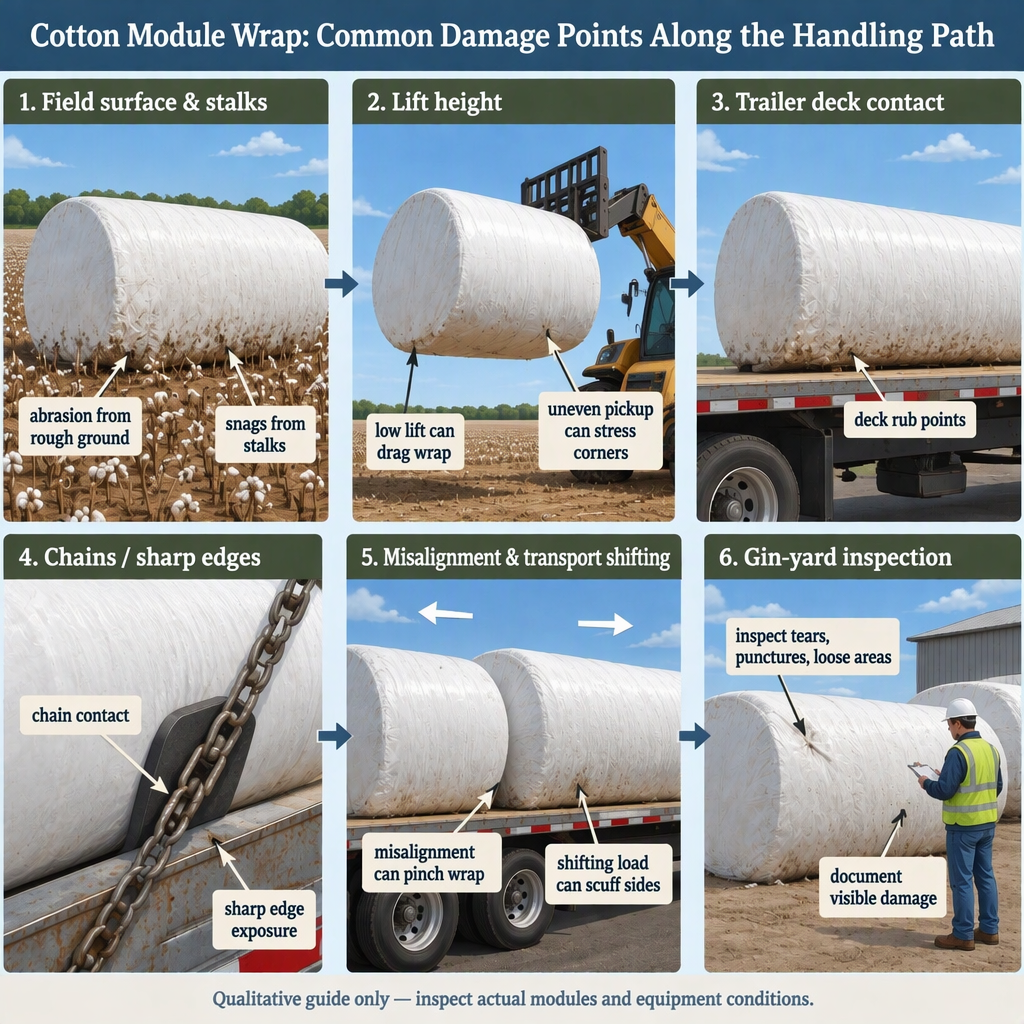
The goal is not simply to avoid visible tears. Scraped, stretched, or abraded wrap can create loose plastic fragments, so crews should manage every surface the module touches from field pickup to gin receiving.
| Damage point | Practical control |
|---|---|
| Standing stalks or crop residue under the module | Lift the module clear before travel; do not drag the wrapped surface across residue. |
| Trailer deck or truck-bed chains | Check contact surfaces before loading and keep the module aligned as it moves onto the bed. |
| Gin-yard removal and handling | Inspect the wrap condition and follow the gin’s removal procedure so damaged film does not become contamination. |
Before a wrapped module is touched, confirm that the pickup path, lifting approach, and staging area reduce contact with stalks, ruts, debris, and sharp edges.
Use a slow, aligned sequence: inspect, lift clear, carry without dragging, align with the trailer, set down without scraping, and recheck the film before transport.
Logistics engineers should treat the trailer or module truck as part of the packaging system because deck condition, chain contact, loading alignment, and shifting can damage the wrap.
| Transport variable | Question to ask | Buyer or operator action |
|---|---|---|
| Deck condition | Can the wrapped surface rub on rough, dirty, or sharp areas? | Clean and inspect contact areas before loading; repair unsafe equipment through approved maintenance channels. |
| Chains and restraints | Can chains contact or abrade the film? | Confirm the restraint method protects the wrap and complies with local load-securing rules. |
| Loading alignment | Will the module enter squarely? | Reposition before loading rather than correcting alignment by dragging the module. |
| Gin-yard handoff | Will the receiving crew know which modules have damaged wrap? | Mark and communicate damaged or suspect modules according to the gin’s receiving procedure. |
Do not improvise repairs to powered beds, chains, or loaders during loading. Stop the move, secure the equipment, isolate energy before any manual access, and use the equipment owner’s approved maintenance process.
When wrap is torn, stop treating the module as routine freight: inspect it, prevent loose film from spreading, record the location, and follow the gin or supplier procedure before transport or unloading.
Universal repair tape, patch geometry, and allowable transport condition should not be assumed. Use the wrap supplier’s instructions, the machine manual, and the gin’s current contamination-prevention procedure.
Before specifying cotton module wrap, ask the supplier for the product’s approval or testing basis, including third-party laboratory certificate-of-analysis information and how the product is represented against the round module wrap certification pathway referenced by the National Cotton Council.
The National Cotton Council page states that approved round module wrap products are supported by third-party laboratory certificates of analysis and references a Round Module Wrap for Seed Cotton certification and standard pathway for ASABE S615.3 compliance. Buyers should confirm the adopted edition and product status directly with the supplier and the relevant industry body before relying on approval claims.
A supplier’s cotton bale wrap category page can show that the supplier offers or discusses cotton wrap, but it is not the same as independent proof of approval-list status, certification, performance life, contamination prevention, or field outcome.
Use industry handling controls for lifting, loading, transport, and gin-yard inspection because these are the operational points where wrap damage can occur.
Treat a cotton bale wrap product category page, including SUZHOU ECOPACK CO.,LTD.’s cotton bale wrap page, as category information unless the buyer also receives current product specifications, test documents, and approval evidence for the exact item being ordered.
Do not generalize one film’s approval, test result, or machine compatibility to another wrap construction. Match the supplier document to the exact product, module system, and season plan.
A useful RFQ should combine handling conditions with product-verification documents so the buyer can compare wraps against real field, transport, and gin-yard risks.
The safest cotton wrap field handling plan is a joined-up plan: protect the film during every lift and contact point, then buy wrap only after confirming the exact product documents and receiving requirements.
These questions help cotton ginners, packaging buyers, and logistics engineers turn cotton wrap field handling into practical operating and purchasing decisions.
Common risks include stalk contact, dragging, rough trailer decks, chain contact, misaligned loading, shifting during transport, and poor wrap handling at the gin.
Dragging a wrapped module over stalks or residue can scrape or puncture the film, so operators should lift clear before travel.
No universal patch method should be assumed. Follow the wrap supplier’s instructions, equipment manual, and gin receiving procedure for the exact situation.
Check deck surfaces, chains, edges, alignment path, load restraint method, and any contact area that could abrade the film.
Ask whether the exact product appears on the relevant approved list, and request the current certificate-of-analysis and testing basis referenced for the product.
A supplier page can show product-category coverage, but buyers should request exact specifications, approval evidence, and handling instructions before specifying the wrap.
Damaged or mishandled wrap can create plastic-fragment risk, so inspection and controlled removal are part of contamination prevention.


