+86-189-1313-5729      gf@szecopack.com
You are here: Home » News » How to Check Cotton Module Wrap Compatibility Before Harvest

How to Check Cotton Module Wrap Compatibility Before Harvest

Views: 0     Author: Site Editor     Publish Time: 2026-11-20      Origin: Site

Inquire

facebook sharing button
twitter sharing button
line sharing button
wechat sharing button
linkedin sharing button
pinterest sharing button
whatsapp sharing button
sharethis sharing button
How to Check Cotton Module Wrap Compatibility Before Harvest

Before harvest, treat cotton module wrap compatibility as a documented acceptance check, not as a brand ranking: confirm approved-list or certificate-of-analysis evidence, supplier identifiers, applicable testing requirements, and the current purchasing specification. Then check the real handling path—field placement, lifting, loading, transport, gin-yard movement, feeder entry, and wrap removal—because plastic contamination risk can arise when wrap is damaged anywhere from harvest through gin handling.

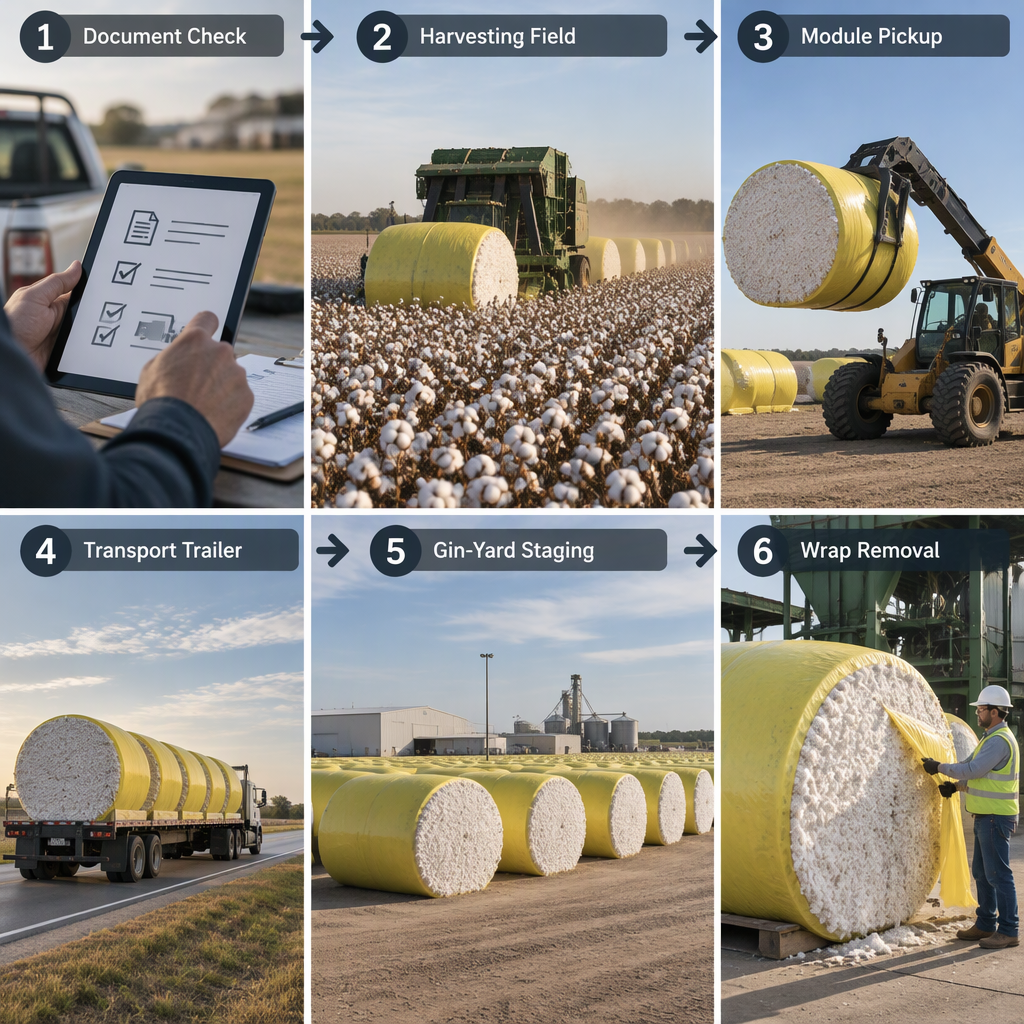
End-to-end cotton module wrap compatibility path from documents to field handling, transport, gin yard and wrap removal

What cotton module wrap compatibility means before harvest

Cotton module wrap compatibility starts with material proof and product identification. It is complete only when the wrap can move through field handling, transport, gin-yard staging, and removal without creating practical contamination exposure.

Document fit

For round module wrap, buyers should verify whether the product appears on the National Cotton Council approved-products list or whether the supplier can provide a certificate of analysis from a third-party certified laboratory route described by that program.

Workflow fit

A compatible choice must also survive the operating interfaces where wrap damage is commonly discussed: field conditions, stalk contact, loading alignment, trailer or chain contact, module condition, gin feeder handling, and wrap removal.

For a gin, packaging buyer, or logistics engineer, the practical question is not “Which wrap brand is most popular?” It is “Which wrap, documentation package, equipment settings, utility and service-interface checks, route, and responsibility map can be accepted before modules start moving?”

Check approved-list and COA evidence before comparing products

Begin by matching the proposed round module wrap to recognized product identifiers and laboratory-backed documentation before you compare price, supply, or purchasing convenience.

The National Cotton Council’s Approved Round Module Wrap Products page describes an approved-list process in which providers may submit a certificate of analysis from third-party certified laboratories, and the listed product fields include supplier, manufacturer, identifier, type, and RFID General Manager Number.

  • Match the supplier name, manufacturer name, product identifier, wrap type, and any RFID General Manager Number exactly against the document set you receive.
  • If the product is being evaluated through a certificate-of-analysis route, ask who performed the testing and whether the laboratory and sample preparation route meet the buyer’s required program.
  • Do not assume that a similar film, a related product family, or a supplier’s separate industrial packaging line has the same round-module acceptance status.
  • Keep the approved-list or COA record attached to the purchase order so receiving, field operations, and the gin do not rely on a sales name alone.

Control standards, edition status, and supplier documents

Use standards references as purchasing controls, but require the supplier and buyer team to confirm the currently applicable edition and acceptance requirement before harvest.

Document to request What it should settle Buyer action before harvest
Approved-list entry or COA package Whether the proposed round module wrap is tied to recognized product identity and laboratory-backed evidence. Attach the record to the purchasing file and receiving checklist.
Applicable standard or certification reference Which testing and performance requirement the buyer is relying on for acceptance. Confirm edition, scope, and acceptance route with the supplier before issuing the harvest-season order.
OEM harvester and gin equipment guidance Whether the wrap, module diameter, handling method, and removal process fit the machines actually used. Check the current OEM manual or dealer bulletin for each machine rather than relying on generic wrap claims.

Map the field, transport, and gin interfaces that can damage wrap

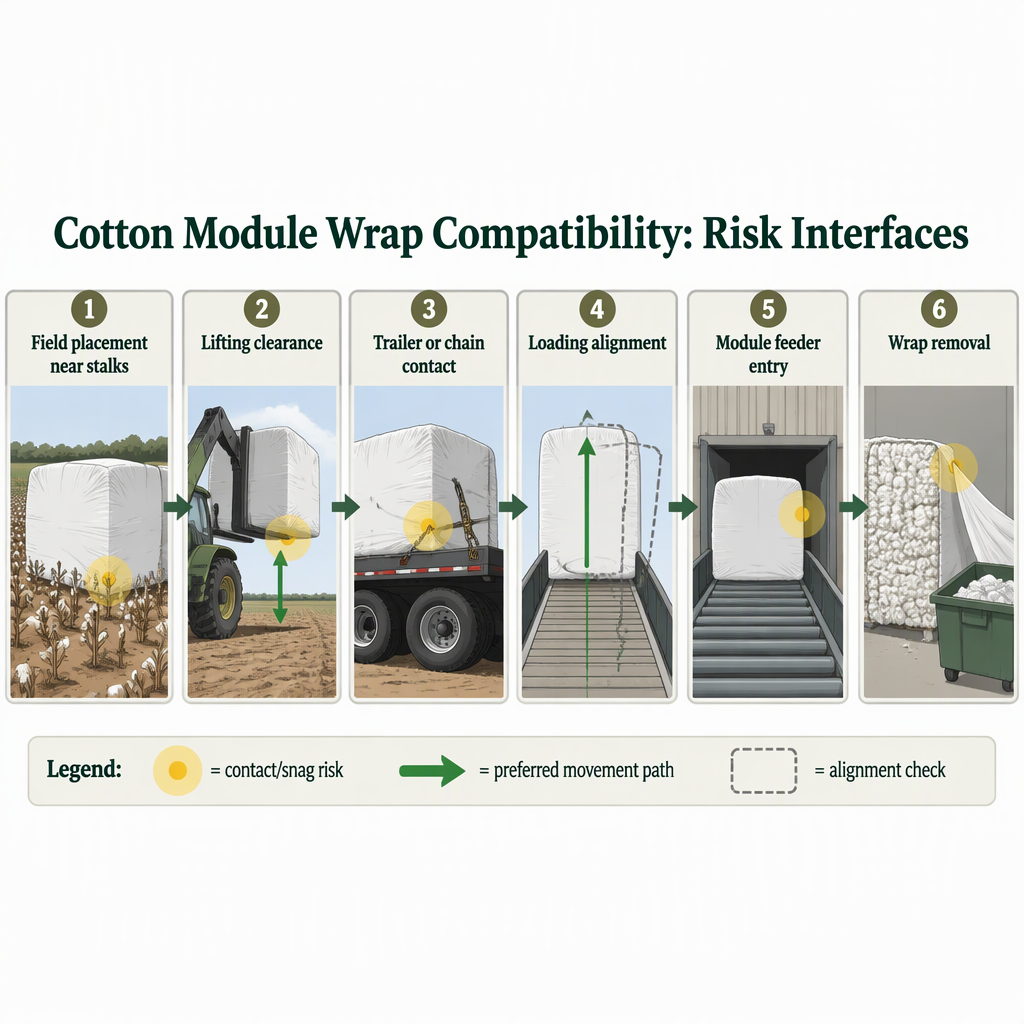
Compatibility must be mapped across the complete module journey because USDA ARS describes plastic contamination as a major U.S. cotton-industry threat and identifies damage-risk points from harvest through transport and gin handling.

Decision-flow illustration of cotton module wrap damage-risk interfaces from field placement to wrap removal
Interface Compatibility question Pre-harvest control
Field placement and stalk contact Could the module be dropped on stalks or moved without enough clearance over stalks? Review field practices and lifting clearance expectations with the grower and harvesting crew.
Trailer, deck, chain, and loading contact Could transport hardware, chains, trailer surfaces, or misaligned loading damage the wrap? Inspect the route and loading surfaces before modules move at volume.
Broken or small-diameter modules Could module condition or diameter create extra handling exposure? Define how exceptions are tagged, handled, and reported to the gin.
Gin feeder and wrap removal Could feeder handling or removal practice leave wrap fragments in the cotton stream? Validate removal practice and stopping rules with the gin operations team.

Run a pre-harvest compatibility workflow

A practical pre-harvest check should move from document control to product identity. It should then test the handling path where wrap damage and contamination risk can occur.

  1. Freeze the document set. Collect the approved-list entry or COA route, product identifier, supplier/manufacturer identity, and any RFID-related identifier before purchase approval.
  2. Match documents to delivered rolls. Receiving should compare labels, identifiers, and purchase records before rolls are released to field use.
  3. Walk the route. Check field exit, module pickup, trailer loading, chain or deck contact, truck movement, gin-yard staging, feeder entry, and wrap removal as one connected path.
  4. Set exception rules. Define how crews respond to damaged wrap, broken modules, small-diameter modules, misaligned loading, or suspected wrap fragments.
  5. Record the trial decision. Decide who can accept the wrap for harvest volume and what evidence is needed if a module is rejected or held.
  • Use the same product name and identifier in procurement, receiving, field instructions, and gin-yard logs.
  • Require route changes or handling changes to be communicated before modules arrive at the gin.
  • Keep a simple photo or inspection record for damaged wrap events so supplier, grower, hauler, and gin discussions use the same facts.

Set responsibility boundaries before modules start moving

Because wrap damage risk can appear at several handoff points, the buyer should assign ownership for each check before the first production modules move.

Boundary Primary owner Compatibility decision
Wrap identity and documentation Procurement with supplier support Confirm approved-list or COA evidence, product identifier, and acceptance requirement before ordering.
Field placement and pickup Grower or harvest operator Prevent avoidable wrap contact with stalks and flag damaged modules before transport.
Loading and transport Hauler or logistics coordinator Check trailer, chain, deck, and loading alignment conditions that may damage wrap.
Gin-yard staging and removal Gin operations Control feeder entry, wrap removal, exception handling, and fragment-response rules.

Validate the line before harvest volume peaks

Line validation should confirm that real modules can be received, staged, fed, and unwrapped without turning known damage points into contamination events.

  1. Run the validation with representative module conditions, including the handling situations most likely to expose wrap damage: loading contact, module condition problems, feeder entry, and removal.
  2. Before validation, confirm applicable power, stored-energy, compressed-air, hydraulic, and site-service interfaces in the current OEM manual, site procedure, or supplier documentation where relevant. Before anyone reaches into, cleans, clears, or inspects powered feeder, conveyor, chain, or wrap-removal areas by hand, switch off and disconnect or lock out the relevant power source, then follow only the access steps permitted by the current equipment manual.
  3. Observe whether the module arrives with wrap cuts, tears, trapped pieces, or handling damage that could move toward the cotton stream.
  4. Record where any damage appears: field, loading, trailer or truck chain contact, gin-yard movement, feeder entry, or removal.
  5. Approve harvest-volume use only after procurement, logistics, and gin operations agree on stop points and exception handling.

Use a procurement checklist for cotton module wrap compatibility

A purchase order should require clear product identity and acceptance evidence. It should also require the operational information needed to prevent wrap damage across the module route.

  • Ask for the supplier, manufacturer, product identifier, wrap type, and any RFID General Manager Number relevant to the proposed round module wrap.
  • Ask whether acceptance is based on an approved-list entry, COA from a third-party certified laboratory, or another buyer-approved route.
  • Ask which ASABE S615.3 edition or purchasing requirement is being used and require the supplier to state the scope in writing.
  • Ask how the supplier recommends preventing damage during field pickup, loading, chain or deck contact, trailer movement, and gin-yard handling.
  • Ask how damaged modules, broken modules, small-diameter modules, or suspected wrap fragments should be isolated and reported.
  • Keep commercial comparisons separate from acceptance evidence; price and availability matter only after the wrap has passed the compatibility gate.

Conclusion

Select cotton module wrap only after the product identity and documentation route are clear. Accept it for harvest only after the field-to-gin handling path has been checked for damage and contamination exposure.

  • Use approved-list or COA evidence to control product identity and acceptance.
  • Map every handoff from field placement to wrap removal, not just the roll specification.
  • Assign responsibility before harvest so exceptions are handled quickly when modules are moving at volume.

FAQs about cotton module wrap compatibility

These questions help procurement, gin operations, and logistics teams turn compatibility into a pre-harvest acceptance process.

Are the top cotton wrap brands in the USA ranked here?

No. This guide focuses on cotton module wrap compatibility checks rather than commercial brand rankings, because buyers need product identity, documentation, handling fit, and contamination-control responsibilities before harvest.

Is an approved-list entry enough by itself?

An approved-list entry helps confirm recognized product identity and program evidence, but buyers still need to match the delivered product and documents to the exact harvest workflow.

What if a supplier provides a COA instead of a list entry?

The National Cotton Council page describes a certificate-of-analysis route from third-party certified laboratories, so the buyer should check laboratory identity, sample preparation route, product identifier, and the purchasing requirement being claimed.

Why does transport matter if the wrap passed a material check?

USDA ARS identifies transport and handling damage points, including trailer and chain damage and misaligned loading, as part of the contamination-risk pathway.

Should compatibility be checked separately for each harvester or gin line?

Yes. Use the current OEM manual, dealer guidance, and site operating procedure for each machine and line, because a generic material claim does not settle every pickup, feeding, and removal condition.

Who should approve the final pre-harvest decision?

The decision should include procurement for documents, field or harvest leadership for module formation and pickup, logistics for transport interfaces, and gin operations for feeder and wrap-removal acceptance.

What is the fastest red flag before purchase?

A red flag is a proposal that cannot tie the offered wrap to a specific supplier, manufacturer, product identifier, approved-list entry, COA route, or defined acceptance requirement.

ECOPACK, established in 2000, is a leading manufacturer of industrial packaging materials in China.
  +86 18913135729
 +86-18913135729
 Building 1,Wanhui Plaza ,Suzhou City, China 215131

Quick Links

Product Category

Contact Us
 Copyright © 2023 Suzhou Ecopack Co.,Ltd. All Rights Reserved. Sitemap | Supported by leadong.com | Privacy Policy