


Plastic in or beside lint from wrapped modules is rarely a one-cause problem. The industry position is zero tolerance for contamination in seed cotton and lint, and the practical response is a chain of controls: screen the wrap before handling, remove and contain the film in a fixed sequence, investigate any finding in a fixed order, and re-test against the measurement your buyer uses. The answer usually sits in handling practice and traceability, not in a single wrap product.
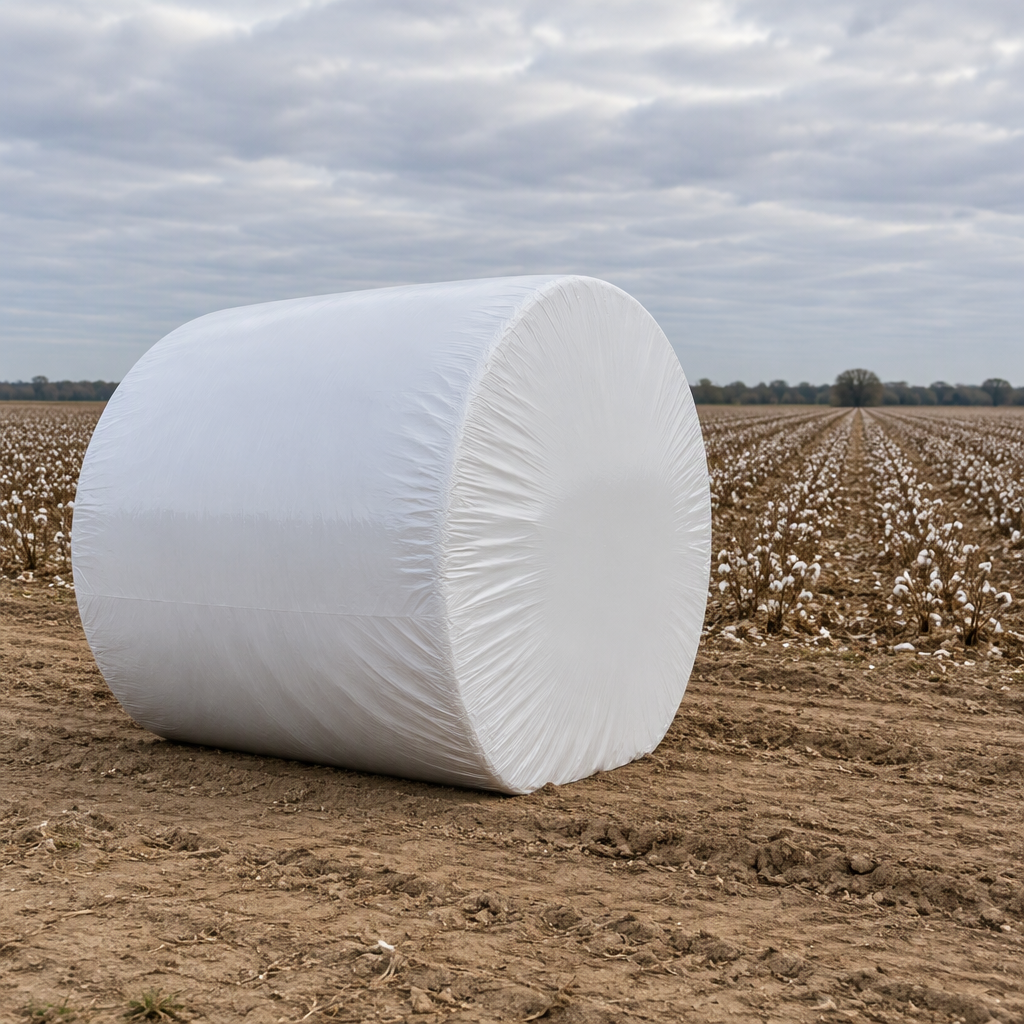
How does plastic contamination from wrapped modules actually reach the bale?
Film reaches lint at a small number of recurring points around a wrapped module: where the wrap is cut, where the cover is left partly attached, where removed film is staged within reach of seed cotton, and where the module meets handling equipment. The National Cotton Council treats seed cotton and lint contamination as a zero-tolerance issue and publishes round module wrap and wrap-removal resources for that reason. Where a fragment appears tells you which point to inspect first, so locate the finding before naming a cause.
| What you observe | Entry point to check first | What to check there |
|---|---|---|
| Loose film fragments on or beside a staged module | Wrap removal and staging | Where the removed wrap was placed, and whether the pad and module top were cleared |
| Fragments with seed cotton at the feeder | Module-to-feeder handoff | Whether the whole cover was removed and accounted for before the module was fed |
| Fragments in ginned lint or a classing sample | Downstream handling and bale packaging | Feeder and conveying surfaces, and the packaging materials used on that bale |
| Repeated findings tied to one field, crew or wrap delivery | Removal practice or that delivery | The removal method, wrap product and delivery lot recorded against those modules |
| Film slivers on the module surface after the cover comes off | Storage and transport | Cover damage, pad cleanliness and how the module was loaded and unloaded |
A fragment is a finding, not a verdict. Treat an unexplained fragment as an open investigation until you can name the stage it passed through without being contained, and keep the sample and photographs with the lot record.
Which module wrap and wrap conditions are acceptable before handling begins?
Two checks come before handling: the wrap on the module should be a round module wrap published in accordance with the ASABE Cotton Module Cover Material Performance standard (S615.3), and the cover should be intact and fully accounted for. The National Cotton Council maintains the industry listing of round module wrap products published to that standard, so the listing, not a supplier's own marketing, is where that check starts.
- Check the wrap product against the current industry listing of round module cover materials before it is ordered or accepted.
- Ask the supplier for the exact standard designation and edition claimed, then confirm that edition's status with the standard's publisher.
- Quarantine a delivery whose film is split, spliced or wound unevenly enough to tear during removal.
- Confirm the cover is intact before transport, with no loose film or tie scraps on or beside the module.
- Record the wrap product, delivery lot and supplier against the module lot at the point of wrapping.
You can check the listing and the handling resources directly: the National Cotton Council's Contamination Free Cotton page collects the round module wrap listing, wrap-removal and handling guidance, the module identification standard and the route for submitting contamination issue reports.
What handling sequence reduces the chance of wrap fragments entering seed cotton?
Plan where the film will go before anyone cuts it, remove the wrap in a defined order, contain it immediately, inspect the exposed module surface, and record the result. The industry body publishes an evaluation of manual and semi-automated round module unwrapping practices together with a wrap-removal poster, so a crew can work from a documented sequence rather than individual habit.
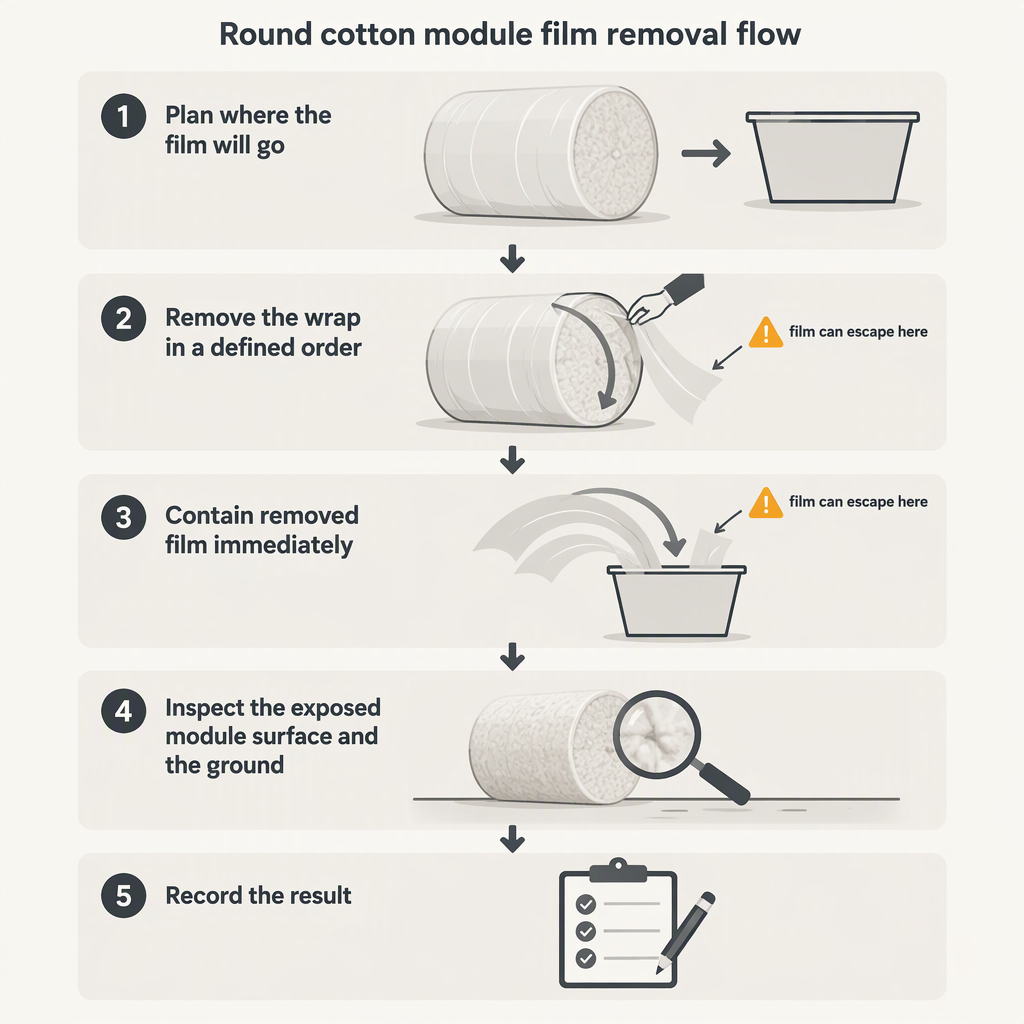
- Clear the pad and staging area first: no film, ties or debris under or around the module before it is opened.
- Split the roles where crew size allows, so the person cutting the cover is not also handling loose film.
- Take the cover off in the order your wrap-removal guidance specifies for that module type, keeping the film in as few pieces as possible and away from the module opening.
- Contain removed film immediately in a closed bag or bin, never on the ground and never on the module.
- Inspect the exposed module surface and the ground beneath it for slivers and fragments before the module is fed.
- Record the wrap product, module identification and the inspection result against the lot.
Two stop points matter more than speed. If removed film cannot be fully accounted for, stop and find the missing piece before that module is fed. If film has to be cleared from a module feeder, unwrapper, stripper or conveyor, shut the machine down and disconnect or isolate its power source before anyone reaches into it, and follow the manufacturer's manual for permitted access instead of improvising a removal method.
In what order should a gin investigate a contamination finding?
Identify what the material is, trace the lot that produced it, then work through the stages that lot passed — removal, containment, storage, transport and downstream handling — before comparing wrap products or suppliers. The industry quality-preservation programme records that USDA classing added extraneous matter codes for samples containing plastic contaminants from 1 July 2018, which is why a finding that reaches a sample is a quality event rather than a housekeeping detail.
- Identify the material: film, strapping, bagging or twine. Keep the sample and photograph it as found.
- Trace the lot: module identification, field, wrap date, crew, wrap product and delivery lot.
- Review removal and containment for that module against the documented sequence.
- Review storage and transport: cover condition, pad cleanliness and how the module was loaded.
- Review downstream stages: feeder, conveying surfaces and the bale packaging used on that bale.
- Only then compare wrap products and suppliers between affected and unaffected lots, changing one variable at a time.
Resist closing on a single cause. A wrap that meets the standard can still be mis-removed, and a correct removal sequence cannot contain film that was already left in the field. If findings continue after a change, record which variables moved so the next comparison still means something, and escalate to the buyer's quality contact before more of the affected lot ships.
How do you verify that a corrective action actually worked?
Decide the measurement and the acceptance level before you change anything, then repeat that same measurement across the affected lots and a comparison group. If your buyer's acceptance depends on classing data, the instrument-based trash-content verification in the USDA cotton classification system is the result to watch, because it is the result your customer sees.
- Write down the measurement, the inspection point and the acceptance level before the change, and keep them fixed.
- Keep the same inspection stage and, where possible, the same people doing the check.
- Run affected and unaffected lots through the same measurement, so a clean result can be compared with something.
- Change one variable at a time and record it against the lot rather than against the season.
- Repeat across several lots before declaring the finding closed.
- Keep samples, photographs and records with the lot, so a buyer or classing office can review the same evidence.
The measurement side is public: USDA Agricultural Marketing Service publishes the Universal Cotton Standards, including calibration cottons and verification standards for instrument color and trash content used in cotton classification.
Which storage and transport conditions belong in the prevention plan?
Cover the module, compact it properly, keep it on an even clean pad and account for every removed piece of wrap and tie before it leaves the field. Under Australian Chain of Responsibility provisions, growers are expected to ensure cotton modules are adequately compacted, not overweight, properly covered in tarpaulins or wrapped, and aligned on even pads so they can be loaded and transported safely. Those expectations come from Australian road-transport rules, so check the equivalent rules for the jurisdiction you operate in.
- Cover or wrap the module fully before it leaves the pad.
- Keep the pad and loading area clear of film, ties and offcuts.
- Account for every removed piece of wrap and tie before the module moves.
- Never store loose film on the module top or in the loader cab.
- Check the cover after loading and unloading for tears or drag marks, and inspect the module on arrival if it was damaged.
If your operation moves modules under a similar chain-of-responsibility framework, Cotton Australia's transport guidance shows how one cotton industry body states those covering, compaction and pad-alignment expectations in practice.
What should packaging buyers specify when sourcing module wrap?
Specify the performance standard and the exact edition you are buying against, require the supplier to state whether the product holds a place on the current industry listing of round module cover materials, and add the handling attributes your own line needs: film that comes off in large panels, survives your storage and transport route, and behaves consistently from roll to roll.
- The standard designation and edition claimed, and the publisher's status for that edition.
- Whether the product appears on the current industry listing of round module wrap products.
- How the film behaves on removal: large panels, or fragments that are hard to contain.
- The storage and transport conditions the wrap must survive between wrapping and ginning.
- How the supplier documents lot-to-lot consistency, and what they will not warrant.
- Traceability from a delivered roll back to its production lot, so a finding can be tied to a delivery.
Module wrap is only one packaging material in the chain. The Joint Cotton Industry Bale Packaging Committee's Specifications for Cotton Bale Packaging Materials and the related mill-side bale-opening guidance cover ginned bale bagging and ties, and the committee has set woven polypropylene bagging as loan eligible only through 2031, with wire ties restricted to export after that crop year. If your mill or buyer attaches conditions to those rules, check them separately from the module wrap specification.
A supplier's own description is the start of the conversation, not the end of it. ECOPACK describes its cotton bale wrap film as a five-layer co-extruded polyethylene film for cotton harvesting, bale storage and transportation, positioned to protect cotton from moisture, dust and contamination. Ask any supplier, including ECOPACK, to put the standard, edition, listing status and lot documentation behind a claim like that in writing, and treat a description you cannot document as an open question rather than a specification.
What is the defensible conclusion for reducing plastic contamination?
Reduce plastic contamination by controlling the whole chain: buy against a stated standard, remove and contain the film in a fixed sequence, investigate a finding in a fixed order, and verify against the measurement your buyer uses. No single wrap product and no single procedure closes the problem on its own.
The work worth doing is unglamorous: clear pads, contained film, crews who know the removal order, lot records that survive the season, and a re-test defined before anything changed. Zero tolerance is a standard for the result, not a slogan for the plan.
Frequently asked questions
The industry body publishes wrap handling guidance, an RFID module identification standard and a route for submitting contamination reports. The answers below point to what you can check or use directly when you are tracing a finding, verifying a fix or reporting a problem.
Is switching to a different wrap enough on its own to stop plastic contamination?
No. A wrap that meets the cover-material standard addresses one link in the chain: film still has to be removed in a controlled order, contained immediately and accounted for, and the stages after the gin, bale packaging and mill-side bale opening, carry their own contamination risk. Treat a wrap change as one control among several and verify it with the measurement you used before the change.
Which USDA classing codes apply to samples containing plastic?
USDA's cotton classing programme added two extraneous matter codes for samples containing plastic contaminants, effective 1 July 2018, as reported on the National Cotton Council's quality-preservation page. Ask your buyer or classing office which of those codes will appear on your lots, what level triggers a claim, and get that in writing before the season starts.
How are modules identified so that a contamination problem can be traced back?
Round module identification is standardised: the industry body references an updated RFID module identification standard, S647.1, JAN2025 edition, for identifying modules through the gin. Pair whatever identification your operation uses with a simple lot record — wrap product, delivery lot, field and date — so a finding can be traced to a module and a delivery rather than to a whole season. If identification data has to stand up in a commercial claim, confirm the current edition with the standards publisher.
Where should a contamination event be reported?
The National Cotton Council provides a channel for submitting contamination issue reports, which is where a finding that may affect other handlers belongs, such as a wrap product that fails repeatedly. Report it locally as well: record it against the lot, keep the sample, and tell your buyer's quality contact before the affected lint moves.
Do semi-automated unwrapping systems remove the contamination risk?
They change where film is handled rather than removing the need to control it. The industry body publishes an evaluation of both manual and semi-automated round module unwrapping practices, and the containment and inspection steps — where the film goes, and whether the module surface and ground are clear before feeding — stay with the crew however the cover comes off.
What should happen to removed wrap and ties?
Contain them immediately and take them off the pad: a closed bag, bin or designated storage point away from seed cotton. Loose film on the ground, on the module top or in a loader cab is one of the shortest routes from a removal task to a contamination finding. Count the pieces removed against the pieces recovered before the module is fed.
Is one clean lot enough to prove the problem is fixed?
No. A single clean lot can reflect a different field, a different crew or a different wrap delivery. Repeat the same measurement across several affected lots and compare it with lots handled the same way, and keep the records together so the comparison can be reviewed later by a buyer or a classing office.


