


Start with the bale packaging specification baseline
Before comparing film options, identify the bale-packaging rules or buyer requirements that apply to the cotton, crop year, bale type, and destination market.
For U.S. cotton bale packaging context, the National Cotton Council 2026 specifications for cotton bale packaging materials describe JCIBPC-approved guidance for the 2026-2027 crop year and present those specifications as manufacturing and use guidelines for cotton bale packaging materials.
Treat that baseline as a starting point, not a universal global rule. Cotton buyers, gins, merchants, destination ports, and regional programs may require different packaging documents, so procurement should name the applicable crop year, bale format, and destination requirements in the RFQ.
For a purchasing team, this step prevents a common mistake: asking suppliers for a generic “strong film” when the real requirement is a wrap structure that can satisfy a defined bale-packaging context and survive the handling route used by that operation.
Map film choice to contamination risk, not only weather protection
A cotton bale wrap film specification should address contamination prevention as clearly as it addresses outdoor protection, because plastic contamination can affect the value and usability of cotton.
The National Cotton Council’s Contamination Free Cotton resource urges producers, ginners, and cotton industry members to prioritize contamination prevention and discusses round module wrap standards as part of that effort.
- Ask whether the wrap system is intended for seed-cotton modules, lint bales, or another bale-packaging use; standards and risk points can differ by application.
- Specify handling conditions that may tear, scuff, puncture, or leave fragments, because USDA ARS identifies wrap damage across field, transport, loading, and gin-handling stages.
- When a program requires approved wrap products, ask the supplier for current proof that matches the exact product, construction, size, and market you plan to buy.
Weather protection still matters, but it is not enough. A wrap that looks acceptable during storage can still create downstream problems if it is difficult to remove cleanly, sheds fragments, or is not suitable for the handling equipment and removal process used at the gin.
Follow the bale from harvest to gin before setting requirements
The practical wrap requirement is set by the full route from harvester wrapping through field storage, loading, transport, unloading, and gin-feeder removal—not by storage conditions alone.
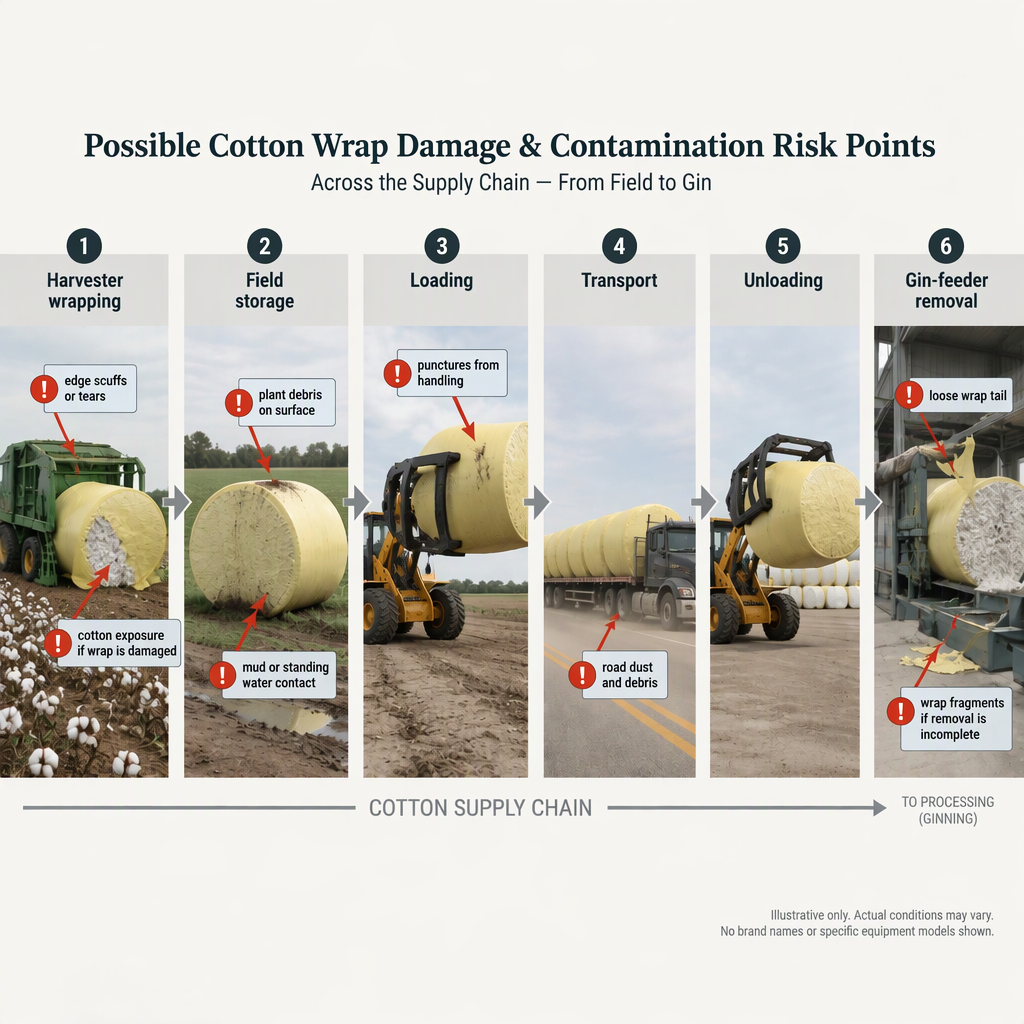
- Harvest and wrapping: define how the module or bale is formed and wrapped, because damage can begin during the wrapping stage.
- Field storage: review exposure, ground contact, module movement, and how operators identify wrap damage before pickup.
- Loading and transport: include forks, spears, chains, trailers, trucks, and repeated handling points in the requirement discussion.
- Gin receiving and removal: check how the wrap is cut, removed, and separated from cotton before it can become a contamination source.
USDA ARS describes plastic contamination in cotton bales as a significant threat and identifies wrap damage risks from harvester wrapping through gin removal, including field, transport, trailer, truck-chain, loading, and gin-feeder handling problems.
For logistics engineers, the useful output is a handling map. Mark each contact point, pulling point, cut point, and transfer point. Then ask suppliers to explain how the proposed cotton bale wrap film is tested for the stresses that matter in that route.
Compare material and structure against real operating conditions
Material and structure should be compared against the packaging specification baseline, contamination-control needs, and handling damage points rather than against marketing claims alone.
| Operating condition | Selection question | Proof to request |
|---|---|---|
| Frequent field movement, loading, or chain contact | Can the film resist damage at the handling points in your route? | Sample-test results and handling-trial notes that match your route. |
| Strict contamination-control program | Does the wrap remove cleanly and reduce fragment risk for the intended application? | Current approval or compliance documents where required by the buyer or program. |
| Crop-year or bale-packaging specification applies | Does the construction match the named specification scope and bale type? | Product datasheet, specification cross-reference, and batch certificate for the exact film supplied. |
| Comparison dimension | What to evaluate | Buyer caution |
|---|---|---|
| Film construction | Layer design, resin system, reinforcement approach, seal or overlap behavior, and removal behavior. | Do not accept a layer count or structure label without a product-specific datasheet. |
| Mechanical durability | Tear, puncture, abrasion, and handling damage resistance under the route you use. | Lab values should be connected to field handling, not reviewed as isolated numbers. |
| Compatibility | Fit with bale type, module size, picker or wrapper system, storage practice, and gin removal method. | Ask for exact model or application scope; avoid broad compatibility claims. |
| Batch consistency | Thickness, width, roll weight, winding quality, labeling, and traceability from lot to lot. | Approve the batch-control process before approving large-volume supply. |
Require sample testing and batch consistency evidence
Sample approval should be tied to the applicable packaging guideline, contamination-control requirement, and your own handling route.
- Request product-specific samples from the same construction, width, thickness, and roll format proposed for purchase.
- Ask for a datasheet that identifies the exact cotton bale wrap film grade, not only a product-family brochure.
- Ask how the supplier aligns the film with the applicable bale-packaging specification or buyer packaging rule.
- For applications governed by contamination programs or approved-wrap rules, request current proof that names the exact product and scope.
- Run handling trials through your most demanding contact points: wrapping, pickup, trailer loading, transport restraint, unloading, staging, cutting, and removal.
- Record roll label, batch number, roll dimensions, appearance, winding quality, and any damage observed during the trial.
- Define acceptance criteria before testing, including what counts as tearing, puncture, fragmenting, poor removal, or unacceptable roll variation.
Because the National Cotton Council discusses ASABE S615.3 as including testing requirements and performance specifications for round module wrap, buyers should ask suppliers for the current official standard documents or program approvals that apply to the specific round-module-wrap use case.
For procurement teams, the important discipline is consistency. A perfect sample is not enough if later batches vary in construction, dimensions, winding quality, or labeling. Make the lot traceability and change-notification process part of the approval.
Build an RFQ that suppliers can answer with evidence
A strong RFQ turns harvest and handling conditions into verifiable requirements, so suppliers can respond with product-specific documents rather than broad claims.
- Name the applicable bale-packaging specification, crop year, buyer program, bale format, and destination market.
- State contamination-control requirements, including any approved-wrap or removal-cleanliness expectations.
- Describe the full handling route: wrapping, field storage, loading equipment, transport method, trailer or truck restraints, unloading, and gin-removal process.
- List required film dimensions, roll format, packaging, labeling, and traceability information.
- Request a product datasheet, test report, compliance statement where applicable, and batch certificate for each shipment.
- Ask whether any formulation, layer structure, resin system, dimensions, or roll-winding process can change without written notice.
- Define sample quantity, trial method, acceptance criteria, and how nonconforming rolls or batches will be handled.
- Require supplier responses to separate confirmed specifications from optional recommendations.
Use the completed RFQ as the comparison basis: require each supplier to answer the same requirement lines, attach product-specific documents, and identify any assumptions separately from confirmed specifications.
Conclusion: choose for the full harvest and handling process
The best cotton bale wrap film choice starts with the packaging baseline, continues with contamination-control requirements, and is confirmed through sample testing across the real handling route.
Do not buy on a single claim such as “strong,” “UV resistant,” or “compatible.” Buy on documented application scope, sample results, batch control, and the supplier’s ability to answer the same technical questions for every shipment.
FAQs about cotton bale wrap film selection
These questions help buyers turn the selection process into practical procurement checks.
Should buyers only use approved wrap products?
If a buyer program, gin, merchant, or destination market requires approved wrap, use only products that have current approval for the exact application and product scope. Ask the supplier for the current document rather than relying on a general brochure.
Can good handling compensate for weak or damaged wrap?
Good handling reduces risk, but it does not replace suitable wrap selection. USDA ARS identifies damage risks across multiple handling stages, so buyers should specify both a suitable film and a disciplined handling process.
Do U.S. cotton bale specifications apply globally?
U.S. cotton bale packaging specifications are a useful reference for U.S. cotton and the stated crop-year scope, but global buyers should confirm local gin, merchant, buyer, port, and destination-market requirements before purchasing.
What is the first document to ask a supplier for?
Ask for the product-specific datasheet for the exact cotton bale wrap film being quoted, followed by test reports, application scope, batch traceability, and any required approval documents.
How should a buyer compare two similar film offers?
Compare the offers by application scope, sample performance in your route, batch-control evidence, roll format, traceability, and supplier response quality. Avoid choosing solely by thickness, layer count, or unit price.
What should logistics engineers contribute to the specification?
Logistics engineers should map the bale’s contact points, restraints, loading method, transfer points, and removal process, because wrap damage can occur during transport, loading, and gin-feeder handling.
When should a sample trial be repeated?
Repeat the trial when the bale type, film construction, roll dimensions, harvest equipment, handling equipment, transport route, storage practice, or gin-removal method changes.


