


Treat every tear in a cotton module wrap as a contamination and moisture event rather than a cosmetic one. Inspect each module the same way before it leaves the field, read the damage pattern, patch only damage that can be closed cleanly and completely, re-wrap when seed cotton is exposed or the film no longer covers it, and tell the gin what you found, what you applied and when.
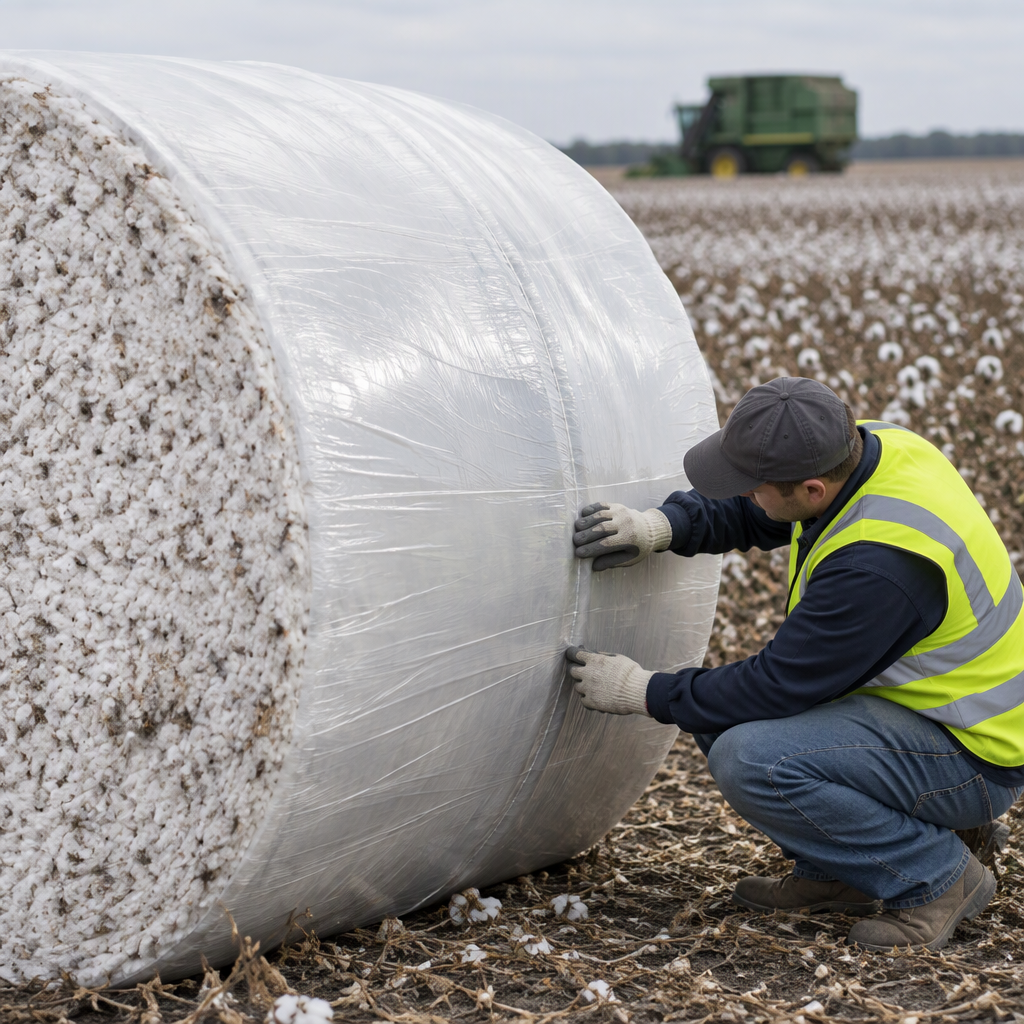
Why Wrap Damage in the Field Matters More Than It Looks
A damaged wrap matters because the film is the only barrier between seed cotton and the ground, the weather and the handling equipment. The National Cotton Council describes lint contamination as a serious threat to U.S. cotton, for the raw-cotton sector as much as for the textile industry that buys it, and its prevention work is built around keeping foreign material, including plastic fragments, out of the fibre.
The council's quality-preservation guidance also records that USDA's Agricultural Marketing Service introduced two extraneous-matter codes for cotton samples containing plastic contaminants from 1 July 2018, and that wet weather negatively affects both lint colour and seed quality.
How to Inspect Module Wrap in the Field: A Repeatable Sequence
Inspect the wrap three times in a module's field life: as it leaves the builder, again at the field edge before it is moved, and once more in the staging row before it goes to the gin. Walk the same route each time — the full circumference, both ends, the overlap seam, the top where water collects and the bottom where the film meets soil — so damage is never missed simply because nobody looked at that side.
- Shut down and isolate before you touch film near the module builder. If film is caught in the builder or any powered equipment, switch the machine off and disconnect its power source or battery before any manual access, then use only the access the model manual allows.
- Walk the full circumference in gloves, looking along the film at an angle so splits and abrasion stand out.
- Check the four high-risk zones in the same order: both ends where the film overlaps, the overlap seam, the top where rain pools, and the ground-contact area underneath.
- Press gently across suspicious areas to feel for thinning. Do not pull a loose edge to find where a tear ends; a lifted edge usually runs further once it is pulled.
- Mark the spot — a flag beside the module or a mark on the film — so the next person finds the same damage without re-walking the whole module.
- Decide on the spot and write it down: module identifier, damage, action taken and who did it.
Reading the Damage: Symptom, Likely Cause and First Action
Field damage follows a few recognisable patterns, and the pattern usually points to both the cause and the first action. Read the damage before you reach for patch material: a clean slit in a tight panel, a lifted overlap, film pulled back from an end, widespread pin-holing and a wet module call for different responses.
| What you see | What it usually means | First action |
|---|---|---|
| Short clean slit or puncture, edges flat, film still tight | Handling contact — loader arm, bucket or stubble — on a sound wrap | Patch if the slit is small and sits on a sound panel, then record it |
| Overlap seam lifted, or an end flap moving in the wind | Seal or tension failed during wrapping, or the film was disturbed after ejection | Close the overlap so no loose edge remains; re-wrap if it will not lie flat |
| Film pulled back from one end, seed cotton visible | End coverage lost; that face is open to rain, soil and handling | Re-wrap the module and flag it for the gin |
| Pin-holes or abrasion over a wide area, film thin | Ground contact, stubble, or repeated contact with the builder and loader | Re-wrap; patches will not restore coverage over a large area |
| Water pooled on top, film wet, module sagging | Moisture has entered the module | Flag and notify the gin; a patch will not dry the cotton inside |
| Film fragments missing, shreds on the ground or in the module | Plastic has already broken away from the wrap | Collect every fragment you can, flag the module and notify the gin |
Patch, Re-Wrap or Flag It: Choosing the Repair Response
Three questions settle the decision: how much of the film is affected, whether seed cotton is exposed, and whether the cotton inside has already been wetted. Patch when the damage is small, sits on a sound panel, and the surrounding film can be closed so no loose edge remains. Re-wrap when coverage is lost at an end or over a large area, or when the film no longer holds tension. Flag and notify the gin when seed cotton is exposed, water has entered the module, or fragments are missing, because a repair cannot undo any of those.
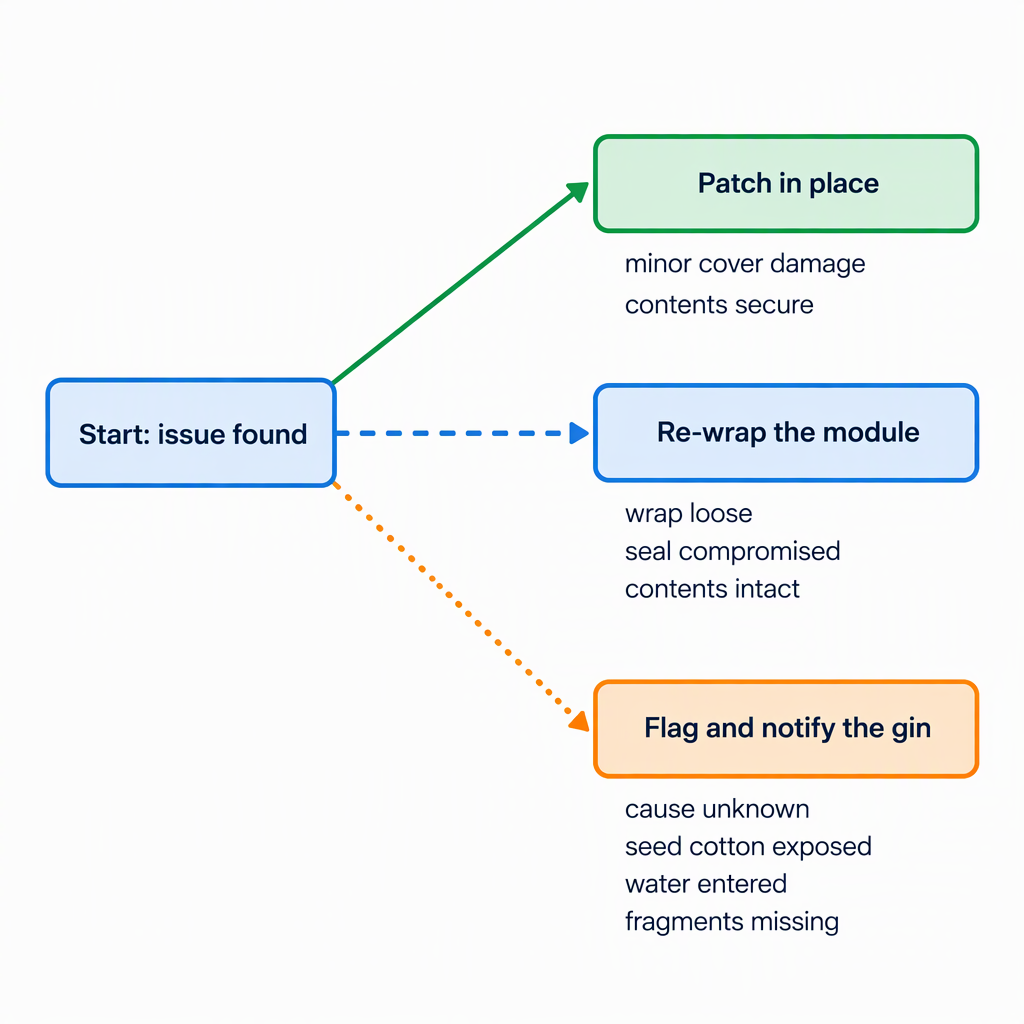
| Response | Applies when | What it protects | Main limits |
|---|---|---|---|
| Patch in place | A small tear or puncture on a sound panel, with edges that can be closed | Keeps soil, rain and handling contact away from an otherwise intact wrap | Does not restore lost end coverage, does not remove fragments already inside, and the patch material has to be removable at the gin |
| Re-wrap the module | Coverage lost at an end or over a wide area; film slack, torn along the seam or worn thin | Restores a full barrier before the module is moved again | Consumes film, labour and harvest time, and does not reverse moisture already absorbed |
| Flag and notify the gin | Seed cotton exposed, water entered, fragments missing, or the cause of the damage is unknown | Puts the condition on record before the module is opened or ginned | Does not itself protect the cotton; moves the response to inspection and segregation at the gin |
What a Field Repair Kit Must Contain — and What Must Stay Out of It
A repair kit should hold only what you can account for afterwards: patch film supplied for the wrap you actually use, a clean cutting tool, gloves, marker or flags, a waste bag for film fragments, and the form you record repairs on. Keep out anything that can shed metal or loose particles, and never set a tool down on the wrap, where it can slide into the module.
- Patch film supplied for the wrap you are using, kept clean and off the ground.
- A sharp, clean blade reserved for film, so it does not carry dirt or grease.
- Gloves that grip wet film.
- Marker, flags or stakes to identify the damaged area and the module.
- A waste bag for every fragment you remove.
- The repair record form: module identifier, damage, action, time and name.
- Nothing that sheds — staples, wire, twine, cable ties and loose fasteners stay in the truck.
What to Confirm About the Wrap Before the Next Season
Get four things in writing before your next wrap order: that the film is intended for round module wrapping of seed cotton at your module size, the width and gauge your module builder runs, the third-party test documentation behind any compliance claim, and how a delivered roll traces back to a production batch. Written answers let you compare offers on the same basis instead of on wording.
Construction detail is worth pinning down too. ECOPACK, for example, describes its cotton bale wrap film as five-layer co-extruded with customizable thickness and width — the kind of description you can ask every supplier to match against your module size and builder settings.
The National Cotton Council's approved round module wrap list is built from certificates of analysis that providers submit from third-party certified laboratories. NCC's certification and standard for round module wrap describes the testing and the minimum performance levels a wrap must meet or exceed to comply with the ASABE S615.3 reference, and the listed vendors are described as meeting those standards according to tests performed by the third-party laboratory SGS. Standard editions are revised over time, so confirm which edition applies, and any local or contractual amendments, with the listing body, your gin or your wrap supplier before you rely on a compliance statement.
- Which round module wrap products can you supply documentation for, and does the testing come from an accredited third-party laboratory?
- What width and gauge options fit our module builder, and how much tolerance is there on each?
- How is each roll traced to a production batch, and what record comes with the delivery?
- What storage and handling conditions does the film need before it is used?
- If a module is damaged in the field, which patch materials do you and our gin accept?
What to Record After a Repair and Who to Notify
Record four things for every damaged module: the module or bale identifier, what the damage looked like and where it sat on the wrap, what you applied and where, and who inspected and repaired it. Then tell the gin before the module is delivered, so the people who open it know which modules to look at and what they are looking for.
Documenting packaging failures is established practice in the U.S. cotton industry: the National Cotton Council and its Joint Cotton Industry Bale Packaging Committee publish bale packaging specifications, a form for reporting bale packaging performance and a USDA-ARS guide to diagnosing bale tie failures. That framework covers universal-density gin bales, their bagging and their wire or PET ties rather than round module wrap film, but it shows the habit a repair record belongs to: a packaging problem written down, with its cause, is reviewable work rather than extra paperwork.
Conclusion
Treat a damaged module wrap as a decision point rather than a cosmetic problem: inspect the same way every time, read the damage pattern, repair only what can be closed cleanly and completely, re-wrap when coverage is gone, and escalate anything that has exposed or wetted the seed cotton. What you write down is what lets the gin act on the repair instead of discovering it at the feeder.
- Patch only sound panels, and only when no loose edge is left behind.
- Re-wrap when coverage is lost; flag every module with exposed or wetted cotton.
- Record the module, the damage, the action and the person before the module moves.
Frequently Asked Questions
These are the questions field teams, gins and packaging buyers raise most often once a repair routine is in place.
Does repair tape or patch film risk contaminating the cotton?
Any material you add to a module is potential foreign material, and the National Cotton Council treats lint contamination as a serious threat to the U.S. cotton crop and to the mills that buy it. That does not rule out patching, but it sets the standard: use a patch material your gin and wrap supplier accept, keep it as small as the damage allows, press it down so no edge can lift in the wind, and record what you applied and where.
Can loose tools, staples or wire from a repair end up contaminating the lint?
Yes, and it is one of the easiest ways to put metal into the lint. Staples, wire, twine, cable ties and loose fasteners should never hold film, and no tool should be set down on the wrap, because anything left behind travels inside the module. Keep metal tools in the truck and hold film with film and hand pressure.
How soon does a torn wrap need attention?
Treat it as work for the same pass, not for later. A module moved, tarped or loaded with film flapping tends to tear further, and every hour a tear is open lets more soil and water reach the seed cotton. Repair before the module is moved again where you can, and record the damage either way.
Can I patch a module if rain is forecast?
Getting film back over the top of the module is worth doing, because pooled water is the main route for moisture to enter. A patch keeps rain off; it does not dry cotton that is already wet, so if water has reached the seed cotton, flag the module as well as patching it.
Should I re-wrap a module that has already been wetted?
Re-wrapping restores the barrier and protects the rest of the module, but wet weather has already affected lint colour and seed quality where the water reached, and a new wrap does not change that. Treat a wetted module as a quality question and tell the gin, rather than presenting a freshly wrapped module as undamaged.
Can I patch with the same film the module builder uses?
Ask your gin and your wrap supplier first: what matters is that a hand-applied patch is accepted for the module you are delivering and that you record it. Keep the patch as tight and as small as the damage allows, and never leave an edge that can catch the wind and peel.
Will a damaged wrap change what I am paid, or my loan eligibility?
Payment and eligibility depend on the programme rules and contracts in force when the cotton is delivered, so ask your gin and confirm the current documents for your region instead of working from an assumption. Settle those terms before harvest starts, and treat the wrap repair itself as a quality and contamination decision.
Who should I tell at the gin, and when?
Tell the gin as soon as a repair is made, and again when the module or load is scheduled for delivery. Give them the module identifier, the damage, the material you applied and the date, so they can look at that module before it is opened.


