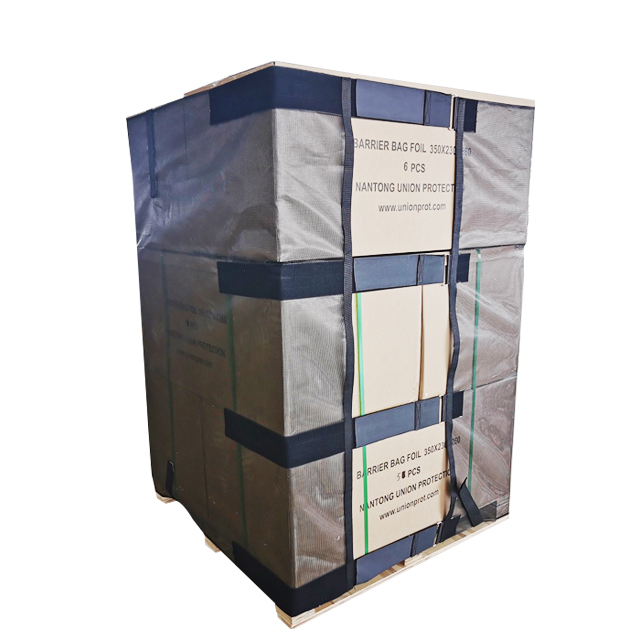
Produce warehouses need to keep palletized cartons and returnable crates organized while avoiding unnecessary obstruction of airflow. Fresh produce continues to exchange heat and moisture with its surroundings, so tightly covering every side of a load may work against the facility's temperature-management plan. A breathable pallet wrap for produce warehouses can be useful where the task is to hold containers together during controlled internal movement rather than create a sealed weather barrier. The packaging decision begins with the product, its container, and the route through the warehouse.
For suitable applications, a breathable reusable pallet wrap made with PVC mesh and Oxford fabric provides a different form of containment from ordinary solid stretch film. It is a reusable textile-based covering, not a perforated film wound around the pallet. Understanding that distinction helps operators assess ventilation, load stability, cleaning, and the need for other protective packaging in their produce-handling workflow.
The practical distinction
A ventilated mesh pallet cover can retain stacked produce containers without enclosing them in a continuous plastic film. It does not create refrigeration, guarantee freshness, or replace hygienic produce packaging.
Why Airflow Matters around Palletized Produce
Produce temperature is influenced by the air reaching containers as well as the heat already stored in the goods. A pallet placed in a cool warehouse may still take time to reach the intended temperature if dense cartons or packaging prevent air movement. A wrap that closes most of the available ventilation openings can make this process less predictable. For produce with active respiration, ventilation requirements may also influence the choice of primary packaging and storage method.
Airflow should be considered at the level of the entire pallet. The position of crate vents, the direction of air movement, aisle spacing, and pallet placement can matter as much as the outer covering. A breathable covering can avoid adding a continuous film barrier, but it cannot overcome blocked vents inside an unsuitable stack. Warehouse teams should review airflow around palletized produce together with the cold-room layout and the product's handling requirements.
What a Mesh-and-Fabric Pallet Wrap Does
A reusable mesh wrap combines a ventilated section with stronger textile areas used for fastening and support. The mesh helps leave portions of the pallet sides open, while straps and closure points control the position of stacked cartons or crates. It can be fitted and removed without continuously unwinding disposable film, which suits facilities that handle the same pallet types repeatedly. The function is containment during suitable short-distance handling, not complete protection from rain or external contamination.
The reusable pallet wrap range is therefore most relevant to controlled warehouse circulation. Operators should not expect a mesh covering to provide the same dust or water barrier as a closed protective cover. Likewise, a mesh wrap should not be treated as a substitute for properly designed food-contact packaging. The produce remains inside its approved cartons, crates, or containers while the wrap acts on the outside of the palletized load.
Identify Produce and Container Types before Ordering
Not every produce load benefits from the same amount of ventilation. Some products require strong cooling airflow, while others need packaging that limits excessive moisture loss. This difference is driven by the crop, temperature plan, primary packaging, and expected dwell time. Warehouse managers should specify the intended produce categories and consult their established postharvest handling procedures before changing pallet containment materials.
Container format adds another variable. Rigid plastic crates may have side ventilation openings, whereas sealed corrugated cartons may allow less air movement regardless of the external wrap. Tall, unstable crates need different restraint from low, tightly stacked boxes. A trial using real warehouse pallet profiles will show whether the proposed cover maintains access to ventilation openings without allowing the load to lean or shift during forklift movement.
Warehouse condition
What to evaluate
Implication for wrapping
Ventilated plastic crates
Position of side openings
Avoid blocking important ventilation paths
Corrugated produce cartons
Carton strength at storage humidity
Control wrap tension and stack pressure
Pre-cooling area
Required airflow through the load
Confirm the covering does not disrupt the process
Cross-aisle transfers
Acceleration and forklift turning
Test load restraint under routine movement
Returned empty wraps
Collection, cleaning and drying
Prevent damp or damaged wraps entering the next cycle
Balance Ventilation with Load Stability
A breathable wrapping choice is useful only when the load still remains stable. Open mesh does not apply the same continuous film pressure as machine stretch wrapping, so operators must evaluate strap positioning, the number of closure points, and how the load behaves during turns. Over-tightening can crush soft cartons or deform stacked crates. Under-tightening may allow containers to move even though the wrap appears fitted at the start of the journey.
Test pallets at their normal maximum height and with representative mixed loads. Check whether any carton corners protrude through openings or create abrasion against the mesh. If the facility frequently handles irregular stacks, it may need better pallet building rather than a tighter wrap. The right balance comes from stable unitization first, then an external restraint that allows the facility's airflow strategy to continue working.
Ventilation is not a food-safety claim
A mesh pallet covering is an outer warehouse-handling component. It should not be described as food-contact packaging or as preventing microbial growth, condensation or spoilage without application-specific evidence.
Control Moisture, Condensation and Cleaning
Moisture buildup in produce pallets can arise from several sources: produce respiration, temperature changes, wet containers, and condensation during movement between warm and cold zones. A mesh wrap may allow better air exchange than a solid film barrier, but it does not remove moisture from the goods or control ambient humidity. Operational steps such as correct pre-cooling, drainage, container design, and minimizing avoidable temperature shifts remain essential.
Reusable coverings also need an agreed hygiene routine. Establish when wraps will be inspected, wiped or washed, dried, and withdrawn from service. A wrap that returns wet to a cold area can create unwanted handling conditions even if its mesh remains intact. Inspection should cover straps, seams, fabric panels, and areas that contact crate corners. Good reusable packaging depends on controlling the return condition, not simply on buying a durable material.
Plan the Internal Return Loop
Produce warehouses often operate predictable routes between receiving, sorting, cold storage, and dispatch. Those routes can support reusable wrapping when covers are collected after the pallet is unloaded. Assign a collection point and record how many covers are issued, how many are returned, and how long they remain in circulation. Lost covers or slow returns can erase some of the operational advantages expected from a reusable approach.
If customers outside the controlled network receive the wrapped pallets, confirm whether they can return the cover. Otherwise, a single-use shipment may be more suitable for a different packaging method. The logistics and warehousing packaging approach should reflect how pallets actually move rather than imposing one solution across every route. A controlled pilot is the best place to learn where reusable mesh wraps fit and where they do not.
Trialing a ventilated pallet wrap
01
Map airflow — Identify ventilation openings and pre-cooling requirements
02
Select loads — Use typical produce cartons and crates at real heights
03
Secure — Test closure position without crushing containers
04
Move — Observe forklift turns, staging and unloading
05
Recover — Inspect, clean and return the cover for another trial
Buying Specifications for Produce Warehouse Pallets
A purchasing specification should identify loaded dimensions, crate or carton type, expected pallet height, and the operating environment. Explain whether the wrap will be used only inside the warehouse or will travel between nearby sites. Give the supplier information about fastening preferences, identification pockets, and the level of access required during quality checks. Samples should be assessed by both warehouse staff and the team responsible for produce temperature management.
When evaluating an OEM reusable packaging manufacturer, discuss mesh area, Oxford fabric positioning, strap adjustment, and cleaning compatibility rather than requesting a generic “breathable film.” The industrial packaging supplier should understand that the material is used externally around packed goods. Buyers can submit a pallet cover customization inquiry with measurements and route details to obtain a proposal based on the intended handling conditions.
Produce warehouse cover trial checklist
✓ Pallet dimensions and crate ventilation are recorded
✓ Mesh and strap areas do not block critical vents
✓ Container stacks remain stable during routine handling
✓ Cleaning and drying requirements are documented
✓ Return responsibility and reuse cycle are defined
✓ Sample testing covers typical and difficult loads
Conclusion
Breathable pallet packaging is a specific handling choice, not a universal substitute for stretch film. A PVC-mesh and Oxford-fabric wrap can suit controlled produce warehouse movements when ventilation, pallet stability, and cover recovery are planned together. Buyers should approve the solution only after checking real produce loads, handling conditions, and the operational requirements of the storage environment.
Frequently Asked Questions
Does breathable pallet wrap keep produce cool on its own?
No. Ventilated wrapping can help avoid unnecessarily blocking airflow, but it does not refrigerate produce. Temperature control still depends on the warehouse and handling process.
When is mesh-style reusable wrapping useful for produce?
It can suit stable palletized cartons or crates moving repeatedly within a controlled warehouse network. The load must remain secure without needing a sealed weather barrier.
How should reusable produce wraps be managed between uses?
Inspect mesh, fasteners and fabric edges for damage or contamination. Establish cleaning, drying and return procedures that match the facility's hygiene requirements.