PVC heat shrink wrap is a useful plastic that shrinks tightly when heated. It gives you very clear views of the product, shows if someone tampered with it, and offers an affordable way to bundle items. This guide covers key features, common uses, and how to choose it over other options like polyolefin. You will find complete, ready-to-use advice that covers how well it works and its effect on the environment for your packaging needs.
Key Takeaways
PVC shrink film is a shiny, low-cost packaging option, but it is less durable and less cold-resistant than polyolefin.
Calculate film density and yield to control costs; higher density means less coverage per pound of material.
What is PVC Heat Shrink Wrap?
Defining Polyvinyl Chloride Film
Polyvinyl chloride, or PVC, forms the base of this versatile shrink film. Manufacturers create this plastic from vinyl chloride monomers that link together into long molecular chains. These chains give the material its strength and flexibility. When you heat the film, the molecules release their internal stress and contract. This reaction creates the tight, protective cover you see on many retail products.
The chemical structure of PVC makes it unique among packaging materials. Its polar nature allows the film to cling to surfaces without adhesives. This property proves valuable when you wrap irregular shapes or bundle multiple items together. The material also resists moisture and many common chemicals, which extends its usefulness across different industries.
How Shrink Film Works
The shrinking process requires precise heat control. You need to apply temperatures between 90–110°C for most PVC films to activate their shrink properties. This range sits notably lower than other shrink materials, making PVC an excellent choice for heat-sensitive products. A typical heat tunnel setting falls between 215–235°F, though you should adjust based on your equipment and film thickness.
Even heat distribution matters more than you might expect. Inconsistent heat within the tunnel causes differential contraction rates across the film surface. Some areas shrink faster than others, creating wrinkles, distortions, or weak spots. Improper airflow patterns and irregular temperature settings worsen this problem. Thicker film sections demand especially careful heat management because their increased mass makes them prone to uneven heating.
You can achieve uniform results with either a heat gun or a heat tunnel. A heat gun works well for small batches and manual operations. Heat tunnels suit high-volume production lines where consistent temperature control is easier to maintain. Whichever method you choose, remember that pvc heat shrink wrap responds best to steady, even heat application. This attention to detail ensures your packaging looks professional and protects your products effectively.
Key Properties of PVC Shrink Film
Clarity, Gloss, and Conformability
When you pick shrink film for packaging, clarity and gloss matter a lot. PVC shrink film lets customers see products clearly and has a shiny finish that makes items look better. This glossy look helps your products stand out on store shelves. The table below shows how PVC and polyolefin shrink film compare in clarity and gloss:
Attribute
PVC Shrink Film
Polyolefin (POF) Shrink Film
Clarity
Slightly lower clarity than POF
High clarity, products remain clearly visible
Gloss
Very high gloss, 'shiny' appearance
Good gloss
Even though PVC is a bit less clear than polyolefin, its very shiny surface gives packaging a high-end feel. The material's density creates this glossy look. Higher density means a smoother surface that reflects light well. PVC shrink film also wraps tightly around odd shapes. You can easily cover items like electronics, cosmetics, and gift baskets. The film shrinks evenly over curves and corners. But you should watch out for its tear resistance. PVC does not resist punctures well. Sharp edges on products can poke holes in the film. Once punctured, it resists tearing strongly. Small holes do not turn into big rips. For items with sharp edges, you might want cross-linked films for extra safety.
Temperature Sensitivity and Storage
PVC shrink film reacts to temperature in two key ways. First, it shrinks when heated between 90-110°C. Second, it gets brittle over time if UV light hits it. Good storage stops this brittleness and keeps the film flexible. Follow these storage tips:
Keep the temperature between 15°C to 27°C (60°F to 80°F)
Maintain low humidity levels for best results
Avoid direct sunlight and UV rays to prevent brittleness
Use opaque containers or light-blocking materials
The density of PVC shrink film changes how it stores. This material's higher density needs careful handling. UV light breaks down the polymer chains over time. This makes the film lose stretch and turn brittle. Brittleness lowers how well your packaging works. Your shrink film might crack when applied or fail to guard the product. The film's density also affects how it performs during storage. When you store PVC shrink film the right way, it lasts longer.
By learning these key properties, you can pick the right PVC heat shrink wrap for your packaging needs. The shrink film protects well when you handle it properly. Pay attention to clarity, conformability, and storage conditions. These factors decide how well your packaging works and how long it lasts.
Common Applications for Shrink Film
Retail, Food, and Tamper-Evident Packaging
You will see pvc shrink film in many stores. Its clear look makes products stand out on shelves. Electronics, cosmetics, and gift baskets all look better with this shiny, see-through cover. The film wraps tightly around odd shapes, so you can package items without special boxes. For food, pvc heat shrink wrap works fine for non-autoclave uses. You can wrap fresh produce, baked goods, and deli items safely. But do not use it for high-heat sterilization. The material cannot handle autoclave conditions.
Tamper-evident seals are one of the most important packaging uses. Shrink bands are thin PVC pieces placed over a lid or container. When heated, they melt and shrink to form an outer seal. Customers must break this seal before using the product. This simple design clearly shows if someone has opened the item. The benefits of shrink bands include:
Clear sign of tampering; any removal try causes breakage or damage
Low cost compared to other tamper-evident options
Works with many closure types and container sizes
Helps meet rules and builds customer trust
Heat shrink bands or wrappers must be firmly applied and heat shrunk to fit tightly. They cannot be taken off and put back on without visible damage. A unique mark that differs for each product size is advised. Tinted bands no longer count as a unique mark. Cellulose wet shrink seals are not acceptable.
Industrial and Bundling Uses
Beyond stores, common pvc shrink film uses reach into industrial settings. You can bundle several items together for shipping or storage. This method cuts handling time and keeps parts organized. Commercial pvc shrink film also guards products from dust, moisture, and light scrapes during transit. The packaging industry values this material for its mix of clarity and protection.
For multipacks, shrink film forms a secure unit that stays together. You can wrap cans, bottles, or boxes into easy bundles. This packaging works well for both display and shipping. The film's flexibility ensures a snug fit around grouped items. You get packaging that looks good and works reliably. The safety benefits also help workers who handle these bundles, since the film stops items from shifting or falling. Whether you need store display packaging or industrial bundling, pvc shrink film gives dependable protection across many packaging uses.
PVC vs. Polyolefin vs. Polyethylene
Durability, Cost, and Performance Trade-offs
When you look at the three main shrink film types, you will notice clear differences in price, strength, and how they work. The table below shows how PVC and polyolefin compare in shrink abilities:
Material
Shrinkage Ratio
Continuous Operating Temperature Range
PVC
Fixed at 2:1
-55°C to 105°C
Polyolefin
2:1, 3:1, 4:1, 6:1
Up to 125°C or 135°C; some variants up to 150°C
PVC shrink film has a set 2:1 shrink ratio and a smaller temperature range. Polyolefin shrink film gives you more choices with ratios up to 6:1. This means polyolefin can fit odd shapes better. PVC turns brittle in cold weather and may crack under pressure. Polyolefin handles temperature shifts well and resists punctures better. The density of PVC shrink film makes it stiffer.
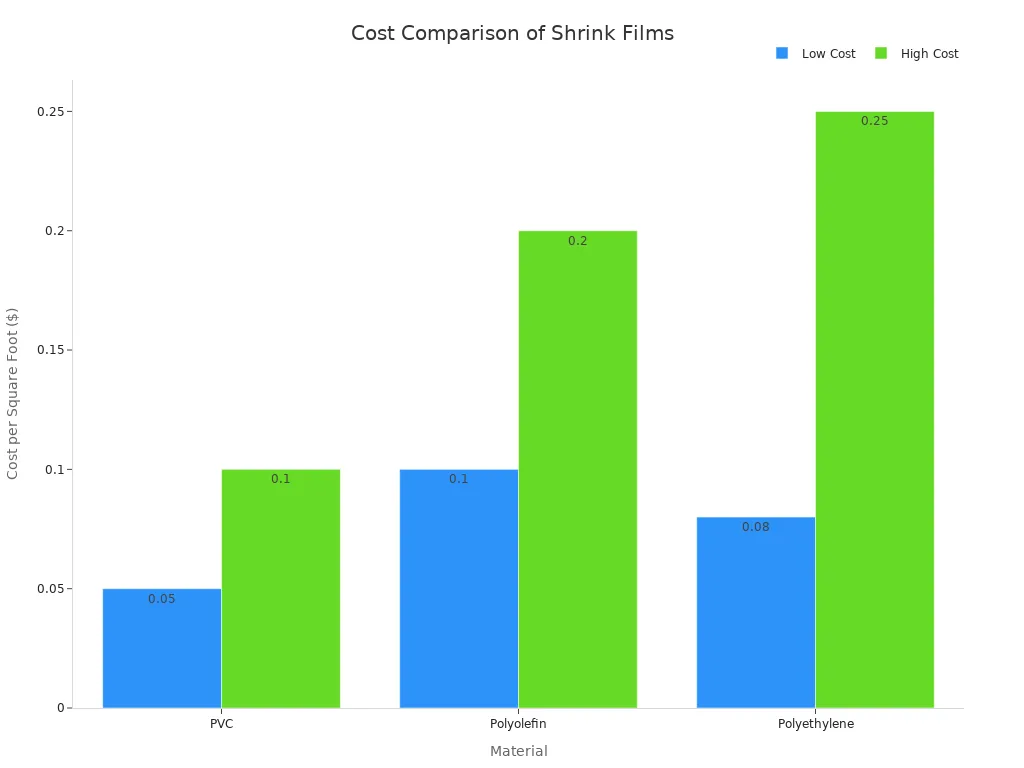
Cost also differs among these shrink film types:
Material
Cost per Square Foot
PVC
$0.05 – $0.10
Polyolefin
$0.10 – $0.20
Polyethylene
$0.08 – $0.25
PVC shrink film costs less, but you give up some toughness. Polyolefin offers great strength and flexibility. It resists splits, tears, and punctures. It works well in cold places, keeping its flexibility and seal strength. These traits suit heavy-duty packaging and outdoor storage. PVC becomes brittle after shrinking, especially in cold weather. It also does not handle heat and humidity well.
Polyethylene costs more than PVC but has lower clarity. You will find it in industrial bundling where clear looks matter less. Its shrink performance does not match the other two film types. The density of polyethylene sits between the other materials.
Environmental Impact and Recyclability
The packaging industry faces more pressure about material choices. Polyvinyl chloride contains chlorine, which raises environmental worries. When you burn PVC, it can release harmful gases. Recycling PVC also poses more challenges than recycling polyolefin. The higher density of PVC makes sorting harder at recycling centers.
Polyolefin recycles better. Many recycling programs accept it more easily. Its lower density makes processing simpler. Polyethylene also recycles well in many city systems. The performance of each material depends on what you need.
For heavy-duty industrial use, think about options like reinforced HDPE wraps. These give strong protection without chlorine. The density of these materials differs from PVC, which affects how they package and recycle. When you weigh your choices, consider the balance between cost, safety, and environmental impact. The safety of your product packaging depends on picking the right material.
For food packaging, make sure your film meets safety rules. PVC works for non-autoclave uses but not for high-heat sterilization. Always check your needs before choosing among shrink film types. The right product packaging protects your items and builds trust with customers.
How to Select the Right PVC Heat Shrink Wrap
Picking the right shrink film means thinking about thickness, form, heat source, and safety rules. The right shrink film keeps your products safe and helps your packaging line run well. This part gives useful guidance to help you choose wisely.
Choosing Thickness and Size
The thickness of your shrink film depends on how heavy and what shape your product is. Light items like gift baskets need thinner film. Heavy products with sharp edges need thicker pvc shrink film so they do not tear. The film gauge you pick changes how strong and safe your product packaging is.
The form of shrink film you pick also matters. You have three main choices: centerfold, flat, and tubing. Among these types of shrink film, pvc gives you clear views at a low price. You can also choose pvc for its shiny look. The table below shows these options to help you decide.
Feature
Centerfold Film
Flat Film
Tubular Film
Physical Form
A single sheet folded in half lengthwise
A flat, unfolded sheet
A pre-formed continuous tube
Best For
Manual or semi-automatic lines with mixed product sizes
High-speed automated lines with consistent product shapes
High-volume lines with uniform products like bottles
Seam Construction
Machine creates two side seals
Machine creates all seals
One pre-made seamless side
Flexibility
High flexibility for varying product heights
Moderate flexibility
Low flexibility; product circumference change requires new roll
Material Efficiency
Potential for more waste
Moderate waste
Highly efficient with minimal waste
Manual work benefits most from centerfold shrink film. You can wrap many different product sizes without changing rolls. Tubular shrink film works best for long, round items like posters or curtain rods. Flat shrink film suits automated machines that fold and wrap the film around your product by themselves.
Matching Heat Sources and Food Safety Standards
Your choice of heat source depends on how much you produce. A heat gun works well for small batches and hand wrapping. You can aim heat at specific spots. Heat tunnels suit big lines where steady temperature matters. The tunnel surrounds your product with even heat for smooth shrinkage.
Safety rules matter a lot when picking packaging. pvc shrink film works for non-autoclave food packagingapplications. You can wrap fresh produce, baked goods, and deli items safely. But this material cannot handle high-heat sterilization. Always check that your pvc shrink film meets food contact rules for your product packaging needs.
The best pvc shrink film for you balances thickness, form, and heat source fit. The best pvc shrink film also meets all safety rules for your product type. When you think about these factors together, you pick high-quality pvc shrink film that works well. Knowing these types of pvc shrink film helps you choose the right one for your packaging line.
Understanding PVC Shrink Film Density and Yield
Density and Its Role in Performance
The density of pvc shrink film typically ranges from 1.33 to 1.40 g/cm³, with 1.35 g/cm³ as a common reference point. This density of pvc shrink film sits notably higher than polyolefin's density of about 0.93 g/cm³. That difference matters for your packaging decisions. Higher density means more material mass per unit of volume. You get a stiffer, more rigid film that holds its shape well. This rigidity helps the shrink film conform tightly around products during the heating process.
The density also affects how you calculate costs. When you buy shrink film by weight, a denser material yields fewer square meters per kilogram. For example, PVC at 1.35 g/cm³ produces roughly 31% less area per kilogram than polyolefin at 0.93 g/cm³. You pay for weight, but you use area. This relationship means your effective cost per packaged item rises with density. Understanding this trade-off helps you budget accurately for your packaging needs.
Calculating Yield and Roll Weight
You can calculate yield and roll weight using straightforward formulas. The table below shows the key calculations for pvc shrink film:
For square-inch calculations, you can use a different formula. Yield (in²/lb) = (Thickness in gauge × Density) ÷ 27.68. Let's work through an example. Take PVC film at 1.15 gauge with a density of 1.32 g/cm³. Multiply 1.15 by 1.32 to get 1.518. Then divide by 27.68. Your result is 18,235 square inches per pound. This number tells you exactly how much coverage you get from each pound of shrink film.
These calculations help you compare suppliers and estimate material needs. You can determine how many rolls you need for a production run. You can also verify that you receive the correct amount of film when shipments arrive. Mastering these formulas gives you control over your packaging costs and inventory planning.
Cost Considerations and Savings Tips
Factors Influencing Price
Several things affect what you pay for shrink film. Thickness is the main cost factor. Thicker film needs more raw material, so it costs more per roll. The density of pvc shrink film also changes the price. Higher density means more material per square foot, which increases your cost. Print quality adds more to the price. Custom logos or designs need extra steps. These steps take more time and create more waste. You pay for that extra work.
The best pvc shrink film balances these factors with your budget. You might pick a thinner film for light products. You might choose a thicker gauge for items with sharp edges. Your choice affects both performance and cost. Keep in mind that pvc shrink film density changes how much film you get per pound. A denser film covers less area. This link directly affects your per-unit packaging cost.
Strategies for Reducing Material Waste
You can reduce waste through down-gauging. This method uses a thinner, high-performance film instead of a thicker standard option. The table below shows the possible savings:
Strategy
Traditional Approach
Optimized Approach (Down-Gauging)
Film Thickness
20-micron commodity film
12-micron high-performance film
Material Usage
Higher plastic weight per pallet
Up to 30-40% less plastic weight
Waste Impact
More plastic waste to landfill
Reduced roll changes and lower landfill waste
This method works well for many packaging uses. You keep protection while using less material. You also cut roll changes, which saves labor time. The savings grow across high-volume production lines.
Scrap recovery offers another way to save. You can recycle clean, post-industrial PVC scrap from your production process. Off-cuts, trim pieces, and start-up scrap all count. Keep these material streams separate and clean. Collection bins near workstations make recycling easy. Set up regular pickups to match your production flow. Manufacturers with steady, clean PVC scrap can join recycling programs. These programs keep waste out of landfills and recover material value.
While pvc shrink film costs less upfront than other options, think about its brittleness. This trait may cause more damage in some uses. Damaged products cost you money. Include this risk in your total cost analysis. The density of pvc shrink film affects its stiffness and handling. Balance these traits against your specific needs.
Environmental and Compliance Factors
Navigating Regulations and Disposal
The density of PVC shrink film creates specific environmental concerns. When burned, polyvinyl chloride releases harmful chlorinated compounds, including hydrogen chloride and chlorine-containing dioxins. Heat breakdown of the material produces HCl and organochlorine compounds such as dioxins and furans. The material's density affects how it behaves during disposal. Higher density means more mass per unit of volume, which changes how it burns. The density of PVC shrink film makes sorting harder at recycling facilities. Recycling this shrink film is possible but tougher than recycling polyolefin. Many facilities downcycle the material or use it for energy recovery. Stricter regulations limit the use of certain materials in packaging. The density of your shrink film affects compliance with these rules. Your packaging safety depends on understanding these factors.
Exploring Eco-Friendly Alternatives
You can consider alternatives that reduce environmental concerns. Polyolefin shrink film offers better recyclability than PVC. The density of polyolefin is lower than PVC's density. This lower density makes it easier to process. This shrink film also provides good protection for your products. For long-term outdoor use, you might choose reinforced HDPE wraps. These wraps offer strong protection and last up to 18 months. The density of reinforced HDPE is higher than standard polyolefin. This density provides durability for harsh conditions. Evaluate each shrink film option based on your specific needs. The density of the material affects both performance and cost. Your packaging safety depends on proper material selection. Your shrink film choice also impacts the environment. Alternative shrink film materials have different recyclability levels. Your shrink film material choice determines suitability for different applications. Disposal safety varies by material type. Your packaging decisions affect both product quality and environmental impact. Choose packaging materials that align with your goals.
Practical Buying and Storage Advice
Sourcing from Reliable Suppliers
Finding a good supplier for your shrink film starts with checking their certifications. You want a partner who meets trusted standards. The table below shows the main certifications to look for:
Certification
What It Means for You
UL (Underwriters Laboratories)
Proves the film is safe for electrical and electronic items
RoHS (Restriction of Hazardous Substances)
Ensures no lead, mercury, or other dangerous materials
ISO (International Organization for Standardization)
Shows the factory follows strict quality control
Beyond certifications, look at how the supplier performs. Check for review scores between 4.5 and 5.0 out of 5.0. Make sure on-time delivery is at or above 90%. A quick reply in four hours or less means good customer service. A reorder rate above 15% shows clients trust the supplier and come back.
Ask for samples before you buy a large order. Testing the samples checks shrinkage, strength, puncture resistance, seal strength, and clarity. These tests confirm the film meets your packaging needs and safety rules. Testing also shows if the film's density works for your products. A higher density pvc shrink film is stiffer but covers less area per pound. You need to know this before you buy.
Best Practices for Storage and Handling
Good storage keeps your shrink film ready to use. The table below shows the best conditions:
Storage Parameter
Recommended Condition
Consequence of Deviation
Temperature
10°C to 30°C (50°F to 86°F)
Above 30°C: film gets sticky, loses shrink power. Below 10°C: film turns brittle and may crack
Relative Humidity
40% to 60%
High humidity: mold grows, clarity drops. Low humidity: film dries out, becomes easy to break
Light Exposure
Avoid direct sunlight; store in dark areas
UV light breaks down PVC polymer, causing color change and weaker strength
Keep your shrink film in the coolest part of your building during summer. Stay away from temperatures above 100°F to stop early shrinkage. Plan deliveries early in the day to avoid hot trucks. During winter, keep film away from doors to avoid big temperature changes. Protect it from rain and snow. The density of pvc shrink film makes it brittle in extreme cold, so handle rolls with care.
Check the film's shelf life when it arrives. Store rolls on their sides on pallets. Never stack them too high, because weight can crush the cores. Handle rolls gently to avoid tears at the edges. A small tear can ruin a whole roll during use. The density of the material affects how easily it tears, so train your staff on proper handling. This care in storage and handling extends the life of your shrink film and cuts down waste.
PVC heat shrink wrap offers versatility and economy for many packaging needs. You must weigh its density against durability and environmental concerns. Understanding shrink film trade-offs helps you choose wisely. Consider clarity, strength, and budget when selecting the best pvc shrink film. Evaluate your applications carefully. This guide equips you with technical knowledge for informed purchasing decisions. Remember that pvc shrink film density affects performance and cost. Choose shrink film that matches your product requirements and regulatory standards.
FAQ
How does PVC shrink film compare to other shrink films?
PVC costs less and has a glossy look. Polyolefin is more flexible. Polyethylene is not as clear. These PVC shrink film types suit different packaging jobs. The film's density helps you choose.
What does the density of PVC shrink film tell you about how it works?
Density is how much material is in a given space. This film's density ranges from 1.35 to 1.40 g/cm³. Higher density makes the film stiffer. Lower density gives you more coverage. Pick shrink film based on its density. Density also affects the cost.
How should you store shrink film for best results?
Keep shrink film in a cool, dry spot. The temperature should be between 10°C and 30°C. Stay away from sunlight. Good storage stops the film from becoming brittle. The film's density matters for storage. This shrink film lasts longer when you handle it carefully.