
Views: 0 Author: Site Editor Publish Time: 2026-07-23 Origin: Site


Large machinery, modular buildings, scaffolded work zones, boats, and recreational vehicles often spend days or months exposed during transport, storage, or project delays. Loose covers can shift, leave gaps, and allow moisture, dust, road spray, or sunlight to reach vulnerable surfaces.
Heat shrink wrap applications address these risks by creating a close-fitting protective layer around oversized or irregular assets. Understanding where this method works best—and where structural crating or additional corrosion control is still needed—helps buyers choose suitable protection for shipping, outdoor storage, construction containment, equipment preservation, and seasonal vehicle storage.
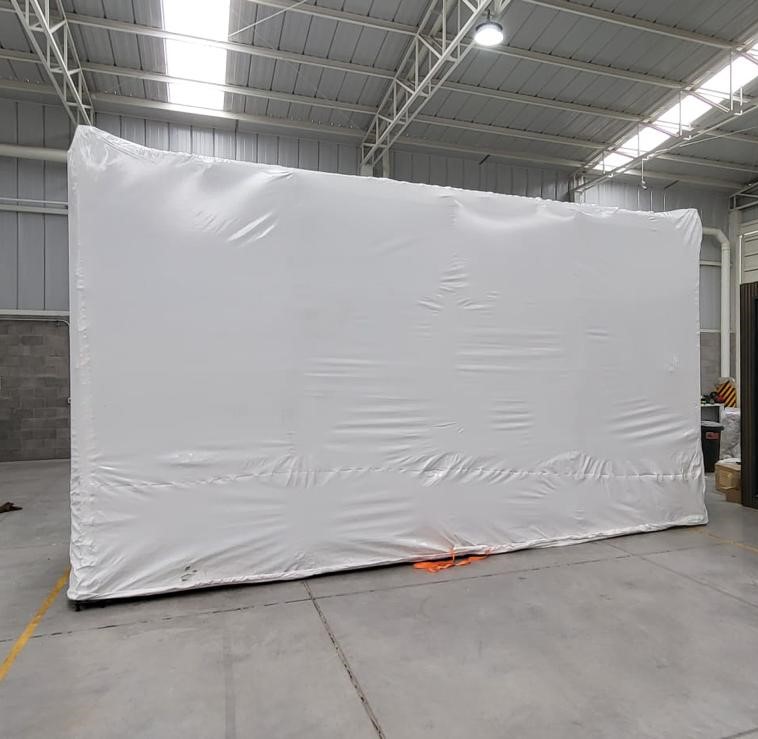
Modular construction places finished walls, roof sections, doors, windows, insulation, and fittings into transport before final installation. Modular shipping & storage covers protect complete units and prefabricated components during factory staging, flatbed transport, port handling, and job-site storage. A close-fitting enclosure reduces gaps, loose folds, and rubbing around corners or projections, while pre-shaped covers make repeated module sizes faster and more consistent to pack.
Cover specifications should be based on drawings, route conditions, destination climate, storage duration, and lifting points rather than dimensions alone. Seams and securing points should also remain clear of lifting hardware so the enclosure does not interfere with handling.
Machinery skids, fabricated assemblies, palletized parts, and oversized construction materials often pass through several exposed logistics stages. A tight exterior layer helps limit rain, road spray, dust, salt-laden air, and surface contamination on open trailers or during port staging. Reinforced film is more suitable where sharp profiles, high-stress contact points, or long-distance vibration increase puncture risk.
Skids, blocking, frames, and crates must still manage lifting forces, impacts, stacking, and movement of the asset itself. For routes involving several transfers, inspection and patch materials should travel with the shipment so small punctures can be repaired before exposure continues.
Port congestion, inspections, seasonal schedules, or site delays can leave finished goods outdoors for weeks. Moisture may enter openings, dust can settle on connection areas, and sunlight can affect coatings, seals, or plastics even when the delay is described as temporary.
Storage period, local weather, inspection frequency, and surface sensitivity should therefore shape the cover design. A planned access point may also prevent crews from cutting and patching the enclosure whenever the load must be checked.
Load | Exposure stage | Main risk | Cover approach |
Modular unit | Factory to site | Gaps and rain | Custom-fit cover |
Machinery skid | Port or flatbed | Spray and salt air | Reinforced film |
Fabricated part | Outdoor staging | UV and dust | UV-stabilized film |
Palletized parts | Repeated handling | Dirt and abrasion | Tight cover over a stable pallet |
Pumps, turbines, compressors, generators, electrical cabinets, processing systems, and skid-mounted packages may remain exposed between inspection, transport, delivery, and startup. During this interval, connectors, vents, control panels, painted housings, machined surfaces, and cable entries can collect moisture or contamination. Industrial equipment & machinery covers conform around frames, pipes, valves, motors, and projecting brackets that are difficult to protect with standard rectangular sheeting.
Padding is still needed over sharp edges because the film should not carry concentrated mechanical loads. Openings that must remain breathable or accessible should be identified before the cover is fabricated.
Repeatable covers also benefit manufacturers shipping the same machine model regularly. Once dimensions, seam locations, closure points, and handling steps have been validated, crews can reduce trimming and packaging variation. This consistency matters because strong material can still fail when attachment areas or vulnerable projections are handled differently on each shipment.
A final inspection should check seams, edge protection, access points, and the stability of the supporting skid before release. Photographs of the completed package can give receiving teams a useful reference for identifying transport damage or unauthorized opening.
Shutdown storage has different requirements from transport because equipment may remain stationary for months while still needing inspection or maintenance. The enclosure should block rain, dust, and direct sunlight, while planned doors or removable sections preserve access without destroying the cover. Ventilation and moisture management also deserve attention wherever temperature changes could create condensation inside the space.
UV stabilization supports extended outdoor use, and reinforced film protects high-stress areas. Corrosion-sensitive machinery requires a distinction between stopping outside weather and managing the internal atmosphere. Waterproof film reduces direct contact with rain and spray, while VCI options can provide temporary protection for exposed ferrous parts in humid or salt-air conditions.
None of these features replaces engineered skids, blocking, tie-downs, lifting points, or impact-resistant crating. The wrap protects the environment around that structural system so equipment can remain cleaner and closer to its preserved condition. Preservation plans should also record inspection intervals, desiccant or VCI requirements, and the procedure for resealing the enclosure after access.
Construction scaffolding & building containment creates a taut temporary skin around scaffold tubes, façades, and selected work zones. Typical uses include exterior painting, restoration, surface preparation, roof transitions, window replacement, and unfinished building-envelope work. Once seams are joined and controlled heat is applied, the film follows corners and uneven elevations more closely than loosely tied sheets, reducing flapping and open gaps.
The enclosure can limit direct rain, dust, and airborne contamination reaching materials, tools, and unfinished surfaces, although it does not remove weather-related site hazards. UV-stabilized material is useful when a façade will remain enclosed for weeks or months, while reinforcement may be needed around fittings and high-traffic contact points.
Access, ventilation, lighting, emergency routes, and material movement should be planned before the film is shrunk. Cutting unplanned openings later can weaken containment and create repeated patching work. The effect of the enclosure on scaffold loading and anchorage must also be assessed separately.
Façade cleaning, blasting, painting, masonry repair, and demolition preparation can release dust, paint particles, and lightweight debris. Heat-welded seams and close-fitting film help create a more continuous boundary around the active area, reducing escape paths left by loosely overlapped sheeting.
The internal process may still require extraction, filtered ventilation, or other controls because film alone does not manage airborne hazards. Flame-retardant material should be selected when the project specification or local rules require a documented fire-performance level.
Wind screens should be used only when the scaffold is secured against anticipated wind forces. Work during storms or high winds also requires a competent safety assessment. Scaffold engineering, anchorage, installation sequence, ventilation, fire performance, and daily site controls should be resolved during planning rather than after the enclosure has been installed.
Boats and personal watercraft need protection during seasonal storage, marina staging, repair-yard holding, dealer inventory, and overland transport. A fitted enclosure limits direct contact with rain, sunlight, dust, bird contamination, insects, and road grime while following the hull more closely than a loose cover.
Sharp fittings should be padded, and suitable supports should prevent water pockets or broad areas of film from resting on vulnerable surfaces. Drainage, ventilation, and inspection access must be designed for the vessel and local climate, especially during long storage periods.
Power sport covers are used for motorcycles, scooters, ATVs, UTVs, snowmobiles, golf carts, and similar vehicles. Handlebars, mirrors, wheels, racks, controls, and open cabins make generic rectangular packaging awkward, while pre-shaped covers improve consistency for repeated models.
Standard film may suit indoor holding or lighter routes, while reinforced areas are better around tires, frames, racks, and other puncture-prone points. The vehicle still requires suitable restraints and transport supports because the cover protects against exposure rather than load movement.
These covers also support factory staging, batch shipment, export handling, seasonal inventory, and outdoor dealer storage. Selection should reflect whether the vehicle is fully assembled, which parts are removable, how it is secured, and where receiving teams need inspection access.
A repeatable fit reduces loose material against painted surfaces and limits on-site trimming. That efficiency is most valuable when many identical units move through the same packaging process.
Selection begins with the operating scenario, not the thickest film. Identify whether the asset will be shipped, stored, staged, or used for temporary containment, then estimate duration, climate, route, and handling frequency. Map sharp edges, sensitive finishes, corrosion-prone metal, and access points before choosing the material.
Evaluate impact, lifting, stacking, and load movement separately because film does not solve structural risks. Repeated modules, machines, boats, or vehicles may justify a pre-shaped cover after the first fit and heating process have been validated.
Standard heat shrink wrap suits uncomplicated shapes and moderate exposure. Reinforced material is better for sharp profiles, rough handling, or points where a small tear could spread. Custom-fit covers make sense when trimming creates waste or identical products need consistent packaging.
ECOPACK provides standard, reinforced, VCI, flame-retardant, and custom-fit configurations for industrial cargo, machinery, modular structures, boats, and vehicles. Thickness alone cannot correct weak attachments, incomplete seams, poor padding, or water-pooling geometry.
Use specialized features to answer a defined risk: UV stabilization for long sunlight exposure, VCI for corrosion-sensitive ferrous equipment, flame-retardant film for documented requirements, and access doors for planned inspections. Reinforcement belongs around genuine puncture hazards, while custom dimensions are most useful for repeated or unusually shaped assets.
Accurate measurements, route details, storage duration, and environmental conditions remain essential inputs.
Condition | Feature | Question |
Long outdoor exposure | UV stabilization | How long will it remain in direct sun? |
Sharp geometry | Reinforcement | Where will stress concentrate? |
Ferrous metal | VCI option | Is corrosion control needed? |
Fire requirement | Flame-retardant film | Which rating applies? |
Repeated model | Custom-fit cover | Will customization reduce labor? |
Scheduled inspection | Access door | How often is entry required? |
Secure attachment, overlap, even heating, edge protection, and seam inspection determine whether the enclosure stays continuous. Crates, frames, blocking, tie-downs, and cushioning remain necessary when impact, stacking, lifting, or movement is the main threat. Effective heat shrink wrap applications keep environmental and structural protection clearly separated.
Heat shrink wrap applications are most effective when the cover is matched to the asset’s shape, exposure period, handling conditions, and protection risks. From modular buildings and industrial machinery to scaffold enclosures, boats, and powersports vehicles, the right film can reduce weather exposure, contamination, packaging waste, and avoidable rework.
Suzhou Ecopack Co.,Ltd. supplies standard, reinforced, VCI, flame-retardant, and custom-fit heat shrink wrap options for transport, storage, and outdoor protection. Choosing only the features a project actually requires helps improve installation consistency, preserve valuable assets, and keep packaging practical rather than unnecessarily complex.
A: Common uses include protecting industrial machinery, modular buildings, scaffolded work areas, boats, powersports vehicles, export loads, and oversized cargo during transport, outdoor storage, or temporary staging.
A: Once heated, the film contracts around irregular surfaces, helping limit exposure to rain, dust, sunlight, road spray, and contamination while reducing loose material around the load.
A: Properly installed film can provide a weather-resistant enclosure, but outdoor performance depends on UV stabilization, sealed seams, secure attachment, drainage, ventilation, exposure time, and routine inspection.
A: No. Stretch wrap relies on tension and is commonly used to unitize pallets, while heat shrink wrap contracts under applied heat to create a tighter, more stable enclosure.
A: Not when impact, stacking, lifting, or load-bearing protection is required. Shrink wrap manages environmental exposure, while skids, blocking, frames, cushioning, or crates handle structural risks.
A: Yes, but the scaffold must be designed and secured for added wind forces. Access, ventilation, fire requirements, anchorage, and competent-person inspections should be addressed before enclosure.


