
Views: 0 Author: Site Editor Publish Time: 2026-07-17 Origin: Site


A modular unit can leave the factory nearly installation-ready, yet a poor packaging choice may expose finished walls, windows, services, and interior components to moisture, abrasion, dust, or handling damage before it reaches the site. Transport distance, route, weather, storage time, and lifting methods all affect the level of protection required.
Choosing prefabricated modular building packaging is therefore less about finding the thickest film and more about matching the enclosure to the module’s real risks. The following sections compare the main options and show how to protect finish quality and installation readiness.
Loose tarpaulins can flap at road speed, rub against finished surfaces, and admit wind-driven rain through open edges. Heat-shrink film contracts around walls, roofs, corners, and irregular contours, leaving less material to move, billow, or catch on surrounding equipment. A close fit also makes punctures, open seams, and damaged areas easier to identify during inspection.
Prefabricated modular building packaging does not secure the module to the transport vehicle. Supports, straps, chains, blocking, and tie-downs must follow a separate load-securement plan. The cover protects surfaces and openings, while the restraint system controls structural movement during transit.
Roof edges, brackets, bolt heads, ducts, lifting eyes, temporary connections, and exposed steelwork can concentrate stress on a small area of film. Standard shrink film may perform well on smooth modules but can become vulnerable when stretched across sharp or irregular features.
Reinforced shrink wrap incorporates strengthening layers or an internal support structure to improve resistance to tearing and puncturing while retaining heat-shrink performance. This makes it particularly suitable for sharp-edged, high-value, or repeatedly handled modules.
Corner guards, padding, capped fasteners, and separation from slings remain necessary. Even reinforced material can fail under concentrated pressure or repeated contact. Reliable protection comes from combining a strong outer enclosure with localized protection at every predictable stress point.
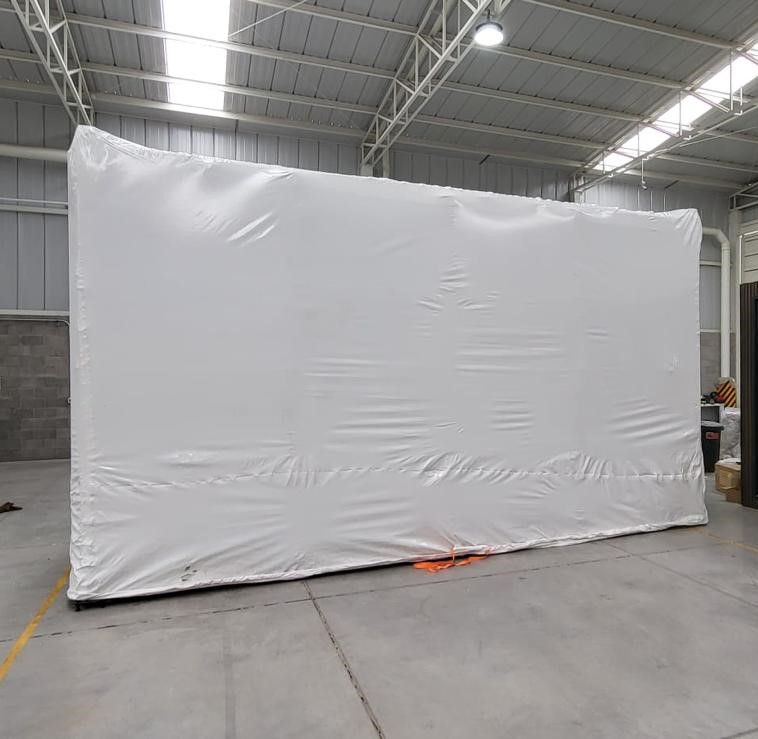
An unfinished structural frame and a fully fitted volumetric room do not have the same protection requirements. Frames may tolerate limited exposure when their coatings, connection points, and interfaces remain intact. Finished modules can suffer scratched cladding, damaged glazing, stained surfaces, contaminated interiors, or water entry through small openings.
The value at risk is not limited to the primary structure. Packaging must also preserve the work completed in the factory so that the unit can move directly into installation rather than repair.
Doors, windows, roof membranes, decorative panels, ventilation openings, service penetrations, and exposed installation interfaces should be identified before material is selected. Sensitive areas may require padding, edge guards, sealed openings, reinforcement patches, or protection from direct film contact.
Transport planning should account for module construction, size, weight, route, distance, temperature changes, moisture exposure, and the number of handling events. A short local movement presents a different risk profile from long-distance open-trailer transport, port handling, ocean freight, or several months of outdoor storage.
Longer exposure generally requires stronger seams, reinforced stress points, UV-stabilized film, and a defined moisture-control strategy. Coastal routes may introduce salt-laden air, while hot and cold temperature cycles can increase the chance of condensation inside a sealed enclosure. Outdoor storage also creates drainage, access, wind-loading, and inspection requirements.
Standard film or a fitted reusable cover may be suitable for unfinished units on short, controlled journeys. More demanding routes normally justify a closely fitted reinforced enclosure with stronger edge protection and planned inspection points.
Prefabricated modular building packaging must reflect how the unit will be lifted, restrained, transferred, and unloaded. Forklift pockets, crane eyes, sling paths, trailer supports, tie-down points, and access openings should be marked before the cover is produced.
Cutting openings after installation can weaken the barrier and create uncontrolled entry points for water or wind. Misplaced restraints may also cut into the film or transfer damaging pressure to finished surfaces.
Access points should therefore be positioned intentionally. They may be reinforced, sealed around the edges, or designed to be opened and closed without compromising the surrounding cover.
Project condition | Packaging direction | Additional protection |
Finished module on an open trailer | Custom-fit reinforced enclosure | Padding and corner guards |
Panel or roof-section bundle | Reinforced film or fitted cover | Spacers and bundle restraint |
Short sheltered delivery | Standard film or fitted cover | Basic contact protection |
Long outdoor staging | UV-stabilized custom enclosure | Access and moisture control |
Steel- or MEP-heavy module | Reinforced custom enclosure | Protection for exposed metal |
This matrix converts exposure conditions into a practical packaging direction. The final specification should still account for the module’s exact geometry, finish, lifting sequence, and storage plan.
Custom-fit shrink covers are pre-sized or pre-formed around a known module profile. They suit repeatable designs, irregular geometry, limited wrapping time, and projects involving multiple similar units. Accurate patterns reduce unnecessary folds and make it easier to position seams away from vulnerable corners or contact points.
Their performance depends on measurement quality. Overall length, width, and height may not capture overhangs, lifting hardware, roof equipment, temporary bracing, or the module’s transport orientation.
Drawings, photographs, and three-dimensional models should record these details before production. Areas requiring reinforcement, ventilation, access, or extra material can then be built into the cover rather than improvised during application.
Roll-applied film is cut, joined, and sealed around the module during packaging. It works well for prototypes, one-off structures, oversized components, field applications, and projects where dimensions change frequently.
Installation crews can adapt the film around unexpected features without waiting for a newly formed cover. The method also allows local reinforcement to be added wherever the module presents an unusual edge, projection, or opening.
That flexibility requires greater application skill and quality control. Additional cutting creates more seams, and poor overlap or uneven heating can reduce weather resistance. Roll-applied packaging works best when crews have adequate space, compatible repair materials, appropriate heating equipment, and a defined sealing procedure.
Tarpaulins are quick to install and reusable for short movements when a close fit and reliable tension can be maintained. Their performance becomes less predictable when edges flap, water collects in folds, or crews cannot inspect and retension the cover during storage.
Reusable fabric covers can work well on repeat routes with standardized modules and organized return logistics. They require suitable attachment points, correct sizing, routine inspection, cleaning, and storage between uses.
Rigid crates and frames provide stronger resistance to impact and stacking pressure, particularly for smaller components. However, they add weight, labor, material handling, storage requirements, and disposal or return costs. Full volumetric modules are often too large for rigid packaging to be the most practical primary solution.
Within modular shipping & storage covers, no format is automatically suitable for every project. The best option is the least complex system that reliably controls weather exposure, puncture, abrasion, handling damage, and storage risk. Performance should be judged by the condition of the module at delivery and its readiness for installation, not by packaging price alone.
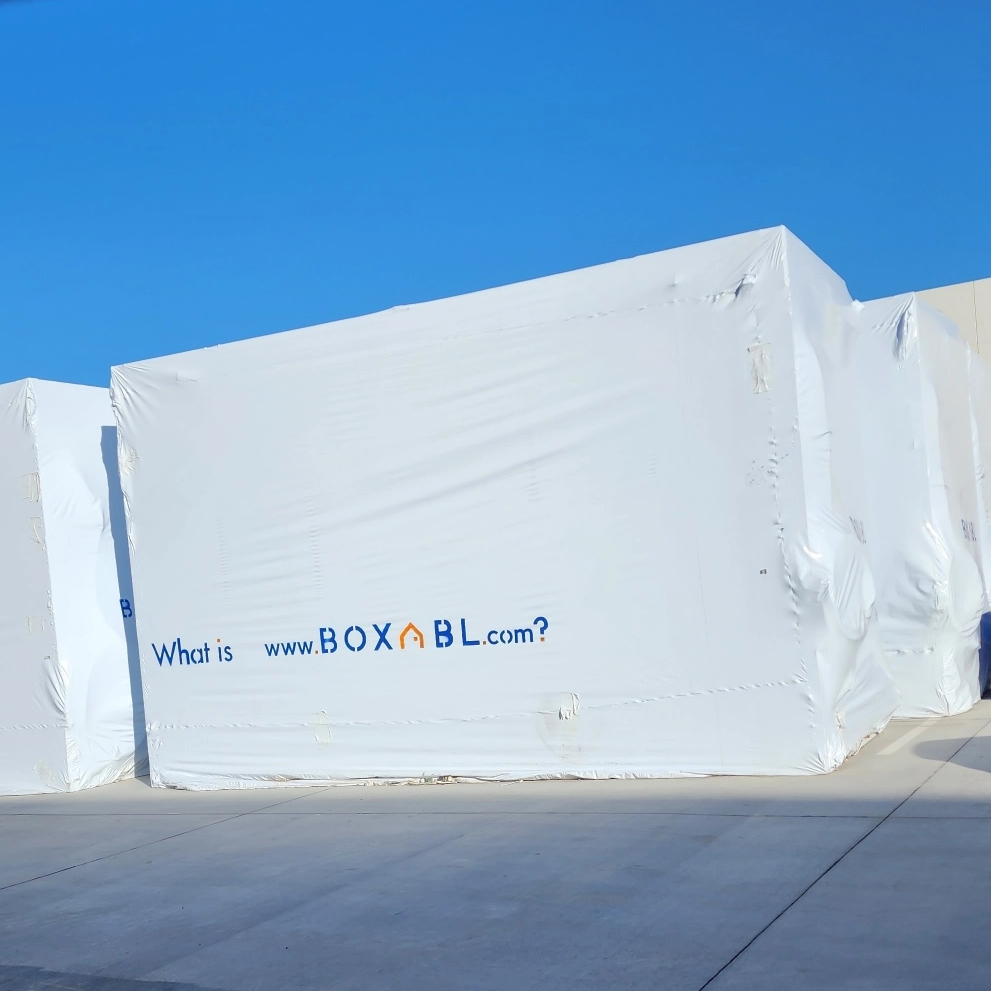
Material construction should reflect puncture exposure, handling frequency, module value, route severity, storage conditions, and expected outdoor duration. Standard film may suit smooth, low-risk units. Reinforced material is usually more appropriate for sharp edges, repeated handling, high winds, and long-distance transportation.
Relevant performance characteristics include tear resistance, puncture resistance, shrink direction, shrink ratio, seam compatibility, repairability, UV stability, and expected service time. The film must also remain workable during installation without becoming unnecessarily heavy or difficult to shrink evenly.
Thickness matters, but it cannot compensate for poor fit. Heavy film may still split over an uncapped bolt, overstretched corner, unsupported span, or weak seam. Well-fitted packaging with suitable local reinforcement can outperform a thicker but poorly installed enclosure.
The complete specification should address film construction, padding, closures, overlaps, access points, patching materials, and inspection requirements together.
A waterproof enclosure can fail when wet materials or humid air are sealed inside. The module should be clean and dry before packaging begins. Construction moisture, recent coatings, wet insulation, and trapped water should be addressed before the enclosure is closed.
Temperature cycling and long-term storage may justify ventilation openings, desiccants, drainage details, or scheduled moisture checks. The correct strategy depends on the module materials, route, climate, and expected storage duration.
Access should be designed rather than improvised. Resealable doors, inspection hatches, or reinforced openings can support checks and minor work without removing the entire cover. Each opening needs a wind-resistant closure that can be sealed again after use.
Application begins with a clean, dry module and a clear work area. Loose debris should be removed, exposed fasteners capped, and sharp roof corners, brackets, welds, lifting points, and trailer contacts protected with padding or guards.
Delicate finishes should be isolated from areas where the film, slings, straps, or other equipment could rub. Reinforcement patches can be added at predictable stress points before the main shrinking process begins.
The lower edge must be secured because wind entering beneath the enclosure can inflate it and place pressure on seams from the inside. Planned drainage, ventilation, and access features should remain functional when the base is closed.
Heat should be applied evenly so the film contracts without scorching, overstretching, or trapping large air pockets. Seams require sufficient overlap, especially at corners, roof transitions, penetrations, and repaired areas.
Unsupported spans should be minimized because repeated wind pressure can enlarge small defects. Corners should be shrunk progressively rather than forced tight in one pass. Wrinkles and folds should be corrected before they develop into stress lines.
Installers should use suitable protective equipment and follow the operating instructions for the heating tools. The heat source must remain in motion to avoid overheating one area. Completed packaging should appear firm and smooth without pulling seams or corners beyond their safe working range.
The right prefabricated modular building packaging should match the module’s finish, geometry, handling method, route, weather exposure, and storage period. For many finished units, a fitted reinforced heat-shrink enclosure provides a practical balance of weather resistance, puncture protection, and efficient application, while simpler covers may suit short, controlled journeys.
Suzhou Ecopack Co.,Ltd. supplies custom-fit and reinforced shrink-cover options for modular components, including configurations for UV exposure, corrosion control, and flame-retardant requirements. These tailored systems can reduce loose material, simplify installation, and help modules arrive ready for site assembly.
A: Custom-fit reinforced shrink wrap is often suitable for finished modules because it creates a tight barrier against rain, dust, wind, abrasion, and road debris.
A: Yes. Properly installed shrink wrap can protect modules during road transport and temporary outdoor storage, provided seams, edges, ventilation, and access points are correctly managed.
A: Reinforced film is better for sharp edges, exposed transport routes, repeated handling, irregular shapes, and modules with brackets, lifting points, or other puncture risks.
A: Shrink wrap generally fits more tightly and moves less in wind, while tarpaulins may suit short, controlled journeys where secure tensioning and regular inspection are possible.
A: Package only dry modules, assess temperature changes, and add suitable ventilation, drainage, or moisture-control materials when long storage or changing climates could trap condensation.
A: No. Shrink wrap protects the module’s surfaces and openings, while approved straps, supports, chains, and restraints prevent structural movement on the transport vehicle.


