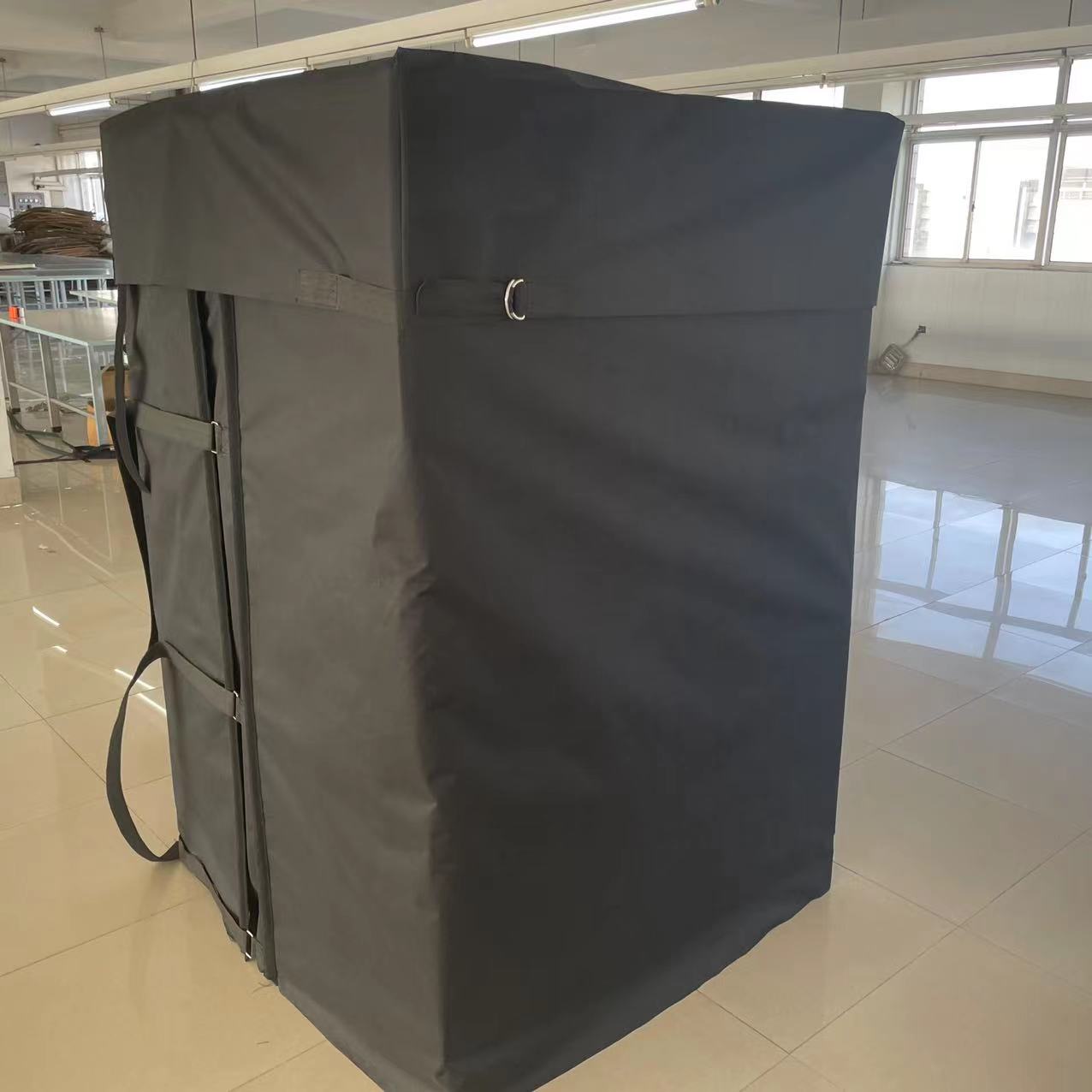
Commercial air-conditioning units and HVAC equipment are difficult to protect with one generic shipping cover. The same shipment may contain cabinet corners, projecting pipe connections, louvered panels, exposed fasteners, and a sensitive finished surface. Equipment is often handled at multiple points between a factory and an overseas site, so a loose cover can shift, snag, or leave openings exposed. Custom HVAC equipment shipping covers should be designed around the actual unit and its handling route rather than ordered as a standard rectangular tarpaulin.
For this application, fabric protective covers for equipment can provide a reusable or removable outer barrier using durable coated fabric and suitable closure details. ECOPACK's protective-cover range includes Oxford-fabric constructions with options such as zippers, straps, and attachment points. These are fabric covers, not heat-shrink films. This guide focuses on selecting the fabric, access openings, fastening system, and information required for a reliable export-cover order.
Design priority
Measure the complete HVAC unit, identify every protrusion and access panel, and decide where the cover needs to open before choosing fabric weight, zipper placement or fastening hardware.
What HVAC Export Covers Need to Protect
An HVAC unit may spend time in a factory yard, a container, a flatbed vehicle, or a partially completed construction site. Each stage presents a different combination of dust, rain, abrasion, and handling risk. A cover that works during stationary storage may fail if it flaps during transport or catches on forklift equipment. The correct specification should describe the most demanding relevant exposure, not simply ask for an “outdoor waterproof cover.”
Protective fabric mainly addresses external contamination and contact. It does not replace protective shipping frames, cushioning around fragile elements, or the cargo-securing system. Electrical enclosures, drain connections, refrigerant lines, and air intakes may require separate treatment according to the equipment manufacturer's shipping instructions. This is why custom HVAC export protective covers should be part of the shipment design rather than an afterthought placed over an already packed unit.
Select Fabric by Exposure and Handling Conditions
Oxford fabric can provide a practical base for protective machinery covers when the coating, fabric construction, and seams are selected for the intended environment. Buyers should ask about fabric composition, surface treatment, abrasion behavior, and suitable cleaning methods. The term “waterproof” by itself is incomplete if it does not address seam construction, zipper openings, and exposure conditions. Water can enter through poor closures even when the main fabric resists direct rain.
For export routes with repeated lifting, evaluate contact points at sharp panel corners and the possibility of chafing against frames or transport restraints. Reinforcement panels may be useful where fabric touches mounting feet or protruding brackets. If the project needs a temporary fully sealed shrink enclosure instead, the industrial protective cover range should be compared by material type and application, rather than assuming textile and film solutions perform the same function.
Measure the Unit and All Projections
Record overall length, width, and height after shipping accessories are fitted. A fan guard, pipe stub, junction box, control panel handle, or lifting eye may change the required shape. Dimension drawings should show these features from more than one view and identify which parts can carry cover pressure. Where units are packed on skids, include the skid height and any space required beneath the cover for tie-down access.
A cover that is too tight can strain seams or pull against vulnerable components. A cover that is too loose can flap or collect water in unsupported pockets. For large rooftop units, consider dividing the cover into panels with reinforced joints so installation remains manageable. The goal is controlled coverage that does not interfere with lifting, unloading, or necessary identification labels.
Equipment feature
Cover design consideration
Buyer information
Control panel
Access without removing full cover
Door position and opening direction
Pipe connections
Local clearance or protective pocket
Size and projection from cabinet
Lifting points
Openings or removable sections
Lifting drawing and sequence
Louvered surfaces
Avoid snagging and local pressure
Panel locations and surface sensitivity
Shipping skid
Bottom closure and tie-down access
Skid dimensions and anchor positions
Choose Zippers and Closures for the Workflow
A long zipper can simplify access to inspection panels, but it also creates a potential path for water and abrasion if positioned poorly. Place closures where technicians can reach them safely and where they will not rub directly against finished sheet metal during transit. Discuss zipper covers or protective flaps if rain exposure is relevant. HVAC cover zipper closures should be evaluated for repeated use, especially when units are inspected at several logistics stages.
Straps, buckles, and D-rings allow a cover to be secured around different parts of the unit, but attachment points must correspond to appropriate structural locations. Do not attach the cover to delicate fins or components that are not intended to take tension. For complex shipping arrangements, give the cover maker the equipment drawing and tie-down plan together. The industrial machinery cover application is most successful when fabric layout and transport handling are considered as one design problem.
Water-resistant fabric does not equal a sealed enclosure
Even a coated Oxford cover needs suitable seam, zipper and bottom-edge design to resist weather exposure. Do not assume it prevents condensation inside an HVAC unit or replaces the equipment manufacturer's shipping preparation.
Keep Installation and Removal Practical
Warehouse staff may be required to fit covers to units much larger than a single operator can comfortably handle. The design should show where the cover is lifted, unfolded, and fastened. Segmenting the cover or adding clearly marked front and rear positions can reduce installation errors. A cover that takes too long to install is more likely to be left loose or improperly secured during a busy dispatch shift.
The removal procedure is equally important. A receiver should be able to expose inspection panels and lifting points without cutting the fabric or placing tension on projecting components. If the cover is expected to return for reuse, choose a folding method and storage arrangement that protects zippers and straps. Repeated handling may justify extra reinforcement in areas that contact the ground or packaging edges.
Plan a Real Export Handling Trial
Fit the sample over a completed unit on its actual shipping base. Inspect clearance near controls, louvers, and pipework, and confirm that all intended lifting and restraining points remain accessible. Then carry out a controlled movement or loading rehearsal where practical. Watch for fabric tension, loose pockets, zipper contact, and interference with handling equipment. Correcting these details before production is usually easier than modifying covers after delivery.
When the cover includes several access openings, label them clearly in the sample drawing. Record any adjustments made during the trial, including strap length and closure direction. The approved sample should be the reference for future units of the same model. If the factory produces several HVAC cabinet variants, confirm which dimensions are shared and which require separate cover patterns.
A cover-development workflow
01
Survey — Measure the fully configured equipment and shipping base
02
Design — Identify fabric panels, openings, straps and reinforcement
03
Sample — Fit the cover and test access to key service and lifting points
04
Handle — Check cover behavior during realistic transfer movements
05
Approve — Freeze the pattern and closure specification for production
Prepare the HVAC Shipping Cover RFQ
A useful RFQ includes the equipment model or drawing, full overall dimensions, projecting connections, shipping route, expected weather exposure, and planned handling frequency. Specify whether the cover is disposable, returnable, or intended for repeated outdoor use. Explain any logo, label pocket, and color requirements only after the technical layout is clear. This helps ensure that decorative details do not interfere with functional openings.
For customized textile packaging, an OEM protective cover manufacturer needs accurate drawings and access information, while the industrial protective packaging supplier discussion should include the quantity and repeat-order requirements. A custom equipment cover quotation can then confirm fabric construction, fastening details, sample costs, and production lead times without making unsupported claims about universal weatherproofing.
HVAC equipment cover specification
✓ Full equipment and skid drawings
✓ All protrusions and sensitive panels marked
✓ Required zipper and access positions
✓ Fabric coating and seam construction discussed
✓ Straps tied to safe structural locations
✓ Fit trial and sample approval process defined
Conclusion
A good HVAC export cover follows the equipment's geometry and handling needs. Coated fabric, closures, reinforcement, and practical access must be specified together to avoid a cover that is difficult to install or vulnerable during transit. A detailed drawing and representative handling trial provide the strongest foundation for ordering custom protective covers for commercial HVAC equipment.
Frequently Asked Questions
Should HVAC covers be measured before or after equipment is crated?
Measure the shipping configuration actually used. Include projecting pipes, handles, pallet bases and protective frames so the finished cover fits without being overstretched.
Can a fabric cover alone prevent corrosion during sea transport?
A cover can shield surfaces from dirt and some external exposure, but corrosion management may also need moisture barriers, desiccants or other approved internal protection.
Which fastening details matter for reusable HVAC shipping covers?
Consider zipper placement, strap positions, lifting access and reinforced contact points. Test installation and removal with the equipment's normal handling procedure.