
Views: 0 Author: Site Editor Publish Time: 2026-07-03 Origin: Site


A machine may be scheduled for only a few days outdoors, yet shipping delays, installation changes, or repeated transport can extend its exposure far beyond the original plan. Under sustained sunlight and heat, ordinary polyethylene film can gradually lose flexibility and become more vulnerable to cracking, especially around seams and sharp edges.
UV resistant heat shrink wrap is designed for situations where that risk could compromise valuable equipment, vehicles, construction components, or finished cargo. Choosing it depends on exposure time, climate, handling conditions, load shape, and the cost of film failure—not simply whether an item will be placed outside.
UV resistant heat shrink wrap becomes practical when equipment or cargo will remain in an uncovered yard, port, depot, or jobsite for weeks rather than hours. Machinery awaiting commissioning, fabricated assemblies pending inspection, and modular components staged before installation are common examples. A short original schedule can expand because of customs holds, vessel changes, installation delays, inspection requirements, or project postponements. When the release date is uncertain, specifying UV protection at the beginning is often more practical than arranging an emergency rewrap after the film has started to deteriorate.
No universal outdoor service life applies to every film or location. Performance depends on the stabilizer formulation, UV intensity, temperature, climate, film thickness, installation quality, surface orientation, and total exposure period. Strong sunlight and elevated temperatures can accelerate the loss of flexibility and move polyethylene film toward brittle behavior. Buyers should therefore match the material to a defined exposure requirement and confirm that the exact film specification is intended for the expected storage conditions.
Exposure does not need to be continuous to create a problem. Repeated outdoor staging, seasonal storage, and regular open-trailer transport can create cumulative UV stress even when each individual period seems manageable. Risk increases in open areas with little shade, hot or high-altitude regions, coastal storage yards, and locations surrounded by pale concrete, water, sand, or other reflective surfaces.
Indoor storage generally lowers the risk but does not eliminate it when strong direct sunlight enters through windows or skylights. An asset left in a bright loading bay for several months may receive meaningful exposure, while fully enclosed warehousing and short loading periods normally present a lower UV risk. In borderline applications, UV resistant heat shrink wrap provides useful protection against exposure that is repeated, intense, seasonal, or difficult to predict.
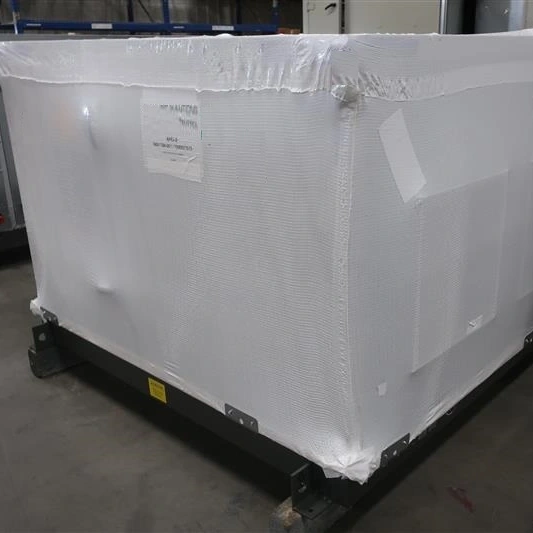
Weathering usually develops as a sequence rather than as a sudden, complete tear. The film may first fade, chalk, stiffen, or lose flexibility. Stress then becomes concentrated around welded seams, corners, lifting points, and protrusions. Small cracks or splits can allow rain, dust, salt air, and road contamination to enter, turning a surface-level material change into a failure of the protective enclosure.
Warning signs often appear before complete breakdown. Brittle areas, splitting beside seams, repeated tape repairs, and material that tears under light tension indicate that the film can no longer accommodate normal movement. Wind, handling, and temperature changes place additional strain on these weakened areas. Once the enclosure opens, the asset may require cleaning, drying, corrosion treatment, repair, reinspection, or complete rewrapping before shipment or commissioning can continue.
UV stabilization slows sunlight-related degradation, but it cannot compensate for poor installation. Weak seams, unprotected corners, and uneven heating can shorten service life even when the film itself is suitable for outdoor use. Material selection and installation quality must therefore be treated as parts of the same protective system.
Exposure time matters, but the cost of failure can matter more. Moderate sunlight may justify UV resistant protection when the enclosure covers polished paint, rubber seals, exterior plastics, hoses, wiring, electrical cabinets, control components, corrosion-sensitive metal, or finished goods that must arrive in presentable condition. The price of the film may be minor compared with cleaning, refinishing, repair, reinspection, production delays, or customer rejection.
A low-value component stored outside for two months may tolerate more packaging risk than a high-value control cabinet exposed for two weeks. The correct question is not only, “How long will it be outside?” Buyers should also ask, “What will happen if the enclosure opens before the asset reaches its destination?”
Shrink film provides environmental protection rather than structural protection. It cannot prevent damage caused by drops, crushing, forklift impact, inadequate blocking, or poor load restraint. The complete packaging plan must also address securement, edge protection, load support, drainage, and internal moisture control where necessary.
Pumps, motors, turbines, processing systems, fabricated assemblies, and electrical cabinets often wait between production, inspection, export, and installation. During this interval, they may face outdoor staging, port storage, road spray, dust, humidity, strong sunlight, and changing project dates. Industrial equipment & machinery covers can create a close temporary enclosure when ordinary indoor packaging would be too vulnerable.
The required construction depends on the equipment’s shape, finish, value, and storage route. Smooth machinery stored in a secure yard may need standard UV-stabilized film, while equipment with sharp brackets or repeated handling may require reinforcement. Corrosion-sensitive components may also need internal VCI materials, desiccants, ventilation, or another moisture-control method.
A machinery package should be designed around its weakest points. Sharp brackets need padding, access doors require complete sealing, and machined surfaces may need additional corrosion protection. UV resistance solves the sunlight problem, but it does not replace preparation for moisture, puncture, wind, or mechanical impact.
ATVs, motorcycles, boats, recreational vehicles, and snowmobiles combine paint, seats, rubber, wiring, trim, and exterior plastics. Seasonal outdoor storage or repeated open transport can expose these materials when loose or degraded film allows sunlight, rain, dust, and road contamination to reach the vehicle. A closely shrunk enclosure also reduces the billowing and repeated surface contact associated with a poorly secured tarp.
Power sport covers are especially useful when handlebars, mirrors, wheels, windscreens, antennas, and curved body panels make roll film difficult to control. A fitted construction can reduce excess folds, uneven tension, and gaps around projections. Reinforcement may be added when the vehicle will face abrasion, high wind, or extended open-trailer transport.
The cover still needs to match the actual storage environment. A vehicle kept indoors between occasional trips may require less UV protection than one stored outdoors throughout a season. Finished surfaces should also be clean and protected from direct contact with sharp fittings before the cover is heated into place.
Modular buildings, prefabricated panels, fabricated steel, large equipment, and irregular cargo may face prolonged sunlight, wind pressure, sharp corners, highway transport, rain, and jobsite dust during the same project. UV resistant film addresses solar degradation, but it does not automatically provide tear resistance or a precise fit. UV stability, puncture resistance, wind performance, and geometry should be evaluated separately.
Smooth modular units may be suitable for UV-stabilized standard film. Exposed fasteners, metal burrs, repeated lifting, or long flatbed routes can justify reinforced shrink wrap. Recurring complex assemblies may benefit from Custom-Fit Shrink Covers that reduce loose material and improve consistency between packaging teams.
Oversized cargo also creates installation challenges because broad surfaces can collect wind pressure. Complete seams, balanced shrinking, secure perimeter attachment, and padding at corners are essential. A suitable film can only perform properly when the enclosure remains continuous throughout staging and transport.

Heat shrink wrap is the practical starting point for smooth, regular-shaped goods that need a tight temporary barrier against sunlight, rain, wind, and dust. The film is draped over the asset, sealed, and heated until it conforms to the load. Proper shrinking reduces loose areas that can collect water or flap in the wind.
The phrase “heat shrink” describes the application method, not the film’s outdoor performance. Buyers must verify that the selected grade contains suitable UV stabilization. White color, high opacity, or greater thickness does not independently confirm that a film can withstand prolonged sunlight.
Important variables include film thickness, roll dimensions, color, opacity, planned exposure time, climate, transportation method, and load geometry. A standard film may provide sufficient protection when the asset has smooth surfaces, moderate handling requirements, and limited puncture risk. The material should still be selected according to the expected outdoor duration rather than initial price alone.
Reinforced Shrink Wrap is appropriate when UV exposure occurs alongside puncture, abrasion, wind, or repeated handling. Heavy machinery, bolt heads, metal burrs, irregular assemblies, open transport, and loads moved several times before installation are typical applications. Reinforcing layers or scrim structures improve resistance to tearing and puncturing while helping the enclosure remain stable under demanding conditions.
UV stabilization and reinforcement perform different functions. UV additives slow sunlight-related degradation, while reinforcement improves mechanical durability. A reinforced film without adequate UV protection may still become brittle outdoors, and a UV-stabilized standard film may still tear when placed directly over a sharp edge.
High-value cargo stored outside and later transported by flatbed may require both features. Corners, lifting points, brackets, and protrusions should still be padded before wrapping. Reinforcement supports good preparation; it does not eliminate the need for careful installation or secure load restraint.
Custom-fit shrink covers suit items with protrusions, curved surfaces, unusual dimensions, or shapes that are packaged repeatedly. A pre-cut or pre-formed cover can reduce on-site measuring, cutting, trimming, excess folds, loose sections, gaps, and variation between packaging teams. The installation process becomes more repeatable because the cover is designed around the asset rather than adjusted from a general-purpose roll.
A fitted cover can be manufactured from standard or reinforced material depending on the mechanical demands of the application. UV-blocking, corrosion-control, or flame-retardant functions may also be specified when the storage and transportation environment requires them.
Custom sizing does not automatically provide UV resistance. Buyers must still define the expected outdoor period, destination climate, handling conditions, transport route, and any corrosion or fire requirements. For repeated packaging, fitted UV-resistant construction can improve consistency because the geometry and material specification are developed together.
Load and Exposure Conditions | Most Suitable Starting Point |
Regular shape, moderate handling, prolonged sunlight | UV-resistant standard film |
Sharp edges, high wind, or repeated handling | UV-resistant reinforced film |
Irregular shape or recurring equipment model | UV-resistant custom-fit cover |
Complex shape plus demanding transport | Reinforced custom-fit cover |
UV resistant heat shrink wrap is most useful when sunlight exposure is prolonged, repeated, intense, or difficult to predict. The right specification should also reflect load shape, climate, transport conditions, handling stress, and the consequences of enclosure failure. Standard film may suit smooth loads, while reinforced or custom-fit constructions can better address sharp edges, wind, abrasion, or complex geometry.
Suzhou Ecopack Co.,Ltd. supplies heat shrink films, reinforced materials, and custom-fit covers for different industrial applications, helping users reduce rewrapping, simplify installation, and keep equipment protected throughout storage and transportation.
A: UV resistant heat shrink wrap is useful for equipment, vehicles, construction components, or cargo exposed to prolonged, repeated, or unpredictable sunlight during outdoor storage, staging, or transportation.
A: Outdoor service life varies with film formulation, UV intensity, temperature, climate, thickness, installation quality, and wind exposure. Confirm the rated exposure period for the specific product.
A: No. Thickness can improve puncture and tear resistance, but it does not prove UV stabilization. The film specification should separately confirm sunlight resistance and expected outdoor duration.
A: Choose standard film for smooth loads with moderate handling. Reinforced shrink wrap is more suitable when sharp edges, abrasion, strong wind, or repeated handling create mechanical stress.
A: Yes. Repeated direct sunlight through windows or skylights can contribute to UV exposure over time. Fully enclosed storage and brief loading periods generally present a lower risk.
A: Shrink wrap is heat-tensioned into a close-fitting enclosure, while a tarp remains loosely draped. A tight installation reduces flapping and gaps, but correct sealing and padding remain essential.


