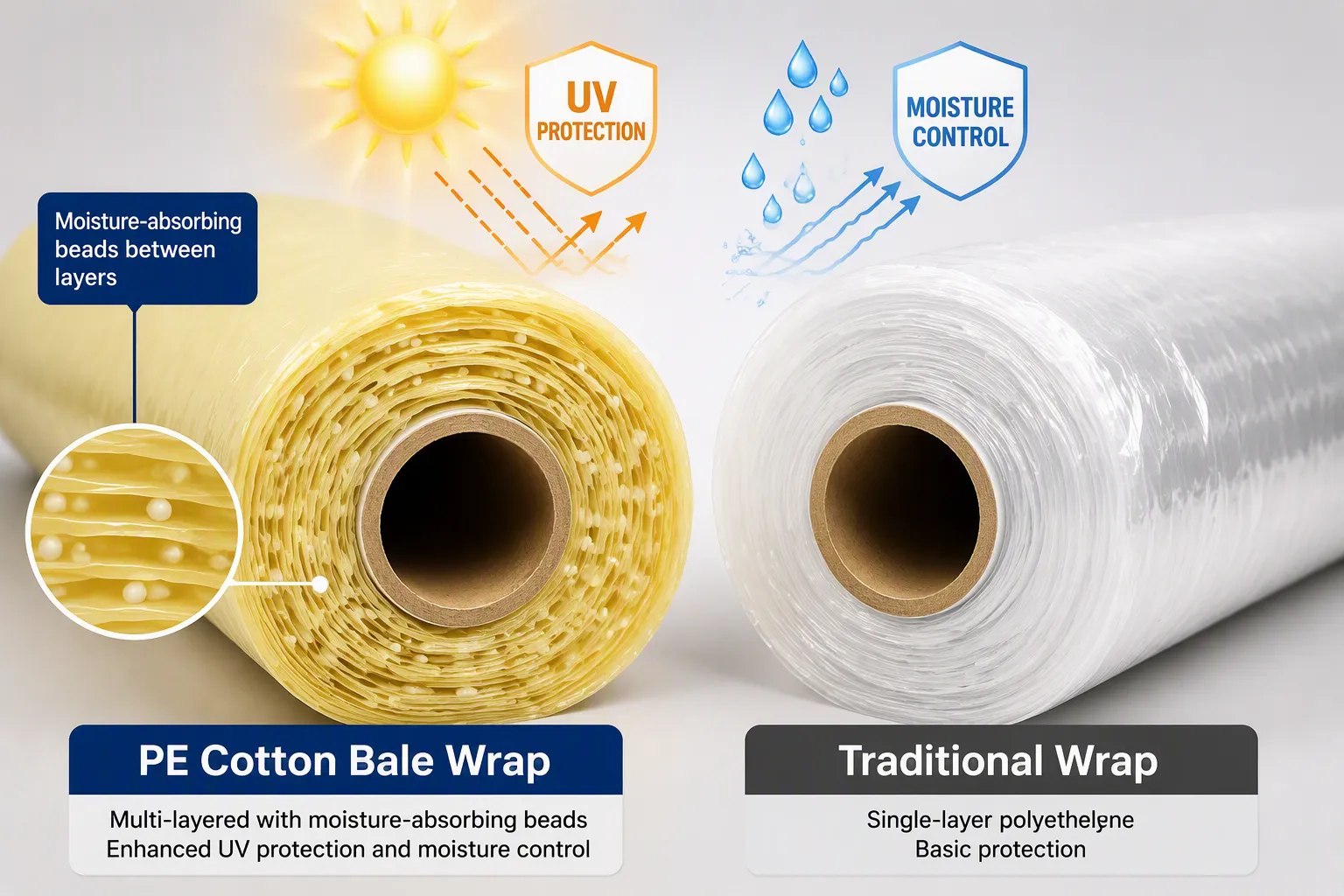
The better choice between cotton wrap film and traditional bale wrap depends on your farm size, how long you store bales, and your local weather. Picture yourself after harvest, looking at two options. You need protection that fits how your farm really works.
Both options offer real benefits. Traditional wrap costs less at first. Cotton wrap film gives better protection against moisture. Your own situation decides which one wins.
This post compares materials, how to apply them, durability, costs, and effects on the environment. You'll find out exactly what matters for your choice. New products like ECOPACK's cotton bale wrap come with advanced UV protection and multiple layers. These features change the value for many growers.
Keep your storage time and weather patterns in mind as you read. Those two things drive most buying choices.
Key Takeaways
Cotton wrap film gives great protection from water and sun, so cotton stays dry and mold-free for up to 24 months.
Traditional bale wrap is cheaper at first, but it can cost more over time because of damage, labor, and lower quality.
Cotton wrap film goes on by itself while baling, so it saves time and work compared to wrapping by hand with traditional wrap.
Use cotton wrap film for large farms or long-term storage; use traditional wrap for small farms with quick sale.
Cotton wrap film can be recycled and uses less material, so it harms the environment less than traditional wrap.
Your local climate should help you decide: humid areas need moisture control, hot areas need UV protection.
Figure out the full cost for each bale, including work time and wrapping again, to see what each choice really costs.
Defining Cotton Wrap Film and Traditional Bale Wrap
What Is Cotton Wrap Film?
Purpose-Built for Cotton Protection
Cotton wrap film is a special protective material made for cotton's unique needs. Cotton fibers are soft and soak up moisture easily. They must be shielded from water, dirt, and sun damage. A regular wrap cannot offer this level of care.
The film is built with reinforced polyethylene. This gives it strong resistance to tearing and stretching. A multi-layer process creates different features. The inner layer is non-tacky, so cotton fibers don't stick to it. Several reinforced layers resist tears and scrapes during handling. The outer layer is tacky, which keeps the module shape during transport and storage.
ECOPACK's cotton bale wrap shows this design well. It has a multi-layer moisture barrier. The water-repellent outer coating blocks rain. The reinforced middle layer adds strength. The non-absorbent inner layer keeps cotton dry. The film also blocks UV rays. This allows outdoor storage for up to six months.
The tapered shape helps it hold up in windy conditions. Over-edge coverage of 15 to 20 cm reduces rain exposure. This cuts down on cotton waste. The film can stretch up to 650% before breaking. This ensures a snug fit around each bale.
Common Materials and Thickness
The main material is polyethylene (PE). The pe cotton bale wrap formula is made for stretch and strength. The thickness ranges from 0.075 to 0.08 mm. This is thin enough to save money. It is thick enough to give reliable protection. Manufacturers offer custom widths and lengths. This lets you match the film to your specific baler.
What Is Traditional Bale Wrap?
Standard Polyethylene and Net Wrap
Traditional bale wrap comes in two main types. The first is woven polypropylene (PP). This material has a custom GSM range from 70 to 160. A common width for plastic bale wrap is 30 inches.
The second type is 100% HDPE with UV stabilization. This material offers UV resistance for 12 to 24 months. The HDPE version is thicker and more durable than the PP version.
Designed for Hay and Forage
Traditional bale wrap is a general-purpose packaging solution for hay and forage. These crops have different needs than cotton. The material is less stretchy than cotton wrap film. It may leave gaps that let in dust and moisture. The woven structure weakens in sunlight over time. It can tear or fray during transport.
For hay and forage, these limits are acceptable. Storage time is often shorter. The crop's value is lower per bale. But for cotton, the same limits create real risks. You may lose quality and face higher costs.
Key Differences at a Glance
Performance and Cost
The table below shows the main differences between the two options.
Aspect
Cotton Wrap Film
Traditional Bale Wrap
Durability
Exceptional weather resistance; strong UV, rain, and temperature protection; moisture barrier prevents mold; elasticity maintains bale integrity
Moderate durability; woven/nonwoven structure weakens in sunlight; prone to tearing/fraying during transport; can compromise bale integrity
Cost
Higher initial cost (film + machinery); long-term savings via reduced labor and minimized cotton loss; cost-effective for large-scale farms
Lower upfront cost; no specialized machinery needed; accessible for small farms; higher long-term costs due to damage, labor, and lower durability
Woven polypropylene/nonwoven; less elastic; may leave gaps for dust/moisture; lower weathering and tearing resistance
Application
Automated, applied during harvesting; reduces manual labor and time; consistent bale size/shape for easy handling
Manual or semi-automatic; labor-intensive and time-consuming; may require additional tying equipment; slows large-scale operations
Availability and Compatibility
Cotton wrap film needs special applicators. Not every baler can use it right away. You may need to buy new equipment. The payoff is faster application and less labor.
Traditional bale wrap is easy to find. Most balers can handle it without changes. This makes it the easy choice for small farms. The lower upfront cost is appealing. But you trade that for higher long-term costs from damage and labor. The pe cotton bale wrap offers a more durable packaging solution for long-term storage.
Choosing the right cotton bale wrap depends on your farm size and equipment. For large operations, cotton bale wrap from ECOPACK provides advanced protection. This cotton bale wrap maintains cotton quality during transport and storage. The right cotton bale wrap saves you money over time by reducing waste.
Material Comparison: PE Cotton Bale Wrap vs. Traditional Wrap
The materials inside each wrap decide how well your cotton survives storage. You need to know these differences before you pick. The right material protects your crop. The wrong one costs you money.
PE Cotton Bale Wrap: Material Advantages
UV Resistance and Additives
Sunlight destroys ordinary plastic wrap. Ultraviolet rays break down the polymer chains. The material becomes brittle. It cracks. It fails. Your cotton bale wrap must fight this process.
Manufacturers add chemical stabilizers to the pe cotton bale wrap formula. Hindered Amine Light Stabilizers (HALS) act as radical scavengers. They neutralize the damaging effects of ultraviolet radiation. High-quality films need enough HALS loading to keep structural integrity for six months or more of continuous field exposure.
The base color also matters. Light colors like yellow reflect heat and prevent destructive sun bleaching. However, the color itself does not block UV degradation. Chemical UV stabilizer additives serve as the main protectant. These chemical inhibitors stop the plastic from becoming brittle.
ECOPACK's cotton bale wrap includes UV protection rated for 6 to 18 months in harsh climates like Australia and Brazil. The aging resistance extends service life beyond two years. This means your bales stay intact through long, sunny summers.
Breathability and Moisture Control
Cotton breathes. Your wrap must allow that. Trapped moisture creates mold. Mold destroys fiber quality. The pe cotton bale wrap uses active moisture-absorbing additives. These keep bale moisture below 10 percent.
The multi-layer construction creates a moisture barrier. The water-repellent outer coating blocks rain. The reinforced middle layer adds strength. The non-absorbent inner layer keeps cotton dry. This design prevents condensation from forming inside the bale.
Traditional Wrap Composition
Polyethylene Strength and Flexibility
Traditional bale wrap uses Linear Low-Density Polyethylene (LLDPE). Manufacturers produce this material through multi-layer co-extrusion technology. Available thicknesses range from 25 to 30 microns. This material offers decent strength for general use.
The flexibility of LLDPE allows the wrap to stretch around bales. It conforms to the shape. It holds tight. But this material lacks the specialized additives found in cotton-specific products. It does not control moisture actively. It does not block UV rays as effectively.
Net Wrap's Open Structure
Net wrap takes a different approach. Its open weave structure allows air circulation. This works well for hay and forage. These crops need ventilation to dry properly. The open structure lets moisture escape.
But this same openness creates problems for cotton. Dust and dirt pass through the gaps. Rain can penetrate. The woven structure weakens in sunlight over time. It can tear or fray during transport. For cotton, these limits create real risks.
Climate Performance
Humid and Wet Conditions
High humidity challenges any packaging solution. Traditional wrap lacks active moisture control. Water vapor condenses inside the bale. Mold grows. Quality drops.
Cotton wrap film performs differently. The operating temperature range spans from -59°F to 104°F (-50°C to 40°C). The material remains stable without brittling in cold or softening in heat. This ensures structural integrity during extreme summer conditions.
The active moisture-absorbing additives directly counter high humidity. They prevent moisture accumulation. This is critical for mold prevention. The cotton bale wrap supports up to 24 months of outdoor storage in persistently humid environments. Traditional wraps lack these additives and fail much sooner.
Hot and Dry Conditions
Heat creates different problems. Intense sunlight degrades plastic. The material becomes brittle. It cracks. It loses strength. Traditional wrap without UV stabilizers degrades rapidly outdoors.
The pe cotton bale wrap handles heat better. The UV protection keeps the material flexible. The light-colored surface reflects solar radiation. This reduces heat buildup inside the bale. Your cotton stays cooler. It maintains its natural color and quality.
The table below summarizes the key performance differences.
Performance Metric
Cotton Wrap Film Specification
Implication for High Humidity & Extreme Heat
Operating Temperature
-59°F to 104°F (-50°C to 40°C)
Remains stable without brittling in cold or softening/melting in heat, ensuring structural integrity during extreme summer conditions.
Moisture Control
Active moisture-absorbing additives keep bale moisture below 10%
Directly counters high humidity by preventing moisture accumulation, which is critical for mold prevention.
Storage Duration in Humid Climates
Up to 24 months of outdoor storage
Demonstrates long-term reliability in persistently humid environments, outperforming traditional wraps that lack such additives.
The base color primarily dictates solar reflection. Light colors like yellow reflect heat and prevent destructive sun bleaching. However, the color itself does not block UV degradation. Chemical UV stabilizer additives serve as the primary protectant. These chemical inhibitors stop the plastic from becoming brittle.
Manufacturers incorporate UV stabilizers, specifically Hindered Amine Light Stabilizers (HALS). These chemical additives act as radical scavengers. They neutralize the degrading effects of ultraviolet radiation. High-quality films require sufficient HALS loading to guarantee structural integrity for six months or more of continuous field exposure.
Your climate determines which wrap protects your cotton best. Humid regions demand active moisture control. Hot regions demand UV protection. The cotton wrap film delivers both. Traditional wrap offers basic protection at a lower price. You must weigh these factors against your local conditions.
The packaging choice affects your bottom line. Quality cotton commands higher prices. Damaged cotton sells at a discount. The right packaging solution preserves your investment. The wrong one erodes your profits.
Application Process: Labor and Equipment
The way you put on each wrap changes your daily work. It also changes your labor costs. Knowing these differences helps you plan your harvest season with confidence.
Applying Cotton Wrap Film
Specialized Applicators and Time Savings
Cotton wrap film needs special applicators on your baler. These machines put the film on automatically while you bale. You don't need extra workers waiting. The film stretches around each bale as the baler shapes it. This makes a tight, even seal every time.
The automated system saves you a lot of time. One operator runs the whole process from the tractor cab. You skip all manual wrapping steps. This speed boost helps most during busy harvest times. You can bale more cotton in less time. Your crew works on other important jobs instead of wrapping bales by hand.
Skill Level Required
Running cotton wrap applicators needs some training. You need to know film tension settings and overlap ratios. Most makers give clear setup guides. You can learn the basics in a few hours. The system then runs smoothly without constant changes.
You also need to check film supply levels. Changing rolls takes about five minutes. The applicator warns you when film is low. This easy upkeep keeps your work running well. Most farmers learn the system in their first season.
Applying Traditional Bale Wrap
Standard Baler Compatibility
Traditional bale wrap works with most normal balers. You rarely need special equipment. Big baler brands use traditional wrap with simple setting changes. John Deere balers might need you to take off two pressure wheel brackets. Other brands may need brake and pull‑test tension adjustments. These changes take minutes, not hours.
This compatibility makes traditional wrap good for smaller farms. You don't buy new machines. Your current equipment does the job. The learning curve is small.
Labor Intensity and Adjustments
Traditional wrap needs more hand labor. With a single bale wrapper, skilled workers can wrap 25 or more bales per hour. You can double this with an in‑line wrapper. But you still need specific workers for this job. They must handle each bale one by one.
The table below shows the key differences in application.
Aspect
Cotton Wrap Film
Traditional Bale Wrap
Application method
Automatic while baling
By hand or partly automatic
Bales per hour
Limited by how fast baler works
25 or more with single wrapper; twice with in‑line
Worker requirement
One operator
A crew just for wrapping
Baler modifications
Need special applicator
Small tension changes
Equipment Costs and Compatibility
Upfront Investment for Cotton Wrap
Cotton wrap applicators cost more than older systems. You pay for the special machine. You also pay for setup and installation. This upfront cost can seem big. But you get back these costs through less labor and fewer damaged bales. The time savings add up over many seasons.
Retrofitting Existing Machinery
You can change many current balers to use cotton wrap applicators. Makers offer conversion kits for common baler models. This costs less than buying a new baler. You keep your current machine while getting new wrapping features. Check with your equipment dealer for compatibility details.
The right choice depends on your farm size. Big farms gain from the automation and speed of cotton wrap systems. Small farms may find traditional wrap good enough. Your labor supply and harvest schedule should guide your choice. Think about your setup carefully before buying new equipment.
Durability and Storage Performance
Your bales face harsh conditions from the moment they leave the field. Rain, humidity, sunlight, and rough handling can all damage your crop. The right packaging material determines whether your cotton stays in top condition or loses value.
Moisture and Contamination Protection
Water Resistance and Sealing
Water is a major threat to your crop. Moisture leads to mold, discoloration, and fiber damage. You need a wrap that keeps water out completely.
PE cotton wrap film creates a 100% vapor barrier that blocks all moisture from getting in. This keeps bales dry even in humid places. The airtight seal stops environmental humidity from reaching the cotton fibers.
Several sealing methods work together to achieve this protection:
The high-cling inner layer creates a hermetic seal that blocks moisture, dust, and contaminants from the moment the bale is formed.
The multi-layer construction uses multiple polyethylene layers to optimize strength and barrier properties.
Proper handling protocols help prevent micro-tears that could compromise the seal.
UV stabilization and thermal resistance maintain seal integrity under extreme temperatures and sunlight.
Traditional wrap often leaves gaps. The woven structure lets moisture seep through. You might find wet spots inside your bales after a rainstorm. That moisture leads to quality loss.
Preventing Mold and Mildew
Mold ruins cotton fiber. It causes discoloration and weakens the strands. Bales with mold sell at a steep discount or get rejected entirely.
The cotton wrap film includes an anti-microbial coating on the inside. This coating directly tackles mold spores. It stops them from growing on your crop. The airtight seal also prevents the humid conditions that mold needs to thrive.
PE cotton wrap film creates a 100% vapor barrier that blocks all moisture from getting in. This keeps bales dry even in humid places. The airtight wrap seals bales completely, stopping environmental humidity from reaching the cotton fibers. An anti-microbial coating on the inside of the film directly tackles mold spores.
This cotton bale wrap gives you confidence in unpredictable weather. You do not need to worry about sudden rain showers. Your cotton stays dry inside.
Long-Term Storage Capabilities
Short-Term vs. Extended Storage
Your plans change how you think about packaging. A few weeks in the field needs less protection. You need durability in storage that lasts through changing seasons.
Traditional wrap works for short-term needs. It keeps dust and light rain away for a while. But it breaks down over time. The material weakens. Gaps form. Moisture gets in.
Cotton bale wrap supports long-term storage for up to 24 months. The multi-layer construction holds up against weather. The UV protection keeps the film flexible. You can store bales outdoors without worrying about degradation.
ECOPACK's cotton bale wrap features a 50% overlap for enhanced protection. This overlap creates double coverage at every seam. Water cannot find a path through the layers. This design ensures your cotton stays protected month after month.
Impact of Sunlight and Weathering
Sunlight is the second biggest threat to your bales. UV rays break down plastic. The wrap becomes brittle. It cracks. It fails.
Traditional wrap without UV stabilizers degrades rapidly outdoors. You might see cracking within weeks. The material loses its strength. Your cotton becomes exposed.
The film uses UV stabilizers to fight this degradation. It remains flexible and strong. It does not become brittle. The light-colored surface reflects heat. Your cotton stays cooler.
Field Performance and Handling
Tear Resistance During Transport
Moving bales from field to mill puts stress on the wrap. You drag them. You stack them. You load them onto trucks. Each step risks tearing the wrap.
Cotton wrap film offers high tear resistance. The multi-layer construction prevents rips from starting. If a tear does begin, the material resists propagation. The tear stays small.
The multi-layer construction gives this cotton bale wrap exceptional durability. Traditional wrap tears more easily. The woven structure snags on rough surfaces. You might need to re-wrap damaged bales. That costs time and money.
Ease of Removal at the Mill
The mill needs to remove the wrap quickly. Difficult removal slows down processing. It adds labor costs.
The cotton wrap film has a non-tacky inner layer. Cotton fibers do not stick to it. The wrap peels away cleanly. No fibers are lost. No residue remains.
Traditional wrap can be harder to remove. Fibers stick to the woven material. You lose some fiber with each bale. Over thousands of bales, that loss adds up.
The right packaging choice protects your investment. Cotton bale wrap from ECOPACK delivers the durability you need for long hauls and transport.
Cost Efficiency: Cotton Bale Wrap vs. Traditional Wrap
The price tag on the roll tells only part of the story. You need to look at the total cost per bale, not just the upfront price. Labor, repairs, and lost cotton all add to your real expenses. This section breaks down those numbers so you can make a smart choice.
Initial Purchase Costs
Price Per Bale Comparison
Cotton wrap film costs more per bale than traditional wrap. The specialized materials and multi-layer construction drive the price up. You might pay 20 to 30 percent more for each roll. That difference adds up across a season.
Traditional bale wrap costs less at the register. The simpler materials keep the price down. For a small farm wrapping a few hundred bales, that savings feels real. You keep more cash in your pocket at harvest time.
But the lower price hides a bigger cost. Traditional wrap tears more easily. It fails faster in sunlight. You may need to re-wrap damaged bales. Each re-wrap costs you film, labor, and time. Those costs eat into your initial savings.
Volume Discounts and Bulk Pricing
Buying in bulk changes the math. Manufacturers offer volume discounts for large orders. The price per roll drops as your order grows. Large farms can negotiate better rates. Small farms pay more per roll because they buy less.
ECOPACK offers tiered pricing for cotton bale wrap. The more you order, the lower your cost per bale. This makes the premium product more affordable for big operations. You should ask about bulk pricing before you decide.
Labor and Time Savings
Reduced Application Time
Cotton wrap film applies automatically during baling. One operator handles the entire process from the tractor cab. You do not need extra workers standing by. The film stretches around each bale as the baler shapes it.
Traditional wrap needs manual labor. Workers must handle each bale individually. A skilled crew can wrap 25 or more bales per hour with a single wrapper. You might double that with an in-line system. But you still pay those workers for their time.
The table below shows the labor difference.
Cost Factor
Cotton Wrap Film
Traditional Bale Wrap
Application labor
One operator
Crew of 2-4 workers
Bales per hour
Limited by baler speed
25+ with single wrapper
Re-wrapping needed
Rare
Common after damage
Total labor cost
Lower
Higher
Fewer Repairs and Re-Wraps
Cotton wrap film resists tears and punctures. The multi-layer construction prevents damage during transport. You rarely need to re-wrap a bale. Each bale stays sealed from field to mill.
Traditional wrap tears more easily. The woven structure snags on rough surfaces. You might find damaged bales after loading or transport. Each damaged bale needs attention. You either re-wrap it or accept the quality loss. Both options cost you money.
Hidden Costs and Savings
Cotton Quality and Market Price Impact
The biggest hidden cost is lost quality. Moisture ruins cotton fiber. Mold and mildew degrade the grade. A lower grade sells at a discount. That discount can wipe out any savings from cheaper wrap.
Moisture is a primary cause of degradation for baled cotton, leading to mold, mildew, and a loss of fiber quality and value. A moisture resistant wrap forms a critical barrier during storage and transit, preserving the cotton's grade and market price.
Cotton wrap film creates a moisture barrier that keeps your cotton dry. The airtight seal blocks humidity. The anti-microbial coating stops mold growth. Your cotton keeps its grade. You sell at full market price.
Traditional wrap leaves gaps. Moisture seeps through. Your cotton loses quality. You accept a lower price or face rejection at the mill. That loss affects your bottom line more than any film price difference.
Waste Disposal and Cleanup Costs
Every wrap creates waste. You must dispose of used film properly. Traditional wrap breaks down in landfills but leaves microplastics. Cotton wrap film is recyclable through specialized programs. Check with your local recycler for options.
Cleanup costs also matter. Torn wrap fragments scatter across fields. You spend time collecting them. That labor adds to your costs. Cotton wrap film stays intact, reducing cleanup time.
The true cost efficiency of your packaging choice depends on the full picture. Calculate your total cost per bale. Include film price, labor, re-wraps, and quality losses. You might find that cotton wrap film saves you money despite the higher upfront price. The right packaging protects your investment and your profits.
Environmental Impact: Which Wrap Is Greener?
Your choice of wrap affects more than your money. It also changes your environmental footprint. Farmers today care about sustainability. You want to protect your crop without hurting the land. This section compares both options through an environmental view.
Material Footprint
Plastic Usage and Thickness
Cotton wrap film uses less material per bale than older wraps. The thin polyethylene layers stretch tightly around each bale. You get full coverage without extra waste. The film fits the bale shape, leaving little scrap behind.
Older wraps often need many layers or larger amounts of material. Burlap, netting, and twine add bulk. You handle more material for the same protection. That extra material means more waste at the end of each season.
The making process also differs. Polyethylene production uses less energy. Making paper or burlap uses more energy. This difference shows up in the overall environmental impact of each product.
Recyclability and Disposal Options
Recyclability matters when you finish using the wrap. Cotton wrap film can be turned into new products. Many recycling programs take clean polyethylene film. You can collect used wrap and send it to a recycler.
Older materials often end up in landfills. Polypropylene twine and netting are single-use items. They do not break down easily. You throw them away after feeding time. The waste piles up quickly.
The older wrap uses non-biodegradable material like polypropylene. This is used as a disposal or single-use item that is thrown away after feeding time. If in a very small farm the farmer unwraps one bale, seven bales per week, and thirty bales in a month, imagine the pile of waste that builds up. The landfill and the microplastics overflow.
Degradation and Soil Contamination
Breakdown in Landfills
Plastic in landfills does not disappear. It breaks into smaller pieces called microplastics. These tiny particles last for decades. They can leak into soil and water. This creates long-term problems for the environment.
Cotton wrap film also contains plastic. But its thinner profile means less material per bale. You create less waste overall. The recyclability of the film offers a better end-of-life option.
Impact on Field Health
Wrap pieces sometimes end up in your fields. Torn bits blow away during transport. They mix with soil. Over time, plastic particles build up. They do not break down naturally. They can affect soil structure and health.
Choosing a wrap that stays whole reduces this risk. Cotton wrap film resists tearing. It stays on the bale until removal. You spend less time picking up debris. Your fields stay cleaner.
Sustainable Alternatives and Innovations
Biodegradable Options
The packaging industry is making new materials. Biodegradable films break down faster than traditional plastics. They offer hope for future cotton protection. But these products are still new. Their performance in harsh field conditions needs more testing.
ECOPACK focuses on sustainability in its making. The company designs products with recyclability in mind. Its cotton bale wrap uses materials that can re-enter the production cycle. This commitment to environmentally friendly practices helps farmers lower their environmental impact.
Industry Trends and Regulations
Rules around plastic waste are getting tighter. Many areas now limit single-use plastics. Farmers must change their practices. Choosing recyclable wrap puts you ahead of these changes.
The table below compares the environmental impact of both options.
Environmental Aspect
PE Cotton Wrap Film
Older Materials
Energy Use in Making
Lower
Higher
Material Waste
Less
More
Transportation Emissions
Reduced
Higher
Recyclability
Recyclable
Often non-recyclable
Durability & Protection
Superior
Less durable
Your choice of wrap shows your values. Sustainability and environmental impact should guide your decision. The right packaging protects your cotton and the environment. You can reach both goals with careful selection.
Best-Use Scenarios: Matching the Wrap to Your Farm
Your farm's size, how long you store bales, and your local weather point you toward one wrap over the other. No single answer fits everyone. You need to match the packaging to your actual operation. This section helps you see which scenario fits your situation.
Small Farms and Short-Term Storage
When Traditional Wrap Makes Sense
Small farms with quick turnaround times often do well with traditional wrap. You harvest, bale, and sell within weeks. Your cotton does not sit in the field for months. The lower upfront cost of traditional wrap keeps your expenses down. You avoid the investment in specialized applicators.
Short-term storage means less exposure to weather. Your bales face fewer rain events and less intense sunlight. Traditional wrap handles these conditions adequately. You move your cotton to the gin before the material degrades.
Cost-Saving Strategies
You can stretch your budget further with smart choices. Use UV-stabilized plastic wrap for outdoor storage. This material reduces dry matter losses to only 7 percent. Unwrapped bales stored outside lose 35 percent of their value. That difference directly saves feed value and reduces waste.
Choose self-adhesive plastic wrap to eliminate twine. This choice offsets part of the wrapping material cost. You also save labor by skipping separate twine application. Every minute you save during harvest matters.
A low-cost manual wrapper offers another path. The "Poor Man's Bale Wrapper" costs under $600. Conventional hydraulic wrappers run $6,000 to $12,000. This manual option needs no power source. One person operates it without tractor fuel or hydraulic costs. It wraps a bale in just over one minute. That speed beats many hydraulic models. The lightweight aluminum frame weighs only 35 pounds. It breaks into two pieces for easy storage and transport. You reduce maintenance and storage overhead significantly.
Large Operations with Long Storage Needs
When Cotton Wrap Film Pays Off
Large farms storing cotton for months need serious protection. The pe cotton bale wrap delivers that protection. Its multi-layer construction blocks moisture completely. The UV stabilizers keep the film flexible under intense sun. Your cotton stays dry and clean through changing seasons.
The automation of cotton wrap film saves you labor costs. One operator handles the entire baling process. You do not hire extra workers for wrapping. The speed of application matches your baler's pace. You process more bales in less time. This efficiency directly improves your bottom line.
The durability of cotton wrap film reduces re-wrapping. Traditional wrap tears during transport. You spend time and money fixing damaged bales. The cotton wrap film resists punctures and tears. Each bale stays sealed from field to mill. You avoid the hidden costs of quality loss.
Climate Considerations
Your local weather should drive your choice. Humid regions demand active moisture control. The cotton wrap film includes moisture-absorbing additives. These keep bale moisture below 10 percent. Mold cannot grow in dry conditions. Your cotton maintains its grade.
Hot, sunny regions demand UV protection. The cotton wrap film blocks harmful rays for 6 to 18 months. The light-colored surface reflects heat. Your cotton stays cooler and retains its natural color. Traditional wrap without UV stabilizers fails quickly in these conditions.
ECOPACK's Cotton Bale Wrap Solution
Features and Benefits
ECOPACK's cotton bale wrap stands out as a premium option. The multi-layer moisture barrier blocks all water. The water-repellent outer coating deflects rain. The reinforced middle layer adds strength. The non-absorbent inner layer keeps cotton dry.
The 50 percent overlap creates double coverage at every seam. Water cannot find a path through the layers. The tapered shape holds up in windy conditions. Over-edge coverage of 15 to 20 cm reduces rain exposure. The film stretches up to 650 percent before breaking. This ensures a snug fit around each bale.
The anti-microbial coating stops mold growth. The non-tacky inner layer prevents fiber sticking. Your cotton peels away cleanly at the mill. No residue remains. No fibers are lost.
Ideal Applications
This cotton bale wrap suits large operations and long-distance export. You store bales outdoors for up to 24 months. The wrap maintains its integrity through extreme temperatures. The operating range spans from -59°F to 104°F. Your cotton stays protected in any climate.
Export logistics demand reliable packaging. Your bales travel by truck, ship, and rail. They face rough handling and changing weather. The cotton bale wrap withstands these challenges. Your cotton arrives at its destination in top condition. This packaging protects your investment across the entire supply chain.
The efficiency gains extend beyond the field. You spend less time on repairs and re-wrapping. You reduce waste disposal costs. You maintain cotton quality from harvest to delivery. For large operations, the pe cotton bale wrap delivers value that traditional wrap cannot match.
Your farm size, storage duration, and climate point you toward the right choice. Cotton wrap film delivers superior moisture protection and long-term storage. Traditional wrap offers lower upfront costs and simpler equipment needs.
Evaluate your operation against these comparison points. Calculate your total cost per bale. Include labor, re-wrapping, and potential quality losses. That number reveals the true value of each option.
ECOPACK provides tailored packaging solutions for every scale. From small farms to large exporters, you can find a cotton wrap that fits your needs. Choose the option that protects your cotton and your profits.
FAQ
How long can I store bales with cotton wrap film?
You can store bales outdoors for up to 24 months with cotton wrap film. The multi-layer construction blocks moisture completely. UV stabilizers keep the film flexible under intense sunlight. Your cotton stays dry and clean through changing seasons.
Will cotton wrap film work with my existing baler?
Many current balers accept cotton wrap applicators through conversion kits. You keep your existing machine while gaining new wrapping features. Check with your equipment dealer for compatibility details. The installation takes minutes, not hours.
Does cotton wrap film prevent mold growth?
Yes. The film includes an anti-microbial coating on the inside. This coating directly tackles mold spores. The airtight seal also prevents the humid conditions mold needs to thrive. Your cotton maintains its grade and market value.
How does cotton wrap film compare on cost per bale?
Cotton wrap film costs 20 to 30 percent more per roll than traditional wrap. But you save on labor, re-wrapping, and quality losses. Calculate your total cost per bale including all factors. The premium product often saves money for large operations.
Is cotton wrap film recyclable?
Yes. Clean polyethylene film can go through many recycling programs. You collect used wrap and send it to a recycler. The thinner profile means less material waste per bale. This reduces your environmental footprint compared to older materials.
What climate conditions does cotton wrap film handle best?
The film operates from -59°F to 104°F. It remains stable without brittling in cold or softening in heat. Active moisture-absorbing additives counter high humidity. UV protection handles hot, sunny regions for 6 to 18 months.
How much stretch does cotton wrap film offer?
The film stretches up to 650 percent before breaking. This ensures a snug fit around each bale. The tight seal prevents gaps where moisture and dust could enter. Your cotton stays protected from field to mill.
Does cotton wrap film require special training?
You need basic training on film tension settings and overlap ratios. Most makers provide clear setup guides. You can learn the basics in a few hours. The system then runs smoothly without constant changes.