
Views: 0 Author: Site Editor Publish Time: 2026-07-15 Origin: Site


Equipment can leave a factory in perfect condition and still arrive with moisture marks, dust contamination, faded surfaces, or abrasion caused by loose packaging. Buyers often focus on thickness first, yet fit, exposure time, handling conditions, and installation method usually determine whether a cover performs as expected.
Custom protective covers address these variables by matching the equipment’s shape and protection needs. The sections ahead explain when customization is worthwhile, how to evaluate materials and measurements, which cover format suits different environments, and what to check before approving a quotation or production sample.
Before specifying custom protective covers, map every stage in which the equipment will remain covered. A machine stored for one shift inside a clean factory does not face the same conditions as a skid-mounted system waiting outdoors for six weeks, crossing a port, or travelling on an open vehicle. Direct rain, humidity, condensation, sunlight, wind, airborne dust, salt air, road spray, and chemical residue should be treated as separate hazards because they affect material and sealing requirements differently.
Protection duration and handling frequency also shape the design of custom protective covers. Repeated lifting, loading, inspection, and re-covering can create abrasion at corners or stress around protrusions. A cover designed only for static warehouse storage may fail during export handling even when the material is nominally waterproof.
A standard tarp or generic cover can be reasonable for short-term, sheltered use on simple, low-value equipment. Custom protective covers become more useful when the asset is expensive, irregularly shaped, repeatedly shipped, exposed for a long period, or built with ports, frames, panels, and connection points that cannot be left open.
Poorly specified custom protective covers may still fail. Loose material can flap in wind, pool water, rub against painted surfaces, or leave gaps around corners. Roll-fed film can also require repeated measuring, trimming, taping, and adjustment when operators pack the same equipment model again and again. A close-fitting cover is worthwhile when it improves protection or workflow; customization should not be purchased merely for appearance.
Buying condition | Standard cover may be enough | Custom cover is usually better |
Equipment shape | Simple and rectangular | Irregular, contoured, or protruding |
Exposure period | Brief and sheltered | Extended or repeated |
Equipment value | Low or easily replaced | High-value or sensitive |
Environment | Indoor and controlled | Outdoor, dusty, humid, or windy |
Packing process | Occasional | Repeat production or shipment |
Materials for custom protective covers should be chosen by performance requirement rather than by a vague label such as “heavy duty.” Buyers should confirm resistance to water, UV exposure, tearing, puncture, abrasion, and the expected temperature range. Metal equipment may also need temporary corrosion protection, while some projects call for flame-retardant properties or reinforced construction around sharp edges.
More thickness is not automatically better. Indoor dust protection may need a lighter, easier-to-handle cover, whereas heavy machinery, long-haul transport, or rough handling can justify a reinforced structure. ECOPACK protective covers are available in cross-linked LLDPE/PE configurations with optional UV resistance, reinforcement, VCI treatment, and flame-retardant performance. The relevant combination should be selected around the route and exposure rather than added as a default package.
Waterproofing in custom protective covers also needs context. Direct rain calls for effective material and secure sealing, but long storage periods raise a separate question: can humidity or condensation remain trapped beneath the enclosure? Buyers should discuss moisture behavior, openings, and the condition of the equipment before packing instead of assuming that a fully closed cover solves every corrosion risk. Proper sealing and treatment of vulnerable edges remain part of the final protection system.
For custom protective covers, length, width, and height are only the starting point. Measurements should capture the widest and highest points as well as handles, pipes, valves, frames, vents, control panels, cable entries, lifting lugs, and removable components. Sharp corners, fragile finishes, high-contact areas, and pressure-sensitive surfaces should be marked so reinforcement or clearance can be planned.
The supplier should also know the required bottom overlap, sealing allowance, ground clearance, and any areas that must stay accessible. Photographs and annotated drawings are often more useful than a bare dimension sheet; CAD files, 3D models, sketches, or a physical sample can support complex designs. Transport method, destination climate, storage period, handling frequency, and exposed metal surfaces complete the equipment profile.
Even well-made custom protective covers lose value when they are difficult to install correctly. Decide whether workers need access to doors, labels, lifting points, inspection panels, or connection areas while the cover remains in place. Reinforced corners, access flaps, vents, straps, identification printing, or marked lifting points should be specified only when they serve that workflow.
The application method must be realistic for the packing site. Heat-activated custom protective covers require suitable sealing space, a heat gun, shrink tunnel, or infrared equipment, and operators trained to apply controlled heat to non-operational equipment. For repeat packaging lines, a pre-shaped cover can reduce trimming and operator variation, but only when the approved size and installation procedure are consistently followed.
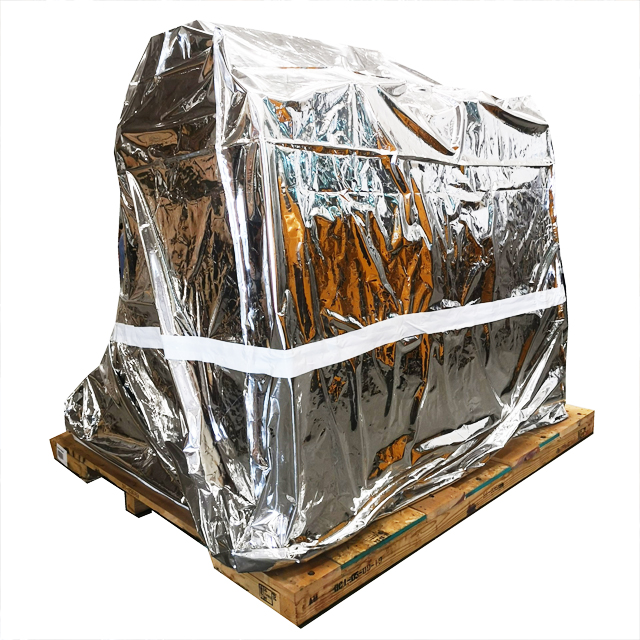
Industrial equipment & machinery covers are used for pumps, motors, processing machines, electrical cabinets, fabricated assemblies, skid-mounted systems, and oversized components. These assets often combine painted surfaces, exposed metal, ports, flanges, frames, instruments, and irregular contours. The cover therefore has to protect both the exterior finish and vulnerable openings without creating excessive material around projections.
Custom protective covers used on export routes may face humidity, salt air, road spray, dust, and repeated cargo handling. Reinforced film may be appropriate for sharp-edged machinery or demanding loading conditions, while optional VCI protection can be considered when metal corrosion is a primary concern. Once a machinery model and cover specification are approved, repeat orders can reduce repeated measuring, cutting, and adjustment at the packing station.
Construction machinery covers are custom protective covers built around a different exposure profile. Equipment may remain outdoors between project phases, travel on open vehicles, or wait at a jobsite before installation. UV radiation, rain, windblown dust, debris, road contamination, and changing temperatures place greater emphasis on outdoor stability, puncture resistance, and secure coverage.
A basic film or loose tarp may be inadequate around heavy frames, exposed edges, or complex shapes. Reinforcement should be concentrated where the load stresses the cover rather than added indiscriminately across every surface. Enhanced UV protection, moisture resistance, VCI performance, or flame-retardant treatment can be selected individually or combined when the machinery, route, and site requirements justify them.
Data center equipment covers are custom protective covers for server cabinets, IT racks, electrical enclosures, UPS units, cooling equipment, and prefabricated modules before installation or commissioning. Such equipment may pass through factory storage, export warehouses, ports, construction sites, and temporary staging areas, where dust, moisture, sunlight, road debris, and repeated handling can affect external surfaces and metal components.
The design should account for doors, frames, vents, panels, connection areas, and protruding components. Close coverage helps reduce loose sections around complex profiles, but the equipment should remain non-operational during heat application. Available configurations include PE or reinforced heat-shrink material in application-dependent thicknesses, with optional UV, VCI, flame-retardant, color, printing, and identification features for project-specific needs.
Custom-fit shrink covers differ from standard roll-fed film because they arrive pre-cut or pre-formed to a defined product profile. Operators place the prepared cover over the equipment, complete the required sealing, and apply controlled heat so the material contracts around edges, corners, and contours. This can reduce on-site trimming, loose folds, scrap, and variation between packing teams.
Standard LLDPE configurations suit lighter protection, indoor storage, dust control, and short-haul transport. Reinforced versions are better aligned with heavy loads, sharp edges, irregular equipment, and demanding routes. Optional VCI, enhanced UV, or flame-retardant functions should follow the actual exposure rather than being treated as universal upgrades.
Application | Main concerns | Cover priorities |
Indoor machinery storage | Dust and surface scratches | Clean fit, easy handling, simple removal |
Machinery export | Humidity, salt air, rough handling | Sealing, reinforcement, corrosion control |
Construction equipment | UV, rain, debris, wind | Outdoor stability and puncture resistance |
Data center equipment | Dust, moisture, clean delivery | Precise coverage and controlled application |
Repeat factory packaging | Labor and inconsistent results | Pre-sized design and repeatable specification |
A useful quotation for custom protective covers describes the proposed solution in measurable terms. Material composition, grade, thickness or fabric weight, dimensional tolerance, reinforcement, sealing method, and functional treatments should be stated clearly. Buyers should also confirm color, printing, identification options, minimum order quantity, lead time, sample policy, and whether the quoted dimensions refer to the equipment, the finished cover, or the cover before shrinkage.
Terms such as “industrial grade,” “weatherproof,” and “premium” are not enough on their own. Ask which storage, transport, and environmental assumptions were used to prepare the proposal. Two prices cannot be compared fairly when one includes reinforced material and corrosion protection while the other covers only basic dust exposure.
Custom protective covers for irregular or high-value equipment warrant a prototype, production sample, or first-article approval. Test the cover under realistic installation conditions rather than judging it while it lies flat. Corners, protrusions, seams, openings, reinforcement points, bottom overlap, and sealing areas should all be inspected after application.
Reusable protective covers should be removed and reinstalled several times to reveal binding, stretched seams, awkward access, or wear at contact points. Shrink covers should contract evenly without exposing edges, creating excessive tension, or affecting sensitive surfaces. Written acceptance criteria and a revision process should be agreed before volume production begins.
The lowest price for custom protective covers may not produce the lowest packaging cost. A complete comparison includes installation labor, trimming waste, storage space, replacement frequency, re-securing time, and the consequences of inadequate coverage. Cleaning, surface repair, corrosion treatment, delayed installation, and equipment damage can outweigh a modest difference in unit cost.
A practical purchasing checklist includes:
● Confirmed drawings, dimensions, and protrusions.
● Storage, route, climate, and handling conditions.
● Material grade, thickness, reinforcement, and treatments.
● Application method, sample approval, tolerances, and revision terms.
● Lead time, order quantity, packaging, and identification requirements.
Customization is not always necessary for simple, sheltered, low-risk applications. For valuable or repeatedly handled equipment, however, the best-value option is the cover that delivers consistent protection with the least material waste and operational disruption.
Choosing custom protective covers begins with understanding how equipment will be stored, transported, handled, and exposed. Material strength matters, but accurate measurements, suitable reinforcement, practical installation, and sample approval are just as important. Comparing complete specifications rather than unit price helps buyers reduce waste, avoid protection gaps, and control long-term packaging costs.
Suzhou Ecopack Co.,Ltd. supplies protective covers and custom-fit shrink options for equipment with different shapes and exposure requirements. By matching cover dimensions and functional features to the application, buyers can improve packing consistency, shorten installation time, and protect valuable assets more effectively.
A: They protect machinery and equipment from dust, moisture, UV exposure, abrasion, road debris, and contamination during storage, transportation, factory staging, or temporary outdoor holding.
A: Record the maximum length, width, and height, including handles, pipes, control panels, lifting points, and other protrusions. Photos or technical drawings help clarify complex shapes.
A: Material selection depends on exposure conditions. Consider water resistance, UV stability, tear strength, temperature range, abrasion, corrosion risk, and whether reinforced or flame-retardant construction is required.
A: Some materials provide waterproof protection, but overall performance also depends on seams, openings, closures, and installation. Condensation management should be considered during extended storage.
A: A custom cover is usually more suitable for valuable, irregularly shaped, repeatedly shipped, or long-term exposed equipment where loose material could create gaps, abrasion, or water pooling.
A: Request a prototype or first-article sample, install it under realistic conditions, and inspect the fit, reinforcement points, sealing areas, access features, and material tension.


